Every Sacred Sunday

I have such an exciting project to share today! I absolutely cannot wait to have this little book arrive on my doorstep in November. Yes, November, I know it’s a ways away, but trust me, the wait will be worth it.
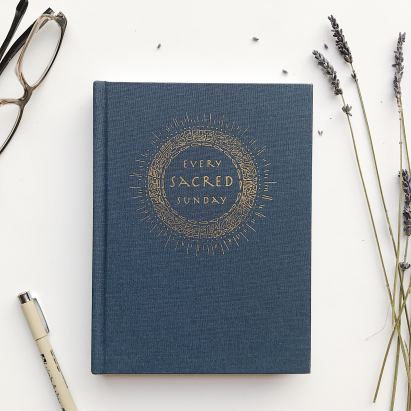
Processed with VSCO with s2 preset
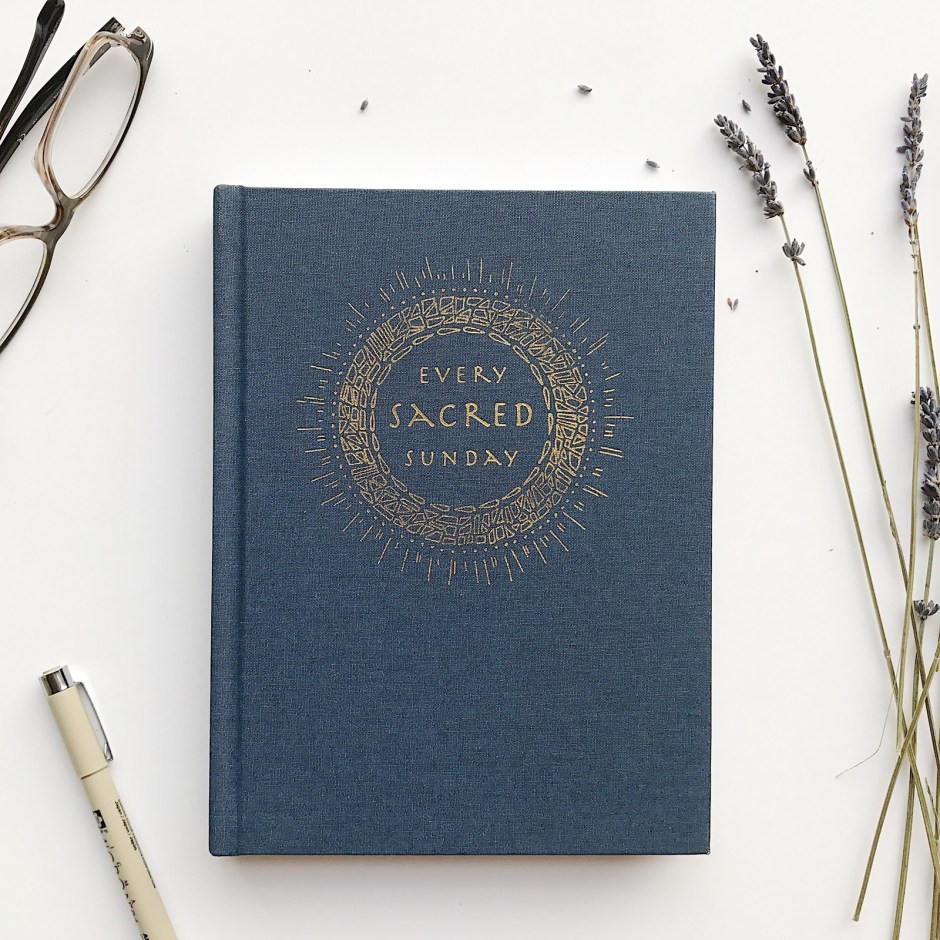
Every Sacred Sunday. Used with Permission

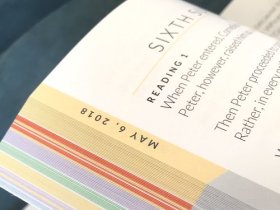
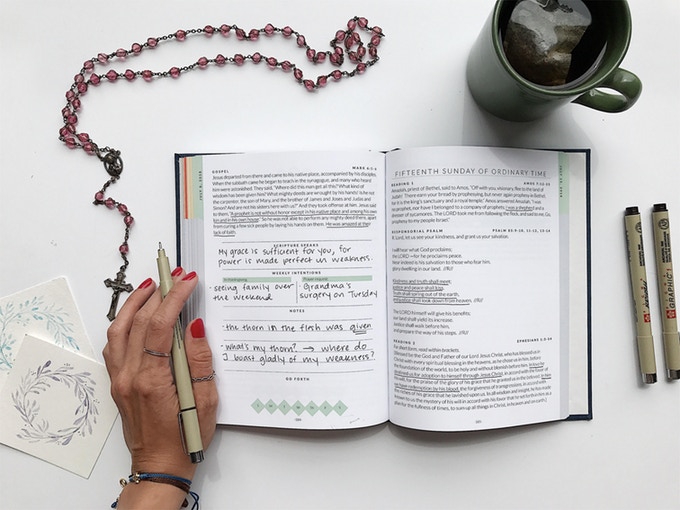
Kassie Manning and Christie Vaughn are launching a brand new journal designed specifically for Catholics called Every Sacred Sunday. This is a Mass journal. It has all the Sunday readings in it (identical to the lectionary, they have gone out of their way to ensure that the readings in their journal are the exact same translation, with proper permissions), plus space to write and reflect on what spoke to you that Sunday, what is a verse or word that stood out to you, any homily or prayer notes, and even a space for how to take the lessons you learned and put them into practice that week.

This journal looks absolutely stunning. Christie, an artist, has drawn some incredibly beautiful illustrations that kick off each liturgical season. I was able to get a sneak peak at Advent’s and I know I am going to spend a good deal of time just praying with that. It is simple, but very profound. I can’t wait to see the others!
ess1
Every Sacred Sunday. Used with Permission

I used this journal for yesterday’s Feast of the Assumption (because these girls have solid Catholic roots and also included all the Holy Days of Obligation). I loved the lectio divina quality it gave to my Mass experience. I was able to read the readings before Mass, then listened to them during Mass, and could reference back to them after as I journaled. After almost 3 complete read throughs, I definitely felt like a specific verse was standing out to me in a way that was new and different. I appreciate that there was a defined space to write. It kept me concise and to the point while still giving me plenty of room to say what I wanted. What might be the most important piece is on the very bottom of the page where Kassie and Christie have included a “Go Forth” section. How will I take what I heard and learned and use it this week? Now I have accountability and frankly, have a thought out, intentional, specific plan instead of a general “I need to try to be nicer/more helpful/etc.”

Processed with VSCO with s2 preset
EVery Sacred Sunday. Used with Permission

Kassie and Christie are using Kickstarter to get this project off the ground. In their first 24 hours of launching, they met their goal (this means guaranteed printing)! How incredible is that? In my opinion, it speaks to a need,  a hunger people have. We, I, want to be able to carry Mass with us through the week. We want to take the time to reflect on what we heard and how to implement it in our lives. Every Sacred Sunday is taking these desires, adding paper, beauty and creativity, and transforming them into an incredible resource.

In the time since the launch, Kassie and Christie have added (and met, whoot!) a stretch goal so now each journal will also have a ribbon placeholder. There is still time to pre-order your journal(s). It is available through kickstarter until August 31. The journals will start to ship in November and should be in everyone’s hands for the first Sunday of Advent, December 3, 2017.
ess3
Every Sacred Sunday. Used with Permission

Head over to everysacredsunday.com to learn more or pledge your support for your own journal now. Kassie and Christie also put together this great video that talks about them, their journey and how awesome Every Sacred Sunday is.

This is going to change hearts and lives in ways we can’t even imagine.
Daily Graces. kktaliaferro.wordpress.com

Let’s Chat about Vocations

Hopefully I don’t crawl too high on top of the proverbial soap box, but I had a moment the other day that got under my skin and I need to get this out there. I would love to have a conversation about this so please comment below or on social media in with your experience and understanding.

Vocations ≠ Priesthood

We used to live in a Church where there was an over-emphasis on the priesthood. To have a vocation went hand in hand with being called to the priesthood. Sisters or nuns were also seen as having a vocation, but on a lesser scale. Then, Second Vatican Council happened and the word “vocation” was given new life. Lumen Gentium explains:

32. By divine institution Holy Church is ordered and governed with a wonderful diversity. “For just as in one body we have many members, yet all the members have not the same function, so we, the many, are one body in Christ, but severally members one of another”.(191) Therefore, the chosen People of God is one: “one Lord, one faith, one baptism”(192); sharing a common dignity as members from their regeneration in Christ, having the same filial grace and the same vocation to perfection; possessing in common one salvation, one hope and one undivided charity. There is, therefore, in Christ and in the Church no inequality on the basis of race or nationality, social condition or sex, because “there is neither Jew nor Greek: there is neither bond nor free: there is neither male nor female. For you are all ‘one’ in Christ Jesus”.(193)

The bold is mine. This is saying that each and every baptized person has a vocation. The first for foremost vocation is as Lumen Gentium states, to perfection. Another way to say this is that each person is called to holiness, called to sanctity. Yes, you, you and even you are called to be a Saint.

The path through which our training in holiness lies is unique. In Church terms, there are generally 2 – 3 broad paths. Religious Life (can be delineated into Priest and Religious Vows like brothers, sisters, nuns, and permanent deacons) and the laity (married or single). We can say that each person’s work is also a form of vocation, since we are called to holiness in all aspects of our life. If we use our work, whatever it may be, to bring God greater glory and to evangelize to our fellow co-workers and those we serve, then our work is sanctified and vocational.

I have noticed in the Church, at least in the American Church, a subtle rise in focus on the call to priesthood. This ties into the priest shortage we feel we are experiencing as parishes consolidate and in some areas of the country the priest-to-parishioner ratio is genuinely out of sync. How many of us pray for an increase in vocations during the Prayers of the Faithful during Mass?

To illustrate this point, here is what happened one morning at our Vacation Bible School. We are fortunate to have two seminarians from San Antonio working in Del Rio this summer. They have been helping with VBS and assisted during Mass. After Mass, they spoke about their experience and how God is calling them to the priesthood. Our director spoke afterward. Instead of inspiring all of the kids to think on their vocation, or exploring how God is calling each of them in the here and now, we focused on whether any of the boys thought they might be priests someday.

I was let down and felt frustrated for the girls in the room. And the boys too. We are not going to fix the priest crisis as some see it by trying to convince 5 and 6 year olds once a year that priests are cool. And we no longer live in a world where the 2nd son is automatically placed in seminary. So what’s left?

A whole lot!! Friends, I firmly believe we are NOT suffering from a vocational crisis. God has not stopped calling people, men and women alike, to religious service. But we are suffering. We are experiencing a lack of vocational awareness. If we are not raising our children to hear God’s call for their life, how can we expect them to hear it? There’s a phrase – “You don’t know what you don’t know until someone tells you you don’t know it.” We can’t hope a young man is going to choose priestly service, or a young woman will choose a life of religious service, when these options have not been thoroughly explored, witnessed and reflected upon. And where does the exploration, the witness and the reflection happen in a person’s life?

In the context of their family and community.

Which do you think is more effective for showing our youth that priests are fun, normal, sometimes even cool people too?

Option 1: Only every seeing a priest within the context of Mass or formal function like VBS? The minimal amount of conversation happens between the family and the priest – usually the good bye as they leave church. Sometimes the priest stops by for a few minutes during the Religious Education class to see what the kids are learning.

Option 2: The family has invited the priest over for dinner or a family gathering. They have asked to have their home or car blessed. Children spend a few moments talking to the priest before or after their parents go to Confession. The family has volunteered to help clean up the church with the hospitality team.

I hope everyone said Option 2.

The over-emphasis on priestly vocations is not helping the situation we are facing. What will? In my opinion we need a stronger presence in and with our families. Vocations of every kind can be cultivated or shattered within the four walls of a family home. We should be focusing on supporting new parents, encouraging all families and making every effort to help grow the faith of the parents as well as their children.

Daily Graces. kktaliaferro.wordpress.com

Something out of Nothing

My mom was here for a visit. Yay!! We reorganize all my decorations – it was a big job. I had bins, boxes, more boxes and random bags of decorations, ornaments, window clings and Easter eggs for days. Many hands make the work light, and it is so true. While she was here we were talking about memories, of course.

One morning, my mom was asking the kids what I did during the day. Rosie, my sweet Rosie, said that during the day I do “nothing.” My mom reminisced about how her mom would be cleaning the floor, or dusting, or anything and the phone would ring. My mom or one of her siblings would answer the phone and say “Sure my mom can talk. She’s doing nothing.”

We started talking about how, as a mom and honestly, as any person, we are very rarely actually doing “nothing.” Just right now, though you may be sitting down, you are reading. Or you could be stirring a pot of tomato sauce for pasta or flipping bacon for breakfast. You might be exercising, watching TV or rocking a baby to sleep. We are always moving, always working, always playing. Even when you are sleeping, you aren’t doing “nothing.” You’re sleeping!

In this sense, we are always working. Our bodies are always working, our heart is pumping blood, our lungs are expanding and contracting, we are smelling, seeing and hearing. Our minds remain active and more often than not so are our hands and feet. Pope John Paul II’s Laborem exercens (1981) is about our relationship with work and how it is through work we come to know ourselves and our Creator. When God created Adam and Eve, he commanded them in no uncertain terms to work. They were to be fruitful, to multiply, to fill and subdue the earth. Notice how the work our first parents were called to is creative work. As images of a creative God, we are capable of participating in the continued creation and renewal of the earth.

If we are called to work, and the work we are given has been directed by God, then the work we do in our fulfillment of our vocation is holy work. Our work, whatever it may be, has the potential to bring us closer to God and to one another. We might scrub floors, change diapers, balance accounts, engineer electrical systems or direct traffic. When we do our work with our best effort and with love for God and neighbor, it is sanctified and so are we.

This might sound sweet and naive. After all, work is more often than not hard! We have to go back to Genesis for the reason, and then look ahead to the Gospels for the reward. Our first parents, though called to be creative, also sinned. The command to work was not taken away, but toil was added to it. Now they were to be fruitful and multiply, but they also had to toil or struggle to make the ground produce food. Work became hard. Death entered the equation. If this was the end of the story, work would amount to a whole lot of nothing.

Now look ahead to Christ. Jesus did not simply pronounce us saved. He did not creatively leave us His Body and Blood and call it good. Jesus, the Incarnation, suffered, he toiled for us through His death on the Cross. The Paschal Mystery is where our salvation lies – Jesus death and resurrection. You cannot have one without the other. And so when we toil, when we work hard to do the will of the Father, we can unite ourselves to Christ crucified. Our work is purified through His work and we collaborate with Christ for the building of the Kingdom of God. All that nothing just turned into a whole lot of something.

  • To learn more about these ideas you should read Laborem exercens, especially the first and last chapters.

The will of our Father is different for each of us and therefore we each have our own unique work. Right now, my work is finding a cheerful, dedicated attitude toward keeping up with my house cleaning. I am also embarking on a new consulting/contractor position as a facilitator for online classes to help form and train catechists and adults in the faith. In August I’ll be lesson planning for our next homeschooling year. Each of these has their own elements of the Cross, of toil and struggle. But thanks be to God I can also see how each of them is bringing me closer to Jesus, closer to holiness.

Daily Graces. kktaliaferro.wordpress.com