Seizing Opportunity

For those of us planners out there, spontaneity may be a challenge. As Ben and I look forward to our 5 year wedding anniversary, I can gladly look back and say that I have relaxed into a more spontaneous person because of our relationship. Nothing puts this better on display than our recent vacation to Disneyland.

Ben had just returned from deployment and we had been blessed with a gift of a 3-day hopper pass from a family member. Military life being what it is, we were not able to plan out months in advance when we would use this pass. Not wanting to let the time slip away or bank on an opportunity down the road, we decided to go for it. Within 10 days or so of deciding to go to Disney, we were there. Crazy – but perfect. Looking back, I’m so glad that we did not overthink the decision. We talked, reasoned both sides and made a decision.

We were so excited to go, we even broke one of our cardinal parenting rules: telling the kids about something before it’s imminent arrival. They had no concept of “Disney” or what was in store for them. We didn’t want them to go in completely unprepared for the massive, overwhelming experience we were going to be throwing them into. So, we started talking about going to visit Mickey Mouse, seeing Sleeping Beauty’s castle, Lightening McQueen’s racetrack, etc. Once they got the idea of vacation in their head, it was all they could do to keep their shoes off.

20150824_102026Finally, when Ben could take no more, he got out a calendar and put it up in John and Rosie’s room. It happened to be 3 days before we were leaving. Ben brought John and Rosie in and sat them down in front of the calendar. He put a sticker on the present day. Then, another one on the day we were leaving. Together, they counted the spaces between. “We have to wait 3 days,” Ben told them. “John, do you remember anyone else who had to wait 3 days for something to happen?” Ben asked. John thought for a bit, and after some prompting, remembered from school that the disciples had to wait 3 days for Jesus to rise.

John was so proud he remembered this connection. I was not in the room so didn’t know the incredible theology lesson Ben was conducting. John came running to the kitchen to tell me how he had to wait for vacation, just like the disciples had to wait for Jesus. I was so proud of him and so impressed with Ben. Ben saw an opportunity to connect faith and life in such a practical way that John could understand.

20150824_114039Disney provided us another such opportunity. John had a less then wonderful Disney experience. John struggles with some anxiety and fear of the unknown. He was doing great with the rides and thrills until he rode on a rather fast race car ride that included a dark tunnel. After this, unless he could see exactly what happened the whole time on a ride beforehand, he was more than reluctant to try it out.

We were so lucky to have my mom be able to come with us on our spontaneous Disney adventure. She was such a help, especially with John’s meltdowns and irrational behavior. At one point, she pulled John aside and they talked quietly for a bit. When they were done, she said that John was going to try hard to make a sacrifice for the family. Though he really wanted to go back to the hotel, he would stay with the family since everyone else wanted to be at the park. We talked about how sacrifices are hard and there were many times that he didn’t want to make the sacrifice. But, we were able to help him through it. His knowledge of Jesus’ sacrifice for us, even though limited, helped him to connect with what he was attempting to do for the family.

These are the moments that I cherish. Moments that God gives us to feel His presence and honor His working in our lives. I’m sure there were other ways for us to help John deal with waiting for vacation and then deal with the vacation itself. I am inspired by the witness and demonstration of faith that both Ben and my mom gave to John and Rosie. They saw an opportunity to share a piece of faith in the everyday ordinary and instead of shying away, they chose to bring God into the kids’ lives. Mine as well.0824151754

A Better View

Another lag in posting has occurred. I try not to put up too much information about Ben and his travels, for a number of reasons. The biggest one being the instantaneous nature of the internet and how quickly it can compromise not only his safety, but those who he works with as well as our own. Ben recently returned home from a deployment and we have been spending some much needed quality family time together, hence the unannounced break.

Image from: http://disney.wikia.com/wiki/Sofia_the_First_(character)

I’ve been keeping a list on my phone of inspirations for blog posts and this one comes from that list. A while back, John and Rosie were super into the DisneyJr. show, Sofia the First. Basically, Sofia’s mother marries the king and they go from villagers to royalty. The whole show is Sofia learning what it means to be a princess, making mistakes, and shaking up the accepted norms of princess behavior.

Not all of the episodes are profound, but some have some pretty decent lessons for young children. One such episode was about putting others before yourself and having an optimistic attitude. The castle butler, Baileywick, is celebrating his birthday and the king and queen decide to give him the day off. His brother comes to town and plans out an elaborate day. However, everyone is used to Baileywick helping them whenever they ask, regardless of his current activities. So, when he tries to leave for his birthday activities, he is continually stopped by the castle children to assist with butterfly catching and tea party color coordination, among other things.

Now, I imagine most of us would get quite fed up with this lack of respect and selfishness of the children. They all know that it is Baileywick’s day off, but they insist that he help them first. Baileywick’s brother actually tries to leave, frustrated that his whole day was spent waiting for Baileywick to finish helping, only to miss the planned activity altogether.

Rather than give into frustration, Baileywick chooses to remain positive. Each time they miss an activity, Baileywick just points to the next one, confident that he and his brother will still be able to spend some time together. His brother is in awe that Baileywick always manages to look on the bright side of things. I actually wrote down Baileywick’s response, it’s that good.

“That’s because there’s always a better view there.”

Such a simple philosophy, but what a great way to think about things. It’s basic optimism, but with a strong visual image to go with it. Studies have shown what an incredible benefit it is to have an optimistic outlook (check out this article if you are interested).

As I’m writing more and reflecting more, I’m finding some recurring themes. One of them is the development of habits. It is easier to make good choices if you have a habit of making good choices. It is easier to be disciplined in a certain area if you have developed the habit of discipline in others. I believe the same goes for optimism.

Baileywick not only teaches the benefits of a habit of optimism but also a habit of self-sacrifice and service to others.

GI3MSBZAAY

“Mommy, Jesus saw a seal! I’ve seen a seal too!”

Raise your hand if remember the incredibly hysterical and spot on book series, Amelia Bedelia. I loved them growing up. I recall one where Amelia went to a school and was told to plant the bulbs with the children, meaning tulip bulbs. Amelia, in true form, has the children unscrew all the light bulbs to plant instead.

We have similar experiences in our house. Small children are so literal, it trips me up some times. One day, I asked Rosie if she wanted some plain crackers. Now, you have to understand that from before their birth, my children are wired for airplanes. Their father is, after all, a pilot. They have lived on very high air traffic bases their whole lives. They wake up to the sound of jet engines, spend the day watching a variety of aircraft circle the pattern and fall asleep to night sorties and engine tests.

So, what do you think Rosie heard when I asked her if the wanted plain crackers? Plane crackers. As in, airplane shaped crackers. Oh the drama, oh the tragedy and hysterics that ensued from John and Rosie after that misstep. Needless to say, when I ask if they want regular ol’ crackers we call them “simple” crackers. It was easier to explain. Once they start reading we will re-visit the topic, hopefully with less meltdowns.

Another such moment happened at Mass this week. In the Gospel reading Jesus said:

Do not work for food that perishes
but for the food that endures for eternal life,
which the Son of Man will give you.
For on him the Father, God, has set his seal (John 6:27)

After reading that (and the title of this post, hint hint), you may be able to guess which work caught John’s attention. Yes, seal. Obviously seals of all kinds inhabit the sea near Capernaum. It was pretty funny and required some quick whispered explanations. John still isn’t quite sure what kind of seal Jesus saw, but we did clarify that it wasn’t the seals from the zoo.

John’s literal understanding of words at this stage reminded me of my post about having faith like a child. It also got me thinking about literal versus figurative language. Since we were at Mass, this particular thought train brought me to the Eucharistic prayer.

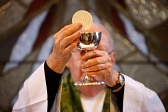
In the three Synoptic Gospels (Matthew, Mark and Luke – called synoptic because they are all similar and based on similar sources, sometimes even the same source – see more here) we hear Jesus say exactly and specifically, “This is my body.” and “This is my blood.” If we are to have faith, and perhaps ears, like a child, then Jesus’ meaning can not be mistaken. Jesus told his disciples that the bread and wine truly became his body and blood, the food and drink of the new covenant. In the Gospel of John (where our Gospel readings from last week and this week came from), Jesus tells his followers in a series of talks that unless they eat the flesh of the Son of Man, they will not enter the Kingdom of Heaven (John 6). Jesus is very specific, even clarifying and re-stating this teaching when queried about it.

Photo from Inmagine.com

The mystery of the Eucharist is a tough mystery to grapple with. How can bead and wine change? How can we be expected to eat flesh and drink blood? The first important thing to remember is that it is a mystery. We will never fully understand the incredible grace we are participating in each liturgy. Second, we have multiple Scripture accounts of the same words of Jesus. This was a community where oral tradition, the stories told, were where records were preserved. Very little was written down and the Gospels were not written as a play-by-play of Jesus’ life. Our earliest Gospel (Mark) was probably written at the earliest, 50 C.E. That’s a full 20-25 years after Jesus’ death. 20 years is a long time for an oral story to change (remember the game “Telephone” from when you were a kid?). But we have the same words of Jesus, written by 3 different authors in 3 different places, plus the extended theology of John. Pretty convincing stuff. Finally, our understanding has not changed over the course of the whole Church. The Eucharist we celebrate today was celebrated by the earliest Christians. We see it in the writings of St. Paul. We also see it in the writings of St. Justin Martyr, a Christian living in Rome and writing around 150 C.E. If you don’t click on any other links in this post, click on this oneJustin writes about what the liturgy looked like in Rome roughly 55 years after the latest written book in the Bible. The consistency with the liturgy we just celebrated this weekend is, for me, beyond words. The liturgy we celebrate today is firmly founded in the traditions and teachings of the apostles. If they took Jesus literally, I think it’s a good bet we should too.