Good Friday 2023

Good Friday is always such a hard day to reflect upon. It’s one of the main reasons why I’ve struggled to write Lenten reflection books, so this is going to be short.

Toward the close of today’s video, I touched on Jesus’ greatest moment of suffering. Just before Jesus dies, He cries out, “My God, my God! Why have you abandoned me?” In this moment of furthest separation from God, Jesus offers up for us the greatest example of His love. He was willing to go so far, as far as to be emptied of everything. Yet at the same time, He was placing on display for the whole world exactly who God is – Love. Perfect, complete, unyielding, undying – God is Love.

Through Chiara Lubich, founder of the Focolare Movement, we have a name for this distinct moment. Jesus Forsaken. I am currently working through a book that contains all of Chiara’s writings about Jesus Forsaken, not light reading to be sure. But at the same time, it is so full of hope and love and light. Jesus’ darkest moment is also where we find His greatest love. Here’s just one quote, a poem of sorts, from too many to count that I’ve highlighted so far, and I’m not halfway through yet.

So that we might have Light, you made yourself blind.

So that we might have union, you tasted separation from the Father.

So that we might possess Wisdom, you made yourself “ignorance.”

So that we might be clothed with innocence, you became “sin.”

So that we might have hope, you almost despaired…

So that God might be in us, you felt him far from you.

So that Heaven might be ours, you experienced Hell.

So that we might have a glad sojourn on earth, among hundreds of brothers and sisters, you were banished from Heaven and from earth, from humankind and from nature.

You are God, you are my God, our God of infinite love.

Chiara Lubich, Jesus Forsaken, pg 33.

A few years ago, Bishop Kurtz of the Louisville Archdiocese, wrote a beautiful article about looking for and discovering Jesus Forsaken in our daily lives. I would invite you to follow the link to read his article. He does a much more eloquent job than I can about how we all have the opportunity to embrace Jesus Forsaken each day.


There will not be a video or blog post for Holy Saturday. Together, we will wait in anticipation for the wondrous miracle of Jesus’ Resurrection on Easter Sunday.

Daily Graces. kktaliaferro.wordpress.com

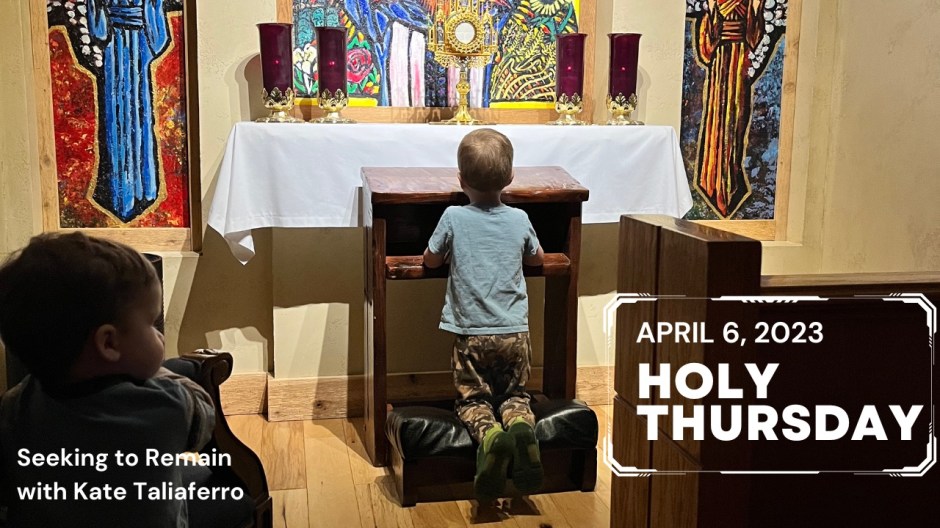
Holy Thursday 2023

Holy Thursday, what a day. We heard this past weekend on Palm Sunday the Institution Narrative (the specific words Jesus used when breaking the bread and sharing the wine which we still use at Mass today for the consecration – the bread and wine becoming literally Jesus’ Body and Blood) from the Gospel of Matthew. Today, while it is the liturgically same moment, we read from John’s Gospel. We don’t actually hear an Institution Narrative on Holy Thursday, though any well formed second grader preparing to receive their First Communion will quickly tell you that Holy Thursday is when Jesus gave us the Eucharist. The Church instead, chooses to highlight the Gospel of John which is the only Gospel containing the washing of the disciples’ feet.

This Gospel passage is one of the critical pillars for the formation of the Sacrament of Holy Orders as a sacrament of service. Jesus is modeling for His disciples what it means to be a true leader, it means to serve. Today, we talk about the model of the servant-leader, someone who puts the needs of those who follow them before their own. This is rooted in Jesus’ model of leadership.

Because this reading highlights the roles and duties of ordained priests, I thought it would be a good time to expand upon that to encompass the priesthood we all take part in by virtue of our baptism. The video for today considers how each one of us, no matter what profession or life situation God has called us to, also has a priestly role to play in our corner of the world. Whole college and graduate level courses could be spent on this topic, so I hope you’ll forgive me another 9 minute video for today.

In this space, I wanted to write out for you the quotes I read in the video in full, as well as a few others that I feel support the idea that each of us is called to a priestly ministry. That’s really what this whole blog is all about, taking the everyday ordinary moments of our day and recognizing in them God’s calling to holiness. Each action, each conversation, each moment (however brief) of silence, is an opportunity to do God’s Will and take a step further in our journey of faith. When we come to the Mass, all these little moments can be united with the bread and wine offered by the community on the altar. Together, the bread, wine, and our very selves, are transformed into Christ. We become what we eat, we are transformed into Christ’s Body here on this present earth.


The baptized, by regeneration and the anointing of the Holy Spirit, are consecrated as a spiritual house and a holy priesthood, that through all their Christian activities they my offer spiritual sacrifices and proclaim the marvels of him who has called them out of darkness into his wonderful light.

Lumen Gentium no. 10

Hence the laity, dedicated as they are to Christ and anointed by the Holy Spirit, ar marvelously called and prepared so that even richer fruits of the Spirit may be produced in them. For all their works, prayers, and apostolic undertakings, family and married life, daily work, relaxation of mind and body, if they are accomplished in the Spirit – indeed even the hardships of life if patiently born – all these become spiritual sacrifices acceptable to God through Jesus Christ. In the celebration of the Eucharist these may most fittingly be offered to the Father along with the body of the Lord. And so, worshipping everywhere by their holy actions, the laity consecrate the world itself to God, everywhere offering worship by the holiness of their lives. (Catechism of the Catholic Church no. 901)


In each celebration of the Eucharist, there are two such invocations of the Holy Spirit [the epiclesis] that are at the heart of the divine action of the sacrament. In the name of the gathered assembly, the presider invokes the Spirit to act so that their offers of bread and wine may become the Body and Blood of Christ (the first epiclesis). Then, after the institution narrative, the presider prays that the Spirit may make of this who eat this brea and wine “one body, one Spirit in Christ” (the second epiclesis). Sent by the Father who hears the church’s prayer of invocation, the Spirit gives new life to those who celebrate the sacraments of Christ. So, in their turn, Christians become sacramental realities-living signs of God alive in human flesh through the synergy of the church’s prayer and of the Spirit’s anointing.

In this context, it is not an exaggeration to say that these two invocations bring about two transubstantiations: the first is the transformation of the bread and wine into the Body and Blood of Christ; the second is the transformation of the believers into the Mystical Body of Christ (Philibert, pg 48-49).


Come to him, a living stone, rejected by human beings but chosen and precious in the sight of God, and, like living stones, let yourselves be built into a spiritual house to be a holy priesthood to offer spiritual sacrifices acceptable to God through Jesus Christ…But you are “a chosen race, a royal priesthood, a holy nation, a people of his own, so that you may announce the praises” of him who called you out of darkness into his wonderful light (1 Peter 2:2-4; 9)


The eyes of faith behold a wonderful scene: that of a countless number of lay people, both women and men, busy at work in their daily life and activity, oftentimes far from view and quite unclaimed by the world, unknown to the world’s great personages but nonetheless looked upon in love by the Father, untiring laborers who work in the Lord’s vineyard. Confident and steadfast through the power of God’s grace, these are the humble yet great builders of the kingdom of God in history (Pope John Paul II, The Lay Members of Christ’s Faithful People, no. 17)

I appeal to you therefore, brothers and sisters, by the mercies of God, to present your bodies as a living sacrifice, holy and acceptable to God, which is your spiritual worship (Romans 12:1).

Daily Graces. kktaliaferro.wordpress.com

Palm Sunday 2023

This week’s video focuses on remaining in the present moment. This means avoiding dwelling on the past which we cannot change and anxiously awaiting the future which distracts us from the moment we are in.

Chiara Lubich, who I reference in the video, explained living in the present moment as being on a train. Once the train starts, you can’t make it travel backward, even by walking to the back and gazing longingly at the fading station. You can only go forward. Similarly, you can’t make the train get to your destination faster, even by walking the length of the train to the front and pressing your nose to the glass. You can only be exactly where you are in that moment. The train is outside of your control.

Life is similar. We only occupy this space in this moment. Unless you have the spiritual gift of bilocation, I suppose. I do not possess this gift.

Expanding on this idea, if we only have this moment, then we should fill it with as much as possible. Right?

Multitasking is a feat many moms pride themselves on. Let’s see just how much I can juggle today without all the plates crashing to the floor is a game I often play. There’s a lot to get done in one day and often, it feels like not enough time to do it all in. So, we multitask. Sometimes this works out really well, the laundry got folded and at the same time I was able to have a heart to heart phone conversation with a friend. Other times, dinner ends up burned because I was also trying to help a child with their piano practice, finish folding the laundry that got started in the morning, hear about a science project and meet the demands of a noisy 1 year old who is as fickle as they come.

I recently read a quote by Peter Kreeft in his book, Christianity for Modern Pagans, that is thought provoking in regards to multitasking:

“We want to complexity our lives. We don’t have to, we want to. We want to be harried and hassled and busy. Unconsciously, we want the very things we complain about. For if we had leisure, we would look at our selves and listen to our hearts and see the great gaping hole in our hearts and be terrified, because that hole is so big nothing but God can fill it.”

Oh boy. How often do I complain, to myself or others, that I’m just too busy? Often. How often do I sit down to critically think about our schedule, the activities we are engaged in, and how much time we have to accomplish everything on the list? Less than often.

Something the Holy Spirit has been working in me is an awareness of “wasted time.” In a multitasker’s world, nothing is worse than wasted time. 30 seconds of non-productivity here, shocking! 5 minutes of wasted time in the grocery line, the horror! Imagine how much I could have gotten done if I only had green lights on the way to x, y, or z! I think you know what I’m talking about. Some days, I have this attitude so intensely swaying my thoughts I get mad at myself for not knitting enough rows while watching TV, what a slacker! All of these are completely ridiculous and in truth, I have thought them all.

Yet, none of these examples are bringing me closer to Jesus. They make me anxious, annoyed, unpleasant to be around, and generally crabby. They are not life-giving. The truly wasted time is the time I spend wallowing in my perceived lack of productivity instead of relishing the gifts God has given me.

God does not desire for us to fill every moment of every day with work, production, or action. That is not the example He gave us. Work hard, yes. But rest well in complement. That means, waste time! Another way I’ve heard this described is to create white space. White space, like the white space on a paper, isn’t filled with plans, activities, to-do lists, etc. It’s blank, open for possibility. It’s time for play, for prayer, for walks, for reading, for laying in a hammock and listening to birds, it’s meditation, it’s phone calls that don’t include laundry folding or dinner making, it’s fill in the blank because that space is open for anything!

Be on the look out for how you can find some white space. It doesn’t need to be whole afternoons of skipping through daisies. Perhaps it is as small as including 5 extra minutes at the breakfast table to savor your coffee instead of downing it in 2 gulps. Make that cup of tea you are craving in the evening but still have your to-do list running in your head. Say yes to a walk, even if it’s just once around the block. Pause and pray when you are prompted, instead of thinking you’ll remember later. These aren’t wasted minutes, these are what make a life well-lived.

Daily Graces. kktaliaferro.wordpress.com