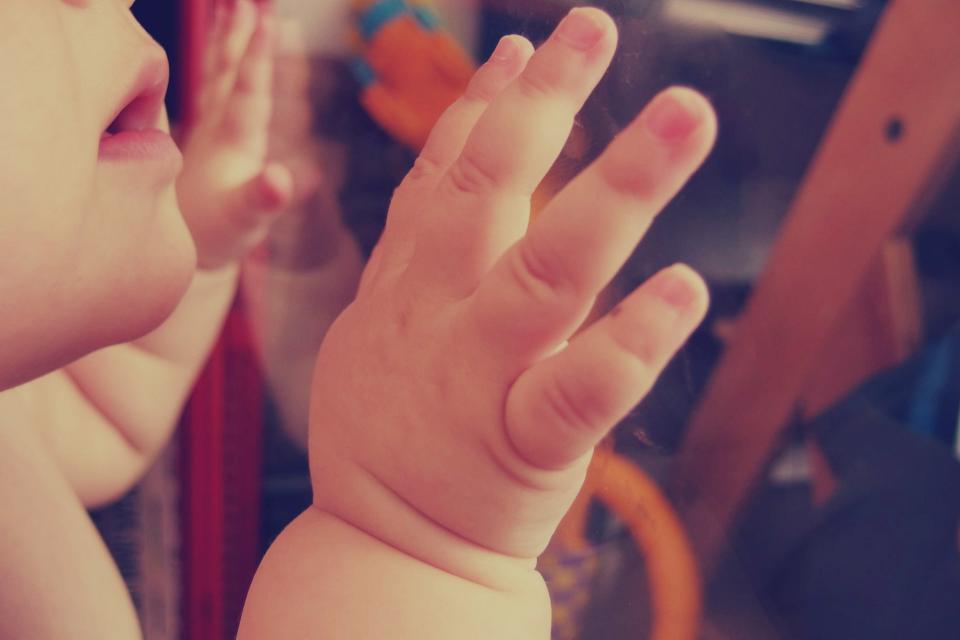
“Mommy, Jesus saw a seal! I’ve seen a seal too!”

Raise your hand if remember the incredibly hysterical and spot on book series, Amelia Bedelia. I loved them growing up. I recall one where Amelia went to a school and was told to plant the bulbs with the children, meaning tulip bulbs. Amelia, in true form, has the children unscrew all the light bulbs to plant instead.

We have similar experiences in our house. Small children are so literal, it trips me up some times. One day, I asked Rosie if she wanted some plain crackers. Now, you have to understand that from before their birth, my children are wired for airplanes. Their father is, after all, a pilot. They have lived on very high air traffic bases their whole lives. They wake up to the sound of jet engines, spend the day watching a variety of aircraft circle the pattern and fall asleep to night sorties and engine tests.

So, what do you think Rosie heard when I asked her if the wanted plain crackers? Plane crackers. As in, airplane shaped crackers. Oh the drama, oh the tragedy and hysterics that ensued from John and Rosie after that misstep. Needless to say, when I ask if they want regular ol’ crackers we call them “simple” crackers. It was easier to explain. Once they start reading we will re-visit the topic, hopefully with less meltdowns.

Another such moment happened at Mass this week. In the Gospel reading Jesus said:

Do not work for food that perishes
but for the food that endures for eternal life,
which the Son of Man will give you.
For on him the Father, God, has set his seal (John 6:27)

After reading that (and the title of this post, hint hint), you may be able to guess which work caught John’s attention. Yes, seal. Obviously seals of all kinds inhabit the sea near Capernaum. It was pretty funny and required some quick whispered explanations. John still isn’t quite sure what kind of seal Jesus saw, but we did clarify that it wasn’t the seals from the zoo.

John’s literal understanding of words at this stage reminded me of my post about having faith like a child. It also got me thinking about literal versus figurative language. Since we were at Mass, this particular thought train brought me to the Eucharistic prayer.

In the three Synoptic Gospels (Matthew, Mark and Luke – called synoptic because they are all similar and based on similar sources, sometimes even the same source – see more here) we hear Jesus say exactly and specifically, “This is my body.” and “This is my blood.” If we are to have faith, and perhaps ears, like a child, then Jesus’ meaning can not be mistaken. Jesus told his disciples that the bread and wine truly became his body and blood, the food and drink of the new covenant. In the Gospel of John (where our Gospel readings from last week and this week came from), Jesus tells his followers in a series of talks that unless they eat the flesh of the Son of Man, they will not enter the Kingdom of Heaven (John 6). Jesus is very specific, even clarifying and re-stating this teaching when queried about it.
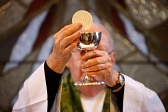
Photo from Inmagine.com

The mystery of the Eucharist is a tough mystery to grapple with. How can bead and wine change? How can we be expected to eat flesh and drink blood? The first important thing to remember is that it is a mystery. We will never fully understand the incredible grace we are participating in each liturgy. Second, we have multiple Scripture accounts of the same words of Jesus. This was a community where oral tradition, the stories told, were where records were preserved. Very little was written down and the Gospels were not written as a play-by-play of Jesus’ life. Our earliest Gospel (Mark) was probably written at the earliest, 50 C.E. That’s a full 20-25 years after Jesus’ death. 20 years is a long time for an oral story to change (remember the game “Telephone” from when you were a kid?). But we have the same words of Jesus, written by 3 different authors in 3 different places, plus the extended theology of John. Pretty convincing stuff. Finally, our understanding has not changed over the course of the whole Church. The Eucharist we celebrate today was celebrated by the earliest Christians. We see it in the writings of St. Paul. We also see it in the writings of St. Justin Martyr, a Christian living in Rome and writing around 150 C.E. If you don’t click on any other links in this post, click on this oneJustin writes about what the liturgy looked like in Rome roughly 55 years after the latest written book in the Bible. The consistency with the liturgy we just celebrated this weekend is, for me, beyond words. The liturgy we celebrate today is firmly founded in the traditions and teachings of the apostles. If they took Jesus literally, I think it’s a good bet we should too.

No Pain, No Gain….But why does it have to hurt so much?

In case you haven’t picked up on it, exercise and working out are not high on my list of activities. I understand the value and recognize the need, but I have not found the proper level of discipline and motivation.

Our base gym has a fantastic service called Peep Drop. It used to be that the parent signed up to volunteer to watch the kids. For every hour you volunteered you got so many hours of gym time and your kids could be taken care of. This was a pretty good deal. Apparently, however, this volunteer for gym hours still wasn’t enough to get me to the gym. Recently, they took away my last excuse. Now you don’t even need to volunteer. You automatically get 10 (I’m pretty sure) hours a week. No more excuses. I couldn’t justify not going anymore.

Image from picjumbo.com

So, twice this week, I’ve gone to the gym. The first day for a class and the second for some time on a treadmill (i had hoped for a second class but misread the schedule – oh well, I probably would have fallen over in the class anyway). As I sit here writing, I would love to not get up for the rest of the evening. I am so sore!

I was telling Ben about my aches and pains and he laughed. “But it’s a good hurt” he said. “My hamstrings won’t move because I did legs yesterday. It’s awesome,” he boasted. What?? How on earth is that awesome? Maybe I am missing a few synaptic pathways in my brain that have to do with exercise and the body aches it causes.  I mean, I get it, kind of. The main means that you worked the muscle and as it heals, it grows stronger. That’s nice and all, but the process hurts.

Since my body aches every time I move for the most part, I’ve obviously spent a lot of time dwelling on it. There are a lot of things in life that are for our good and overall benefit that involve a process of pain. How many times does a child learning to walk fall before acquiring the core and leg strength and balance necessary? How much did your head hurt when studying for a difficult final or exam in school? How much did it hurt your pride to have to admit an error or mistake at work was your fault? So many lessons in life are learnt through a process of pain. But we grow because of it. We learn to walk. We retain the knowledge from the test which shapes our future learning experiences. We grow as an individual when we own up to the mistakes we make.

Even faith grows in a similar manner. St. Peter tells us, “So that the genuineness of your faith, more precious than gold that is perishable even though tested by fire, may prove to be for praise, glory, and honor at the revelation of Jesus Christ” (1 Peter 1:7) Even though tested by fire – sounds painful to me. But, if my faith deepens and grows because of it, isn’t it worth it? If I am able to more clearly see the hand of God in my life and am better able to trust in the good plans He has crafted for me, isn’t that enough?

If we expect our faith to carry us, then our spiritual muscles need training to go the distance. Habits of prayer, sacrifice, communication, service, self-denial. All these are elements of a healthy, active and growing spiritual life – spiritual muscles.

If we neglect one area, we may find some fatigue, some soreness or discontent, not unlike what my body is presently experiencing. The challenge, just like with exercise, is to go back even though you are sore, confident that any pain or frustration is temporary and that good will come from it. So, maybe it’s time to stop complaining and start training.

Faith Like a Child…..or at least like my children

In Matthew 18, Jesus brings a child before his disciples and tells them that if they don’t start acting like children, they won’t get into the kingdom of heaven. Ok, so that’s a bit of a paraphrase. (Here it is for real). Now I don’t know about your kids, but if you acted like mine all the time, I’m not so sure you would get into heaven. Don’t get me wrong, I love them to the moon and back, but angels they are not.

Fortunately, Jesus wasn’t telling his disciples that they should be self-centered, whiny, nose-picking, diaper-filling children. Jesus was pointing to other things which I can see in my own kids.5Z8QJ8SIHD

  • Children are full of trust. They rely completely on their parents and adults around them to fulfill all of their needs. Think about a baby. Clare at 10 months old cannot communicate what she needs. She trusts that I will figure it out every time and take care of her.
  • Children have no worries or cares for tomorrow, or yesterday. They live completely in the moment, focused on the here and now. They don’t trouble themselves with what went right or wrong yesterday and they harbor no fears about what may or may not happen tomorrow.
  • Children have an incredible capacity for wonder and awe. We will go for a walk and Rosie will stop and smell a flower as if it was the first flower she had ever seen (and she will tell you, every time, “Look Mommy, Look! The most beautiful flower I’ve ever seen, I’ve never seen one before!”).
  • Children are always learning something. They seek greater knowledge every day. Sometimes it seems like they need to learn more than they need to breathe. Side story: There are pros and cons here for the parents. Pros – your child is learning to walk, talk, write, read, etc. Great! Cons: When your 4yr old and 2yr old learn that when the baby cries it means that mom had to put her down because she is coming back into their room to tell them to go to bed for the 10th time so they scurry back in bed before she gets in the room to act like they weren’t just jumping on the bed – great cause and effect learning, frustration for the mother.
  • Children don’t need complicated answers, at least the little ones don’t. As children get older, the wonderful question “But why?” comes into play. This ties back into the constantly learning piece.
  • Children don’t care what others are thinking. If they are moved to dance, they dance. If they are moved to cry, they cry. They aren’t concerned about putting on a show or a mask for appearances’ sake. (see my last post about that).

Trust, contentment, wonder, a quest for knowledge, simplicity – these are some of the qualities that I see in my children which inspire my faith every day.