I think one of the scariest things that has happened to me as a parent is hearing my voice mimicked back to me by my children. My son, who is 4, is a particularly excellent parrot. It is not uncommon to hear him shout through the house lines memorized from his favorite books, movies or TV shows. It’s especially fun to hear him tie different storylines together, weaving such complicated web that only he can decipher. Consider this recent tale:
“Rapunzel! Merida is stuck in the seaweed. We have to call the Octonauts to save her. Calling all Octonauts. Captain, we have to save Merida. On my honor as an Octonaut, we will save her. Peso! We have to figure out how to get her out. Can you do it? Yes Captain. OK, let’s go!”
It was so funny! I’m glad I was in the kitchen listening in so that he didn’t get self-conscious.
As cute and sweet as these kids can be, sometimes I wish they weren’t always listening. Like the other evening when John said that dinner “was gross.” He must have heard me me the previous day when I said that a rotten clementine was gross. Or when Rosie says “Mommy, you don’t get to talk like that. I don’t like that voice!” which she frequently hears from my husband and I when she starts to have an attitude about cleaning up the toys.
Speech may be one of the most important things that we teach our children. They learn it from us, in my experience, by listening to what adults say and how we say it. Kids are brutally honest and their speech pattern holds us accountable to our own. A child is more likely to say “please” and “thank you” if they hear these works spoken to them and around them, not just because they are told to say them.
When John was quite young, I went to a play group. There was a mom there who had a few older children and her youngest was about 1 and a half I would say. I noticed how every time she had to tell her daughter “No” she said “No thank you.” Even when we were leaving and her daughter ran into the parking lot, as her mom ran after her she was shouting “That’s a No Thank You!” I realized that this mom had trained her speech to always say “No Thank You”, modeling for her daughter a more polite speech pattern. When I retold the story to Ben, we both decided to make the same change. So, we are the “No Thank You” family. We also try to be very aware of saying “Excuse me” to the kids, trying not to interrupt them, and always saying “Please.”
As parents, we are charged with raising up our children to live, work and contribute to society. Part of being a parent is recognizing that we still have room to grow and sometimes we make mistakes. Fortunate for us, we are all children of a forgiving and merciful God, who we call Father. As His children, still learning who we are and what His will for our lives is, we can look to His example, just as our children look to us. Scripture tells us that God spoke and creation came into being. God spoke, imbuing all of the Earth with His Word. If this wasn’t example enough, God sent His Word to live among us, to be with us, to die for us, and to bring us safely home to heaven once again. When we turn our gaze, or to continue with the speech example, our ears, to the Word of God, we are better able to mimic or reflect the speech of the Father.

 I know that I fall into this trap. Thank goodness there are authors out there like Br. Richard Contino, OSF, who have the courage to write a book like These Sacred Days: Walking with Jesus through the Sacred Triduum.

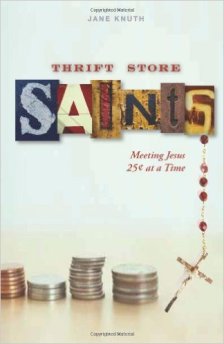 This is a quick read but packed with inspiration and wisdom. Jane chronicles her experiences working at a St. Vincent de Paul store in Michigan. Like so many of us, she walked into the store expecting to complete a simple transaction, only to find herself colliding (quite literally) with an unexpected face of Jesus – Jesus in the poor, the homeless, the needy, and the lonely.
 Daily Graces