The Empire vs. The Cross

With the upcoming release of Season 2 of Disney’s Star Wars series Andor, Ben and I have been rewatching Season 1. We both enjoy this gritty story and the way the characters develop throughout the episodes. This time through, we have been commenting on some particular phrases that the Empire uses as it begins to take further control of the galaxy. The security folks (I’m not going to get super technical here), talk about “tightening their grip” and extending the reach of imperial control. Contract security is out, storm troopers are in. As we watched this unfold, we looked at each other and said Leia’s line from Episode 4: A New Hope, “the more you tighten your grip, the more star systems will slip through your fingers.” Here, in Andor, we were watching the beginnings of the tightening, which is the same moment that the rebellion is really starting to come together. The further the Empire stretches itself, the more cracks form for the rebels to slip in and out of.

The Empire’s purpose in all of this is control. They want things ordered they way they want them with no surprises, incidents, or creative thought. When watching Star Wars, I would think that most of us are inclined to side with the rebels. Stand up to the power, resist!

And yet, as I was reading through my most recent copy of Evangelization & Culture (Issue No. 22 on Courage), I found myself coming to realize that deep down, I’m much more like the Empire than I would want to admit.

At its most basic, primal level, the Empire (in my estimation) is operating from a place of fear. The fear of the unknown, of individual thought, of being replaced, of losing what it had gained. The fear of loss of control is a critical motivating force that causes the grip tightening seen in the Andor series. In his article “Spiritual Direction for the Fearful,” Fr. Billy Swan’s counsel reminded me of the Empire and how it’s actions are exactly what not to do in our own lives:

For us, the fear of losing our lives might not be active every waking hour, but the fear of losing something is always lurking – material things, power, honor, status, our mob, our health, our loved ones, our independence, our freedoms. How do we respond to this fear of loss? One option is to double down on our efforts to protect what we have, whether it be our freedoms, our assets, or even our very lives. Yet we know deep down, sooner or later, that we will have to let go of everything and surrender to the mystery of love that is infinitely greater than our fears.

What am I holding on to too tightly? Where am I seeking to be in control, instead of allowing God to direct my life? What am I afraid to lose?

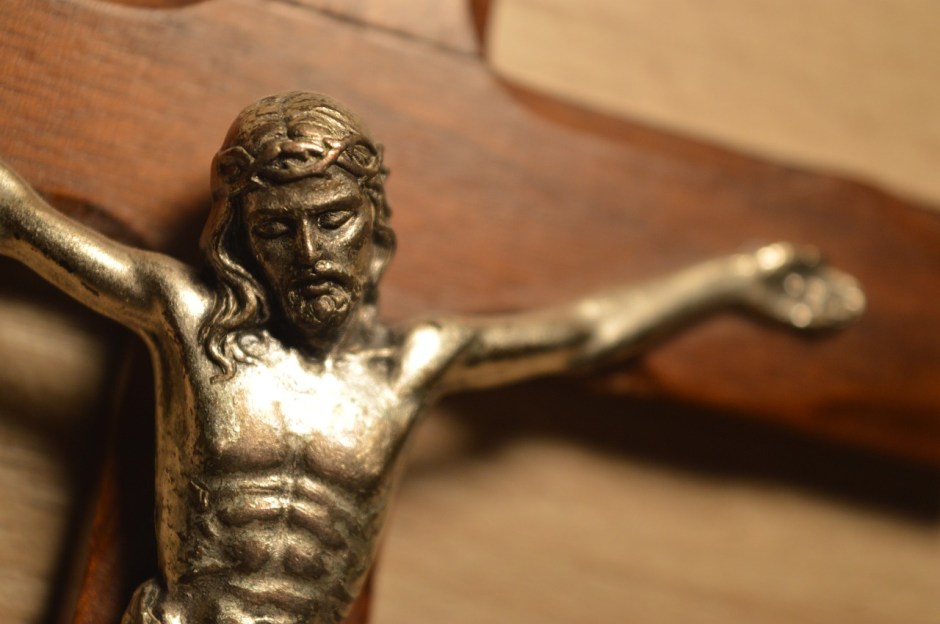
Today is Good Friday, the day of the complete loss of control. Not in the sense of acting rashly or wildly, like a young child who cannot contain her emotions. No, today is the day where we see what perfect surrender looks like. It is the day where hands are stretched wide, holding nothing and at the same time, holding everything at once. Jesus hangs on the cross in what appears to be a complete loss of control. He was taken, beaten, stripped of everything he had, even his connection with the Father. In these moments, Jesus completely empties himself of everything he is. Where Adam and Eve grasped, tightening their grip on the forbidden fruit to gain something they did not need, Jesus releases his hold on everything, to gain everything we desperately require.

Nothing, not one thing. No one, not one person, slips through Jesus’ fingers.

We have a choice today. Will we join Christ, opening our own hands wide to accept all God has to offer us? Or will we side with the Empire, tightening our grip on the things we think we need, only to watch them slip away one day at a time, never realizing that all we had to do was let go. In a magnificent reversal, to find what we truly need, we have to be ready to lose everything.

Daily Graces. kktaliaferro.wordpress.com

A Wellspring

We aren’t farmers. It’s good to say that from the start. This past summer our family moved again and this time we chose a home that sits on a little less than 4 acres of land. A good portion is woods, but we are definitely “in the country” side of town. Our neighbors have horses that we can see every morning from our front yard. Down the lane another neighbor has a large garden and the best tomatoes at their farm stand during the summer.

When we bought our home we knew it was on a well. Naively, we thought we knew enough about wells due to a few previous experiences that, in hindsight, did not at all provide us with enough information to believe we knew what it meant to live with a well.

You don’t know what you don’t know

After a few formative experiences, such as learning that standing water around the well did not in fact mean we had a such a surplus of water it was literally bubbling out of the ground – this meant we had a serious leak that should have been addressed at least a month prior – we are quickly realizing that there is a lot to learn about wells. There is also a lot that is simply beyond our control.

When we first moved in, we let the well alone. We didn’t know how to measure its depth, and according to our neighbor the well had always been sufficient for the previous owners. It should be noted, again, hindsight being so clear, that the previous owners were an elderly couple. The water usage in laundry alone when comparing the needs of an elderly couple and our family of eight is rather extreme. So, while the well might have produced more than enough for them, our family has a very different level of need.

After the aforementioned leak experience, we figured out how to measure the well’s depth. We have a spreadsheet where we are tracking the depth of the well twice a week. We also have a rain gauge so we can keep a good account of the amount of rain we get. We have learned things like just because it’s raining today doesn’t mean we will see those gains in the well tomorrow. It takes a few months for the rain of today to filter down deep enough to be seen in the well. And, if there is a dry period, we can expect to see that reflected in the well’s measurements a few months later.

To whom does water belong?

We have learned so much in a few months. And yet, there is little of it we can control besides measuring and watching. Laundry still has to be done. Toilets have to be flushed. Dishes have to be washed and showers taken. We use water all the time. Not a day goes by that I don’t think of the well. We have even started including the well in our nightly prayers as a family.

This whole experience has given me a deeper appreciation for those who rely on the weather for their livelihood and way of life. We are fortunate that we can call a company to bring water to refill the well (we’ve had to once already) when, in our ignorance, we ran it dry. Now, as we learn more, we are striving to maintain a better understanding of the well, where it is sitting, and how we can modify our habits to be good users of the water we have available. Not everyone has such a luxury.

I am also praying my morning prayer with more awareness. So many psalms talk about the importance of water and all its many facets. (The following are quotes from the Liturgy of the Hours translation of the Psalms).

  • O God, you are my God, for you I long; for you my soul is thirsting. My body pines for you, like a dry, weary land without water. Psalm 63:2
  • The Lord’s voice resounding on the waters, the Lord on the immensity of waters; the voice of the Lord, full of power, the voice of the Lord, full of splendor. Psalm 29:3-4
  • The Lord’s is the earth and its fullness, the world and all its peoples. It is he who set it on the seas; on the waters he made it firm. Psalm 24:1-2
  • Indeed you love truth in the heart; then in the secret of my heart teach me wisdom. O purify me, then I shall be clean; O wash me, I shall be whiter than snow. Psalm 51:8-9
  • You care for the earth, give it water; you fill it with riches. Your river in heaven brims over to provide its grain. And thus you provide for the earth; you drench its furrows, you live it soften it with showers, you bless its growth. Psalm 65:10-11

The list goes on. Water doesn’t belong to us. This well doesn’t belong to us. I am discovering our relationship with water in this house is a lot like the Serenity Prayer. We can absolutely take ownership of how we use the water, but we cannot control its availability. We have to rely on God’s providence in the weather.

So much of the big things in life are like this. We have the gift of life, of waking up each morning. We can choose how to spend our day, but we rely on God’s love and mercy to wake us up tomorrow. We can take ownership of our actions, but we cannot demand others act or perceive our actions in a certain manner. We can make great plans for the future and have them all change in a single day.

Through this well, our family is learning to rely even more on God. We are learning to be more patient and to be more aware of the gifts He provides the earth in the form of rain. Water is precious. Life is precious. While it would be so much easier to be on city water, I wouldn’t trade these lessons and conversations we have had because of our well.

Daily Graces. kktaliaferro.wordpress.com