Go Alone – Twenty-third Sunday of Ordinary Time

We have the amazing ability to be able to share our thoughts and opinions with the world via the internet. While not all of us have a million followers on Instagram or whatever Twitter is called these days, the things we share on the internet last. Time and again we are seeing how mistakes in the past are coming back to haunt politicians of all flavors, celebrities, and other more famous individuals. Post a picture, it’s there for ever. Say something overly negative about a particular person you have a problem with, it can be found at a later, likely very inconvenient, time.

Jesus’ advice in today’s Gospel is so important, and not because we are concerned about who is going to uncover what. There are, of course, many wonderful things about the interconnectivity of the internet, the ability to dialogue with people in other places beyond even your own country, and the way knowledge can be shared across a massive number of people. It’s amazing to fathom the positive possibilities the internet can bring.

However, there are downsides. One of the big struggles I have with the internet is the impersonal way it allows us to relate to one another. I can’t see a person’s hurt expression if I make an unkind comment. I can’t read facial expressions to understand what is sarcasm and what is a misunderstanding. I don’t see tears welling in someone’s eyes at hurtful comments made by others. These social cues are nonexistent in the online atmosphere.

Jesus’ approach is so different from how disagreements get handled online. Jesus says to go to the person in private and have a conversation with them. Find out if there is a misunderstanding, apologize if needed. Take the time to seek that person out and make them feel valued and heard so that the disagreement can peacefully be reconciled. If this doesn’t work, then include others into the conversation.

This one-on-one approach is vital for the building up of families and communities. How many of us have been doubly hurt when a situation got aired out in front of others instead of remaining between the two people who it pertained to? How often have you seen a group turn on a person who they know nothing about, but because the grievance got posted online now that person is being hit from all sides?

The next time you have an issue with someone, consider Jesus’ words. Are you seeking healing and reconciliation by sharing about the struggle in a public space, or just looking to vent and possibly due harm to that person’s reputation? Is the issue important enough for you to take time out of your own schedule to meet with that person, or share a phone call? If you were on the other end of this event, how would you want it handled?

Daily Graces. kktaliaferro.wordpress.com

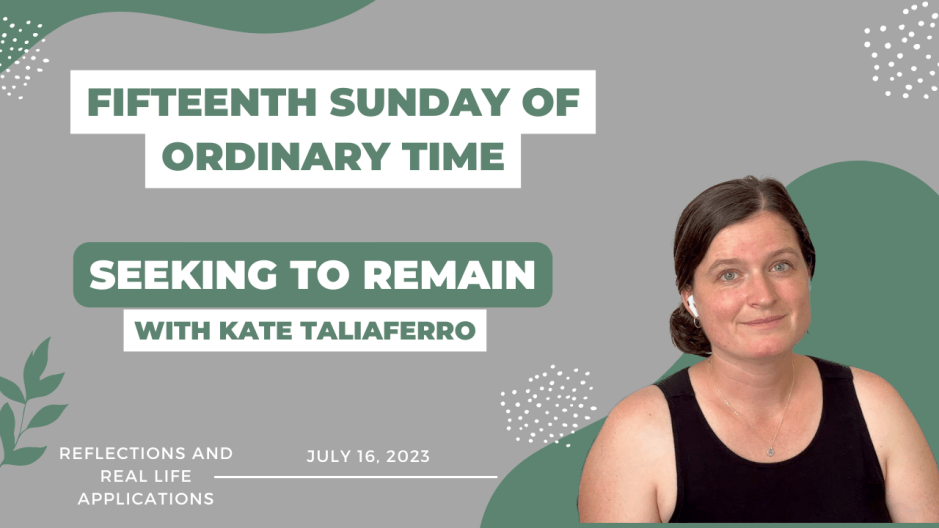
Fifteenth Sunday of Ordinary Time

This week’s Gospel reading is quite long. 23 verses is a lot to work with, especially when it includes one of the rare moments when Jesus explains more fully a parable. In this week’s video, I pulled the lens back some from solely the Gospel and took some cues from the Old Testament and Responsorial Psalm for guidance. I think it turned out really well! I also have learned that my headphones don’t actually talk to my camera app – fun fact! Good to know, because now that I know why the audio quality of my videos isn’t great. Not so good to know because now I’m discerning whether to invest in an actual microphone or not. We shall see. If you have an opinion on audio quality, I’m all ears (pun intended).

For this written reflection, I was drawn to the verses of Isaiah that Jesus quotes in the Gospel reading:

You shall indeed hear but not understand,

you shall indeed look but never see.

Gross is the heart of this people,

They will hardly hear with their ears,

they have closed their eyes,

lest they see with their eyes

and hear with their ears

and understand with their hearts and be converted,

and I heal them.

Matthew 13:14-15 – quoting Isaiah 6:9-10

These are hard words to hear, but we must hear them. The imagery is so vivid. When I read the passage the first time, it reminded me of my kids when they were little and how they played hide-and-seek. They would cover their eyes and with all the certainty in the world, were convinced I couldn’t see them because they couldn’t see me. As adults, we see the absurdity of the action and we chuckle at the sweet innocence of a child at play.

Too often, we do this same thing as adults. As we settle into our house, I’m already doing this.

“If I just don’t look in that corner, I won’t have to think about the boxes that still need to be gone through.”

“If I don’t read that email, I won’t have to worry about whether or not we have time for another activity.”

“I’ll just buy another bottle of ranch, if I look through the pantry to see if there’s another one I’ll find all sorts of things we didn’t actually need to move or save but did anyway because I didn’t take the time to properly sort through them before we left.”

In the short term, so often it’s easier to close our eyes, cover our ears, and go about our business. Until we run into a wall of course. I’ll end up re-boxing boxes that should have been sorted next summer, packing things we definitely don’t need or want. We will miss out on opportunities because I didn’t take the time to sort through my email properly and update it with new organizations in our new city. I’ll end up with 4 “back up” bottles of ranch (don’t worry, my girls will work through it in no time) but is that really being the best steward of our finances?

This behavior can extend to all areas of life and believe me, it’s not a comfortable topic. We do this with politics, poverty, racism, extremism, hunger, violence, and so many other challenging topics. We think if we can’t see it, we don’t have to worry about it. If we don’t know about it, we don’t have to deal with it. I know I am guilty of this. I am speaking about it from a place of humility and, honestly, some shame. I know I could do better, open my eyes wider. It’s not that we are called to solve all of the world’s problems. But we should know what’s happening around us, we should be able to speak to what we know and be honest about what we don’t know. We should be able to pray for local, national and global issues that God places on our hearts.

An example. We want our children to know and be able to speak confidently about their heritage. Both mine and Ben’s families have been in the United States for quite some time. Ben’s family, however, has been in the US since before it was a country. He has ancestors that fought in the Revolutionary War, which is pretty cool to know. What is more challenging to know is that later in US history, his family also owned slaves and fought for the Confederacy which wanted to split the US into two countries.

We could chose not to share this with them. We could say, “Well, they will find out eventually if they want to.” Instead, we’ve chosen to share with them, as they show interest and maturity, the fullness of their family story. We want their eyes to be open. Slavery was and is a horrible thing that never should have happened. Yes, our family was part of that problem at that time in history. This does not mean we, or our kids are bad people. It does mean that today, everyone has a responsibility to uphold the rights and dignity of all people regardless of who they are, where they come from, or what their family has done in the past. We want them to embrace their family history, to be proud of the good things and to recognize the faults of the wrong things. Only with open eyes and open ears do we ensure the wrongs of history aren’t repeated.

Jesus tells us that we will bear good fruit if we hear His Word and obey. Jesus is Truth. We need to keep our eyes and ears open to what Jesus reveals to us. Little by little, Jesus will heal our brokenness. Through our commitment to Jesus’ Truth, the world will be transformed by love and forgiveness into the Kingdom of God.

Daily Graces. kktaliaferro.wordpress.com

Feast of the Ascension – 2023

Depending on where you are in the world, there is the possibility that the feast of the Ascension will supersede the Seventh Sunday of Easter. The Ascension fell on May 18 this year and either your local diocese or conference of bishops will have decided which readings will be used for this Sunday. So, to cover all my bases, the reflection here is a reflection on the Feast of the Ascension. The YouTube video for the week considers the Gospel for the Seventh Sunday of Easter. No matter which place you went first, and even if you don’t make it to the other reflection, I hope that something here will be meaningful for your week.

It in interesting that we hear the story of the Ascension as told by St. Luke in the Acts of the Apostles for the First Reading, and then the Great Commission from St. Matthew for the Gospel. This is the final moment of Matthew’s Gospel, it is how he concludes the whole story.

Go, therefore, and make disciples of all nations

Matthew 28:19

I love reading different Bible translations. I find language fascinating and if I could have all the time in the world, I think I would have studied Biblical Greek and Hebrew so I could go back and read these texts in their original forms. One Bible translation I find particularly interesting (I’ve mentioned this before in other posts, but it’s been a while), is called The Message. It is originally a Protestant translation, but there is a version which includes the books the Catholic Church maintains as the original canon of Scripture. This translation was intended to be a more “modern” translation. The translator, a pastor named Eugene H. Peterson, explains it this way:

I became a ‘translator’…daily standing in on the border between two worlds, getting the language of the Bible that God uses to create and save us, heal and bless us, judge and rule over us, into the language of Today that we use to gossip and tell stories, give directions and do business, sing songs and talk to our children.

The Message, pg. 12

Peterson is good about being upfront that this Bible isn’t meant to replace other study Bibles or translations used for liturgical practices. This is a reading Bible, a “let’s get to know one another” Bible. I love how he chose to translate the passage I quoted above.

Go out and train everyone you meet, far and near, in this way of life

Matthew 28:19

It is the same thing, but I find the word “train” to hit a little differently. I also find the phrase, “in this way of life” impactful. In order to train someone, first we have to know what we are teaching. For a lot of us, this might make us suddenly uncomfortable. This even makes me uncomfortable to a certain extent. For a large part of the Church’s history, the laity were not part of the teaching apparatus of the Church. Clergy and religious, who were able to receive additional schooling, time for prayer, mentorship, etc., were the ones looked to for passing down the faith. As time has passed, the Holy Spirit has inspired the Church to encourage all the baptized to take Jesus’ Great Commission to heart. These words aren’t simply for clergy, they are for all disciples.

Each one of us is called to be a disciple. A disciple is someone who not only follows a master, but promotes and spreads those teachings which they have received. Jesus lays out for us very clearly what He expects of His disciples. And it’s not always easy, especially when you consider Peterson’s translation in The Message. We are asked to train everyone you meet. Everyone? Even people we don’t like? Even people we will only interact with once? Even people we converse with online?

This is the thing about the Great Commission of Jesus. To be a disciple doesn’t mean living according to the teachings of Jesus when it’s convenient, or on Sunday mornings. It is an all or nothing kind of thing.

But before you get scared away. Consider this. Jesus doesn’t ascend into heaven to get away from us. Pope Francis explains it better than I can in his homily for the Feast of the Ascension in 2014:

“Jesus departs, he ascends to Heaven, that is, he returns to the Father from whom he had been sent to the world. He finished his work, thus, he returns to the Father. But this does not mean a separation, for he remains forever with us, in a new way. By his ascension, the Risen Lord draws the gaze of the Apostles — and our gaze — to the heights of Heaven to show us that the end of our journey is the Father. He himself said that he would go to prepare a place for us in Heaven. Yet, Jesus remains present and active in the affairs of human history through the power and the gifts of his Spirit; he is beside each of us: even if we do not see him with our eyes, He is there! He accompanies us, he guides us, he takes us by the hand and he lifts us up when we fall down. The risen Jesus is close to persecuted and discriminated Christians; he is close to every man and woman who suffers. He is close to us all; he is here, too, with us in the square; the Lord is with us! Do you believe this? Then let’s say it together: the Lord is with us!”

How beautiful is this! We are called to be disciples, but we do not do it alone. Never alone. The tasks of discipleship are challenging. We can’t get around that. This feast forces us to take a good look at our lives. Are we living out the tasks Jesus has given us? How can we more fully realize Jesus’ desire for our lives? Where is Jesus calling you to go out and train everyone you meet?

Daily Graces. kktaliaferro.wordpress.com