The Devout Life – Book Review

St. Francis de Sales is a spiritual teacher par excellence. The instruction he offers in, Introduction to the Devout Life (Introduction for short), which was first published in 1609, is as rich and beneficial today as it was over 400 years ago. However, as with most texts of this kind of history, sometimes the phrasing can be unfamiliar. Enter The Devout Life: A Modern Guide to Practical Holiness with St. Francis de Sales by Deacon Matthew Newsome.

Dcn. Newsome haș carefully and thoughtfully brought St. Francis de Sales’ timeless advice into a format that is easily accessible for anyone who wishes to learn more about the devout life. Newsome is quick to point out that this book isn’t a summary or a new translation. Rather, “it is a helpful resource, built upon the framework of St. Francis’s Introduction, for anyone seeking to grow in devotion to God through individual or small group-study” (pg.3). 

Newsome follows the same structure of short reflections as the original Introduction. He offers practical ideas for how to digest and better put into practice the principles St. Francis de Sales recommends for growing in the spiritual life. There are reflection questions at the end of each 1-3 page section as well as an applicable Scripture verse which corresponds with the topic discussed. These additions lend themselves very well to individual journaling, conversations with Jesus during Adoration, or for sharing in a group setting. 

All people are called to holiness. St. Francis de Sales wrote his Introduction to be a roadmap for everyday ordinary people to learn to lead a devout life, a life of holiness. To lead a devout life, one must practice devotion. Newsome recommends reading his book a little at a time, just one section a day. In this manner, the reader is building a habit of daily time with the Lord and considering how they are living out this calling to holiness. 

Personally, I can attest to the strength of this wisdom. This is not a book to read in a weekend. It is one you can return to again and again, especially after slowly walking through it in its entirety. There will be times in your life when specific reflections will speak more strongly to you than others. The division of sections and topics makes this book easy to reference as you go through different seasons of the spiritual life.

The structure, the pace, the reflections, the wisdom – this book provides a solid frame work for anyone who wishes to cultivate habits of listening for God’s voice in their everyday life and making concrete choices which will help them live a holier, devout life.

For disclosures: I received a free copy of this book from Sophia Institute Press in order to review it both here and on Catholicmom.com. The opinions I share here are my own.

Daily Graces. kktaliaferro.wordpress.com

The Heart Sees – Nineteenth Sunday in Ordinary Time 2023

While this week’s YouTube video focuses on the Gospel, as usual, I can’t pass up an opportunity to talk about the story of Elijah in 1 Kings. This is one of my favorite Old Testament stories. It is quite the epic situation. Elijah is on the run for his life. He has wandered through the wilderness and come close to death. He has been sustained by angels and miraculous food appearing before him. Finally, he has found shelter in a cave on Mount Horeb, the mountain of the Lord.

This mountain is not insignificant. You might know it by another name, Mount Sinai. This is the same mountain where Moses received the Ten Commandments. This is the place of covenant, a place where God came to meet His people. Elijah has had to flee here, not from outsiders, but from his own people. Elijah tells God that, “the Israelites have forsaken your covenant. They have destroyed your altars and murdered your prophets by the sword. I alone remain, and they seek to take my life” (1 Kings 19:10).

Frightened and fearful, Elijah gives his report to God. What would God say? What do you think went through Elijah’s mind when God called him to stand outside the cave, utterly exposed, so God could pass by?

And then we behold both God’s power and His restraint. There is a wind that whips through the mountains, strong enough to crush rocks. An earthquake shakes the world, fire scorches past. Power, yes, such power over all the elements. How small Elijah must have felt. Yet, also perceptive. While these wonders were indeed displays of God’s power, He Himself was not in them.

In a way, and this is my own interpretation, God was giving Elijah one final test. You see, Elijah could have been righteously angry at the Israelites. He could have desired their punishment or at least reprimand for the way they were neglecting their faith. He could have sought revenge for his fellow prophets who had been killed. He could have sought retribution for the pains he himself had suffered. Any of those first displays of power could have swayed Elijah – yes, here is my mighty God who will bring vengeance and judgment down upon the people! But it would have been false, because God was not truly there.

The disposition of our heart affects how we perceive the world. Elijah’s heart was not full of anger, revenge, or despair. Through it all, he had remained faithful to God’s friendship and obedient to God’s will. This is why it is only in the smallest breeze, a still, small wind, that he hid his face in his cloak and went out to meet his God.

So often, we chase after what we believe will make us happy only to be disappointed. The disposition of our hearts can lead us in all manner of directions. The Bible talks quite a bit about our heart. One of the recurring themes in the season of Lent is the notion of allowing God to soften our heart, to give us a new heart. This new heart is one that is soft and clean, rather than hard and stoney.

A clean heart create for me, God;
renew within me a steadfast spirit.

Psalm 51:12

I am aware it isn’t Lent, but the message is timeless. God is always in what’s best for us, and what’s best for us is always God. This doesn’t necessarily mean a life of solitude and a diet of brown bread and water. And thank God! A person with a clean heart, a soft heart, is one that God can shape and form into who he or she God intended them to be. Another word for this is holiness. Holiness is a universal call – each one of you reading this, as well as the person sitting next to you, as well as your neighbor down the street, even that person who cut you off on the highway – all of us are called to holiness.

Pope Francis’ excellent exhortation, Gaudete et exultate, is all about the universal call to holiness. Check this quote out:

The important thing is that each believer discern his or her own path, that they bring out the very best of themselves, the most personal gifts that God has placed in their hearts (cf. 1 Cor 12:7), rather than hopelessly trying to imitate something not meant for them. We are all called to be witnesses, but there are many actual ways of bearing witness. Indeed, when the great mystic, Saint John of the Cross, wrote his Spiritual Canticle, he preferred to avoid hard and fast rules for all. He explained that his verses were composed so that everyone could benefit from them “in his or her own way”. For God’s life is communicated “to some in one way and to others in another”.

Gaudete et exsultate, 11.

So good, right? Ok, I know this has been a longer post so I’ll leave it here. I would encourage you to read over that quote again though and think about what gifts God has specially and specifically given to your heart. How are you using them? This really is a beautiful exhortation, though I wouldn’t read it all in one sitting. Take it a paragraph at a time. It’s really worth it.

Daily Graces. kktaliaferro.wordpress.com

Landmarks

We were driving into Austin, TX so that Ben could run in the marathon (He’s insane, in my humble opinion. But he finished under his goal and we are super proud!). Per our usual arrangement, Ben was driving and I was navigating. I started chuckling to myself as I told him he would need to turn left ahead, and that there would be a Joe’s Crab Shack on the right. Usually, I don’t give him references like that, and he made a funny face. “What?” I said, “Google says so.” Within the directions on my phone it had not just what streets to turn on, but it also gave landmarks for most of them. This was new to us.

Google told us things like “Pass by the Pizza Hut on the left,” and “Turn before the Wendy’s across the street on the right.” I don’t think this is a feature everywhere (I ran a search from our house to base and didn’t get any helpful hints). But Austin is a major city, so I imagine this is the the next step for Google navigation.

I am more of a landmark based direction person. I can find my way around much better if I can connect a memory to the location or the steps in the directions. This was clear on the way back to the car when I found myself saying things like,”Oh we have to turn here because remember, John, you saw the longhorn statue,” and “I think we keep going straight because we need to pass the corner where that huge tree is.”

Landmarks, large and small, trigger memories. They cause us to think of something. The Statue of Liberty may bring forward memories of a visit to Ellis Island or perhaps your sophomore year high school history class learning about the Irish Famine and the immigrants who passed under her torch. A picture of Mt. Everest might make you think of endurance, persistence and the ultimate challenge. Maybe seeing the Grand Canyon or the Golden Gate Bridge will make you recall a favorite vacation or family who live nearby.

Landmarks

Our lives are filled with landmarks.  We all have favorite spots, restaurants, parks, places that hold fond memories. There are also landmarks that don’t necessarily hold memories, rather they serve as guideposts. They are the landmarks that help us remember how to get where we want to go. On our way to base, Clare, who is 3, can shout out at least 4 different landmarks along the route. There’s that coffee shop you pass on your daily run, which subconsciously lets  you know you only have 1 mile left until you are home. You pass by a pizza place or go over a bridge every time you go to your grandma’s house.

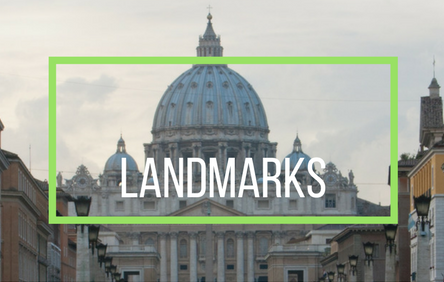
The Church, wise as she is, give us lots and lots of landmarks, both big and small. The big ones – the Vatican, the Sistine Chapel, Chartes Cathedral, The Chapel of the Nativity, and so so many more. The point of these immense spaces is to point our gaze heavenward. They are beautiful in their own right, but they are also beautiful because they show us a glimpse of a deeper reality. If you would like an example, check out this short (6 minutes) video excerpt from Bishop Robert Barron’s Catholicism series.

As reflective individuals, we have the opportunity to decorate our homes and environments. We surround ourselves with images, furniture, and necessities. Some of these items we need, like clothes, cooking supplies, food, etc. Others are more decorative – pictures on the wall, stylized couches and tables, calendars, books, clocks, and accessories. We can, and often do, place certain items with great care and in specific rooms. The dining table obviously goes in the dining room or kitchen. A pull-out couch or bed would be out of place in the patio.

Just as the everyday items of our home “belong” certain places, religious items too can have great significance on what goes on in that space. They serve as landmarks within our home, helping to guide our families’ day along paths of holiness. A crucifix in each bedroom is a great place to start. Many families have a small holy water font by the front door. Perhaps an icon of the Holy Trinity, whose image the family reflects, would fit well in your living or dining room. Our kids have an icon of their saint namesake in their bedrooms. Ben’s grandmother has a small photograph of a young refugee girl near her front door because it reminds her to pray for all those who will spend the day/night without a home, especially refugees. I have an icon of Mary and a few prayer cards scattered throughout the kitchen because they remind me to approach the day as Mary did, with a smile and a Yes to God’s will.

What sorts of landmarks do you have in your home that help you and your family keep on your path to holiness? Daily Graces. kktaliaferro.wordpress.com