
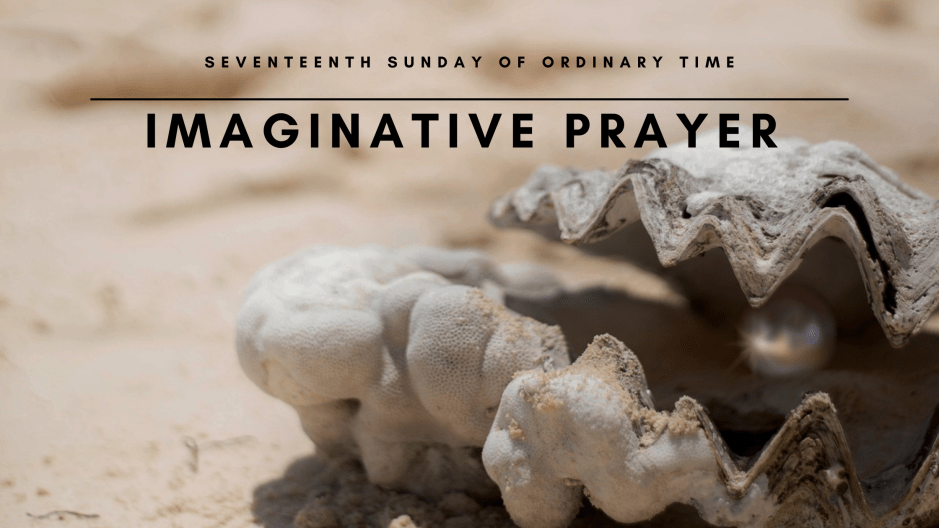
This Sunday’s Gospel reading includes some famous imagery. Jesus tells us that the Kingdom of Heaven is like a treasure in a field, or a pearl of great price. In both instances, a person happens upon their desired object, surprised to discover it. They swiftly go to sell all they have so they can purchase their prize, so precious it is to them.
Jesus is a master storyteller. There is so much to unpack and explore in His teachings and parables. While there are a number of angles to approach Jesus’ parables, I’d like to hold up Ignatian Contemplation, or Imaginative Prayer, as an excellent way to spend time with these parables. If you are not familiar with Ignatian imaginative prayer, or Ignatian spirituality in general, Ignatianspirituality.com is a great resource for you to check out. In a most basic definition, Ignatian imaginative prayer involves placing yourself in the scene depicted by Scripture, something from the Gospels most often, though this method is not exclusive to the Gospels. You might be a bystander in the scene, observing as things unfold. Or, you might put yourself in the place of a certain character.
A classic example is the Parable of the Prodigal Son. In imaginative prayer, you might first place yourself in the scene as the Good Samaritan. Hear what God has to say to you about your actions and attitudes in light of the Good Samaritan’s choices. Then, a second time (either that day or in the near future), place yourself in the scene as the beaten man. A third time, as the priest or Levite. A fourth time as a robber. A fifth time as the inn keeper. A sixth time as a silent observer. This one passage, only 22 verses, seen from 6 different perspectives. This is a powerful tool!
It is also possible to walk through a passage with a guide of sorts. Either a person reading aloud, or, as I propose to do for you here, a written guide that goes through the passage. There will be prompts for reflection, questions to discover how you are perceiving a specific moment or action, moments of prayer, etc.
As I studied this Gospel, I was struck by the amount of movement happening in just a few short lines. There is a discovery, there is a flurry of activity, there is a return, there is rest. So, if you will permit me to walk with you, let’s go through Matthew 13:45-46 together. I’ll include the verses, as well as questions for you to consider. I’ll be letting you into my own imaginative prayer as I consider the story of the Pearl of Great Price from the perspective of the merchant who finds it.
The kingdom of heaven is like a merchant searching for fine pearls.
Mathew 13:45
It is a normal day. The sun is shining, I can hear birds singing. I do not expect anything unordinary to happen. In the back of my mind, I know I am looking for something, a jewel or pearl perhaps, something really worth looking at. Something so beyond compare in its perfection and beauty. I do not expect to find it today, I’m not sure I expect to ever find it. But every so often, the desire for it comes to me and I wish desperately I could find it.
What are you wishing for? What do you wish would happen in your life? Where are you looking for fulfillment?
I am walking through the shops and stalls of the market. I pause by stands as items catch my attention. I am not looking for anything particular on this trip. Money changes hands, my sack becomes heavier. I’ll need to return to my caravan soon, but there is one last stall to check. You never know what you’ll find when you aren’t looking for anything special. I go over, and in my shock, I drop my sack.
The most beautiful, precious pearl I have ever seen is on a piece of cloth.
What does the Kingdom of Heaven look like to you? What would make you stop dead in your tracks when you saw it, achieved it? If Jesus were speaking this parable to you, what image would He use?
When he finds a pearl of great price, he goes and sells all that he has and buys it.
Matthew 13:46
I am in complete shock and elation. I never thought I would find such a pearl! With my mouth still hanging open, I hurriedly pick up my fallen sack of goods, paltry items in comparison to the beauty and perfection before me. I offer them to the merchant. “Please,” I beg him, “Please I must purchase this pearl.” His price is high, higher than the goods I have with me. I think, maybe, if I can sell everything I have in reserve, that might be enough. I had him my bag in the hopes he won’t sell the pearl to anyone else. I race back to my caravan and start shouting orders to unload everything. My servants are confused, we aren’t meant to sell these items here but along the road in the next few towns. My joy is bubbling over as I wildly grin, “I found it! I have found the most perfect, most precious, most lovely pearl. It is worth every shekel the merchant is asking for it and more. It is priceless to me and nothing is going to stop me from acquiring it. We sell everything!”
Have you ever experienced a joy like this? The merchant almost sounds foolish, doesn’t he? Yet how many of us have been a fool in love, walking around with that silly, classic grin and the feeling of weightlessness? Have you ever felt this way about God, the gift of salvation or the gift of forgiveness? Is this a feeling you desire to have about God?
What lengths are you willing to go to be at Mass on Sunday? What are you willing to sacrifice for prayer time? How foolish are you willing to appear to others for the sake of the Truth of the Good News?
After selling all I have, even after telling my servants I can no longer pay them and that I am selling the caravan itself along with my favorite cloak, I finally have enough. It took some time, but I was relentless. I have nothing left in the eyes of my servants or the people I sold my goods to. They do not understand that what I am gaining far surpasses anything I am leaving behind.
Trembling, I approach the merchant. He smiles warmly, the only one with understanding in his eyes. I hand him his payment. Carefully, reverently, he wraps the pearl in its cloth and holds out his hand. I open my hands and extend them, not wanting to risk the pearl dropping. He places the pearl in my hands and closes my fingers around it.
“You have worked hard and sacrificed much, ” the merchant says to me. “Yes,” I reply. “But this moment has made it all worth it. I am finally at peace. I am no longer searching for anything in the world. All I need, I have. All I desire, I possess. My soul is finally at rest.”
Do you believe this kind of peace is meant for you? Would you be able to let go of everything for the sake of Jesus? What are you holding onto? What is keeping you from letting Jesus enter fully into your soul?
I hope this reflection resonated with you in some way. Use it as a springboard to begin a conversation with God. Perhaps one question or section really stood out to you. Go back to that place and spend some time there. What is God trying to say to you, specifically to you?




 Daily Graces