The Empire vs. The Cross

With the upcoming release of Season 2 of Disney’s Star Wars series Andor, Ben and I have been rewatching Season 1. We both enjoy this gritty story and the way the characters develop throughout the episodes. This time through, we have been commenting on some particular phrases that the Empire uses as it begins to take further control of the galaxy. The security folks (I’m not going to get super technical here), talk about “tightening their grip” and extending the reach of imperial control. Contract security is out, storm troopers are in. As we watched this unfold, we looked at each other and said Leia’s line from Episode 4: A New Hope, “the more you tighten your grip, the more star systems will slip through your fingers.” Here, in Andor, we were watching the beginnings of the tightening, which is the same moment that the rebellion is really starting to come together. The further the Empire stretches itself, the more cracks form for the rebels to slip in and out of.

The Empire’s purpose in all of this is control. They want things ordered they way they want them with no surprises, incidents, or creative thought. When watching Star Wars, I would think that most of us are inclined to side with the rebels. Stand up to the power, resist!

And yet, as I was reading through my most recent copy of Evangelization & Culture (Issue No. 22 on Courage), I found myself coming to realize that deep down, I’m much more like the Empire than I would want to admit.

At its most basic, primal level, the Empire (in my estimation) is operating from a place of fear. The fear of the unknown, of individual thought, of being replaced, of losing what it had gained. The fear of loss of control is a critical motivating force that causes the grip tightening seen in the Andor series. In his article “Spiritual Direction for the Fearful,” Fr. Billy Swan’s counsel reminded me of the Empire and how it’s actions are exactly what not to do in our own lives:

For us, the fear of losing our lives might not be active every waking hour, but the fear of losing something is always lurking – material things, power, honor, status, our mob, our health, our loved ones, our independence, our freedoms. How do we respond to this fear of loss? One option is to double down on our efforts to protect what we have, whether it be our freedoms, our assets, or even our very lives. Yet we know deep down, sooner or later, that we will have to let go of everything and surrender to the mystery of love that is infinitely greater than our fears.

What am I holding on to too tightly? Where am I seeking to be in control, instead of allowing God to direct my life? What am I afraid to lose?

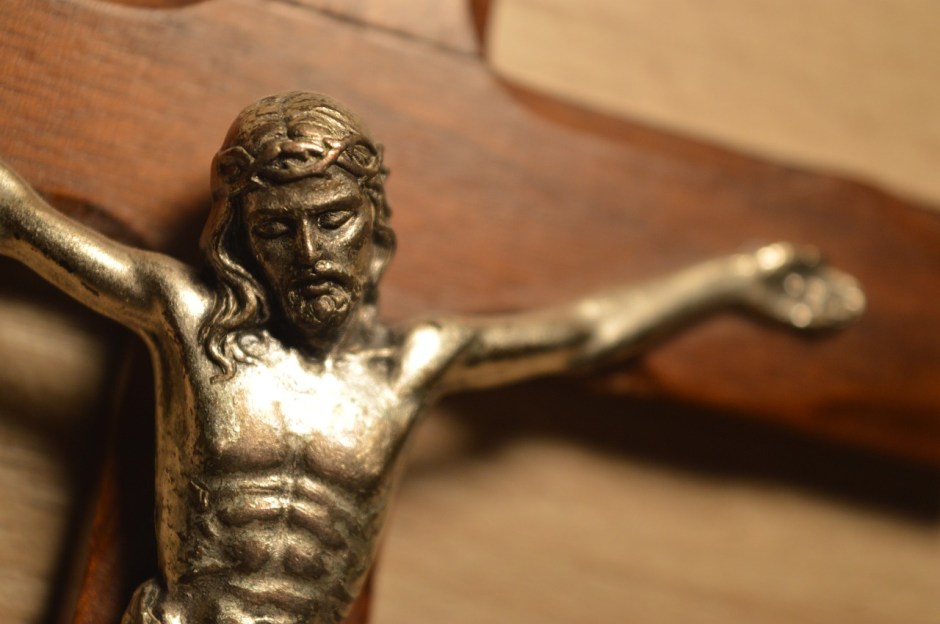
Today is Good Friday, the day of the complete loss of control. Not in the sense of acting rashly or wildly, like a young child who cannot contain her emotions. No, today is the day where we see what perfect surrender looks like. It is the day where hands are stretched wide, holding nothing and at the same time, holding everything at once. Jesus hangs on the cross in what appears to be a complete loss of control. He was taken, beaten, stripped of everything he had, even his connection with the Father. In these moments, Jesus completely empties himself of everything he is. Where Adam and Eve grasped, tightening their grip on the forbidden fruit to gain something they did not need, Jesus releases his hold on everything, to gain everything we desperately require.

Nothing, not one thing. No one, not one person, slips through Jesus’ fingers.

We have a choice today. Will we join Christ, opening our own hands wide to accept all God has to offer us? Or will we side with the Empire, tightening our grip on the things we think we need, only to watch them slip away one day at a time, never realizing that all we had to do was let go. In a magnificent reversal, to find what we truly need, we have to be ready to lose everything.

Daily Graces. kktaliaferro.wordpress.com

Plans for Lent + Hallow Review

As is typical for this time of year, it’s good to share about what some of my plans are for Lent. Not only will this help keep me accountable to them, but I have found a good many ideas for how to observe the season by hearing how others plan to pray, fast, and give alms.

Screens

I’m on the fence about this first one, which probably means it would be a good idea to give it a shot. In a Focolare women’s group meeting last month, we were talking about communication and especially social media use. A few ideas were shared about how to make our phones less attractive and it was a really interesting conversation. Our phones are brightly colored and everything about them is designed to make them appealing. The apps we engage with utilize all kinds of methods that foster addictive behaviors, consistently and constantly drawing us back to their content. While I know giving up social media or a specific app is a popular Lenten observance, there were a few other ideas shared that I’m considering.

  • Turn your phone to black and white mode. Our brains are wired to be attracted to bright colors. I know for me, I don’t even read the names under the app icons, I’m looking for the picture or color associated with the app. So, if we turn off the colors, we will have to be more intentional in order to even find what we are looking for. Then, once we are in the app, it’s actually rather dull. The same exact content we looked at the day before is less catchy, less interesting, less “scroll worthy.”
  • Turn off all (or nearly all) notifications. Do I really need to know when someone posts on Instagram? What about the little red numbers that show something is waiting for me on Facebook?
  • Removing the social media apps. This doesn’t mean necessarily taking a break from them, just making it harder to get to because of the extra steps required to get there. So, I would only access them through a web browser. Or, even further, I only access them on my computer, not on my phone.

Hallow

I am very excited for this one. I am going to be participating in the Pray40 challenge for adults on the Hallow app. I have not been disappointed by this program yet so I am confident this year will be another good one. In the past, I have tried to listen in the mornings when I’m getting ready for the day. The challenge this year will be timing, because I am already listening (also on Hallow) to a daily Gospel reflection that is usually about 10 minutes. Perfect for my typical morning routine. In past years, I’ve replaced this Gospel reflection time with the Pray40 content. However, I would very much like to continue with the Gospel reflections in addition to the Pray40 experience. So, it’s going to take some trial and error to see when will be the best time to listen consistently.

In addition to the Pray40 challenge, Hallow is going to be offering a kids’ Lenten content journey. They are calling it “The Little Way” and I’m very excited about it. Hallow actually reached out to me and asked if I would offer a review of the content which got me even more excited for it.

This series is going to be more than a series of prayers. The kids will be journeying along with Paul and Mia Buckley, two kids who are on a trip through France. We are going to get to experience their story while also meeting some pretty fabulous saints, hearing vocation stories, Sunday homilies, even a few family games. Of course, there are also going to be opportunities for prayer and reflection throughout the 40 days of Lent. 

The Saints Alive podcast, the creators of The Little Way, provide truly immersive and thoughtful podcast episodes exploring the lives of the saints. Complete with a multitude of voices, sound effects, surprises, and applications for little lives, our family enjoys these episodes so much. I was very excited to hear that they were behind this new initiative of Hallow’s. 

Disclaimer: It is important to remember that this experience, as well as Hallow’s Pray40 Lenten reflections for adults, are part of their premium content and are not available on the free version of the app.

The Plan

I know, you’re probably wondering where on earth we are going to find time to add this to our schedule. However, I have a plan. I recently saw on Corda Candle’s website a package of Lent-focused candles which I was delighted to find (Corda did not request this review or mention, I just love their candles and these are going to fit so well with my Lenten plans). I don’t know about your kids, but mine find candles fascinating. It draws everyone in, even for a few minutes, and can really help focus a few minutes of quiet. As an added bonus, these candles are beautifully scented. We had one that we used for our prayer time over the Christmas season and not a day went by that we forgot because everyone loved the smell and looked forward to lighting it. I am hoping for a repeat experience.

My plan is to light one of the candles in the middle of the table, and then we will listen to our episode during lunchtime. My kids usually read during lunch because they can’t seem to survive without a book in front of them. With this plan, we are going to offer the sacrifice of a few minutes of free reading time to listen together. 

Fasting

The past few years now I’ve chosen to do a full fast on all of the Fridays during Lent, not only on Ash Wednesday and Good Friday. I’m thinking I’ll do this again, though I’m praying about my motivation for doing it. It isn’t easy to be sure, but it is familiar. Am I choosing this fast because of its familiarity, like someone who habitually gives up chocolate because it’s just what they do without much thought put into why, or because I’m avoiding considering alternatives God could be calling me to? I have some time yet to discover the answer.

These are some of my ideas for Lent this year. What will you be doing? I hope that you discover the practices God is calling you to work with this Lent that will draw you closer to His merciful love.

Daily Graces. kktaliaferro.wordpress.com

The Heart Sees – Nineteenth Sunday in Ordinary Time 2023

While this week’s YouTube video focuses on the Gospel, as usual, I can’t pass up an opportunity to talk about the story of Elijah in 1 Kings. This is one of my favorite Old Testament stories. It is quite the epic situation. Elijah is on the run for his life. He has wandered through the wilderness and come close to death. He has been sustained by angels and miraculous food appearing before him. Finally, he has found shelter in a cave on Mount Horeb, the mountain of the Lord.

This mountain is not insignificant. You might know it by another name, Mount Sinai. This is the same mountain where Moses received the Ten Commandments. This is the place of covenant, a place where God came to meet His people. Elijah has had to flee here, not from outsiders, but from his own people. Elijah tells God that, “the Israelites have forsaken your covenant. They have destroyed your altars and murdered your prophets by the sword. I alone remain, and they seek to take my life” (1 Kings 19:10).

Frightened and fearful, Elijah gives his report to God. What would God say? What do you think went through Elijah’s mind when God called him to stand outside the cave, utterly exposed, so God could pass by?

And then we behold both God’s power and His restraint. There is a wind that whips through the mountains, strong enough to crush rocks. An earthquake shakes the world, fire scorches past. Power, yes, such power over all the elements. How small Elijah must have felt. Yet, also perceptive. While these wonders were indeed displays of God’s power, He Himself was not in them.

In a way, and this is my own interpretation, God was giving Elijah one final test. You see, Elijah could have been righteously angry at the Israelites. He could have desired their punishment or at least reprimand for the way they were neglecting their faith. He could have sought revenge for his fellow prophets who had been killed. He could have sought retribution for the pains he himself had suffered. Any of those first displays of power could have swayed Elijah – yes, here is my mighty God who will bring vengeance and judgment down upon the people! But it would have been false, because God was not truly there.

The disposition of our heart affects how we perceive the world. Elijah’s heart was not full of anger, revenge, or despair. Through it all, he had remained faithful to God’s friendship and obedient to God’s will. This is why it is only in the smallest breeze, a still, small wind, that he hid his face in his cloak and went out to meet his God.

So often, we chase after what we believe will make us happy only to be disappointed. The disposition of our hearts can lead us in all manner of directions. The Bible talks quite a bit about our heart. One of the recurring themes in the season of Lent is the notion of allowing God to soften our heart, to give us a new heart. This new heart is one that is soft and clean, rather than hard and stoney.

A clean heart create for me, God;
renew within me a steadfast spirit.

Psalm 51:12

I am aware it isn’t Lent, but the message is timeless. God is always in what’s best for us, and what’s best for us is always God. This doesn’t necessarily mean a life of solitude and a diet of brown bread and water. And thank God! A person with a clean heart, a soft heart, is one that God can shape and form into who he or she God intended them to be. Another word for this is holiness. Holiness is a universal call – each one of you reading this, as well as the person sitting next to you, as well as your neighbor down the street, even that person who cut you off on the highway – all of us are called to holiness.

Pope Francis’ excellent exhortation, Gaudete et exultate, is all about the universal call to holiness. Check this quote out:

The important thing is that each believer discern his or her own path, that they bring out the very best of themselves, the most personal gifts that God has placed in their hearts (cf. 1 Cor 12:7), rather than hopelessly trying to imitate something not meant for them. We are all called to be witnesses, but there are many actual ways of bearing witness. Indeed, when the great mystic, Saint John of the Cross, wrote his Spiritual Canticle, he preferred to avoid hard and fast rules for all. He explained that his verses were composed so that everyone could benefit from them “in his or her own way”. For God’s life is communicated “to some in one way and to others in another”.

Gaudete et exsultate, 11.

So good, right? Ok, I know this has been a longer post so I’ll leave it here. I would encourage you to read over that quote again though and think about what gifts God has specially and specifically given to your heart. How are you using them? This really is a beautiful exhortation, though I wouldn’t read it all in one sitting. Take it a paragraph at a time. It’s really worth it.

Daily Graces. kktaliaferro.wordpress.com