Advent Reflections – December 14, 2015

Willing to Make Sacrifices for Others: In Church Tradition

In late November, our family participated in a new ritual that our parish began at the end of October. Each week, a family is bringing home a special crucifix and promises to pray together each day, in the presence of this crucifix, for vocations, especially vocations to military chaplaincy. It is sitting on my kitchen table from where we prayed with it last night at dinner, watching over me as I write this post.

If I felt I needed to do research or seek inspiration for this post, I need not look farther than across the table. There, waiting for me and you with open arms, is Jesus, forsaken and crucified. Here is God, the creator and savior of the universe, who is greater than anything we can conceive of, subject to human cruelty, torture, pain and anguish. For what? For what purpose could God, who operates outside of time and space, enter into the finite world as a baby, born of simple origins, to live a simple life and to die an unwarranted painful death?

Love.

jesus-753063_1920For God so loved the world that he gave his only Son, so that everyone who believes in him might not perish but might have eternal life. For God did not send his Son into the world to condemn the world, but that the world might be saved through him. – John 3:16-17

This is really what we are waiting for, what we are preparing for. Yes, we are waiting for Jesus to come as a babe. But we would be missing the point if we did not connect cradle with cross. One of my favorite Advent songs is called “Wood of the Cradle.” This is the last line of the refrain:

Kneel at the manger and rise from the grave.

Jesus gives us the ultimate example of self-sacrificing love. What is one way you can unite yourself with Jesus Crucified today?

Advent Reflections – December 11, 2015

Able to Love without Requiring Love in Return: Real Life

How do we do this in real life? How do we love someone without expecting them to love us back or at least expecting some kind of good return on our investment?

For starters, love is a choice. We are conditioned from an early age to associate love with good feelings, of warmth, hearts and red roses. When we understand love in this way, the focus is inward – it’s all about me and how I feel loved. We will never be satisfied with this kind of love.

The love that does not need anything in return is a much deeper, harder and more profound love. Rather than a love of self, this kind of love stretches beyond us and reaches to the other person. This selfless love seeks first the comfort, health, nourishment and safety of the other person, setting their needs above your own. A loving choice places someone else in the center of your focus, rather than yourself.

Think of someone who has shown you this kind of love, a love that put your own needs before their own. Reach out to them if you are able and thank them. 

Advent Reflections – December 10, 2015

Able to Love without Requiring Love in Return: In Church Tradition

Very simply, love is choosing to put another’s needs before our own. The First Letter of John says,

If someone who has worldly means sees a brother in need and refuses him compassion, how can the love of God remain in him? – 1 John 3:17

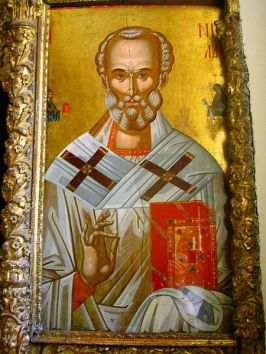
Everyone knows the iconic man, who is merry, jolly and bright, and the joy he brings to children across the world. There is a story about St. Nicholas, aka Santa Claus, that beautifully demonstrates this kind of love.

Nicholas lived in the 300s (fun fact: he attended the Council of Nicea in 325 C.E. which is when the Church formalized our understanding of Jesus’ relationship with the God the Father and officially formulated the first part of the Nicene Creed – the statement of faith we still say to this day at Mass). In those days, a father had to produce a dowry, money or some other possession of value, that would go with his daughter when she married. No dowry = little chance of a husband. The father in our story was poor and had 3 daughters. Nicholas heard of this situation and had the means to fix it. On three separate nights, he tossed a bag of gold coins (some legends say a ball of gold) into an open window, allowing the girls to have enough money for a respectable marriage.

Saint_Nicholas_icon,_Holy_Trinity_Church,_Halki_seminary
Photo of St. Nicholas byzantine icon from the Chapel of the Holy Trinity at Theological SChool of Chalki, Heybeliada Turkey. By Lapost (2015). Via Wikimedia (2005), CC.

Nicholas had two options. He could have called the father to his home and graciously bestowed the money. He could have made a public spectacle of the event, showing off to everyone what a kind and generous person he is. But, Nicholas heard well the admonishment of Jesus:


“[But] take care not to perform righteous deeds in order that people may see them; otherwise, you will have no recompense from your heavenly Father. – Matthew 6:1

Is it easier to do acts of love when others are watching? How can I more freely act in love without looking for praise or recognition in return?