Proper Language

In the past few months I’ve been trying to make an effort to be more present on Twitter and Instagram. It’s been fun, challenging and sometimes tiring, but I think it’s been worth the effort. I’ve found some pretty incredible articles and resources that I would have missed or not known about had I not been using these social media tools.

As with all things, I have also stumbled across some things I wish I hadn’t, or read statements I do not agree with. Once such instance happened this past weekend that got me so riled up, I’m still thinking about it and maybe, if this post goes well, try to formulate my thoughts into an article that I could submit to a publication (hopes and dreams anyway).

I was scrolling through Twitter when I came across this tweet from a pro-life activist:

Lots of would be mothers regret their abortions.I dont know a single mom who regrets having a child
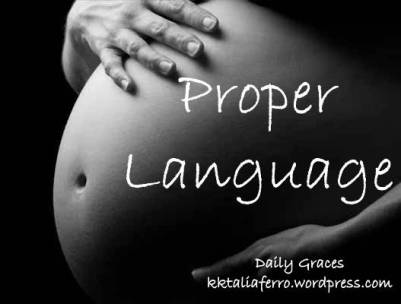
Proper Language, especially in pro-life ministry. Daily Graces. kktaliaferro.wordpress.com
Photo by tipstimes.com/pregnancy. 2008. via Flickr. CC. Modified by Kate Taliaferro 2016

Now, there are a few things that I take issue with in this statement, and I am pro-life. Regarding the 2nd sentence, I am sure that there are mothers out there, unfortunately, who go through periods of time that they regret having children. Maybe they regret a loss of independence or ability to work, maybe they are struggling to feed all the members of their family, maybe they regret the circumstances that lead to that child. While each child is a precious gift from God, we are a broken humanity who do not always recognize God’s gifts when we receive them.

But this is not my main issue. My main issue is the term “would be mothers.” Friends, if we ever, and I mean EVER, hope to bring about a cultural revolution for the culture of life, we have to first remove the log from our own eye before looking to anyone else’s. Consider the term “would be mother.” According to Merriam-Webster, “would-be” is defined as
used to describe someone who hopes to be a particular person or type of person
or
having the potential to be
So, based on this tweet and it’s language, a would be mother is someone who has the potential to be a mother, but isn’t. And you might say, of course. In this context, we are talking about a woman who had an abortion, so she isn’t a mother.
Or is she?
Here’s the kicker folks, by calling these women “would-be mothers” we are denying the fact that they ever were mothers. We are denying the fact that the life in her womb began at conception. Fr. Frank Pavone says it best:

A woman who is pregnant is not “expecting” a child. She already has one. The child exists and is living and growing in her womb. She is not about to bring the child “into the world.” The child is already in the world. The mother’s womb is as much in the world as the mother herself.

The pregnant woman is not “going to be” a mother. She already is a mother. By saying she is “going to be” a mother, we inadvertently reinforce the notion that motherhood begins at birth. This reinforces the idea that the child really is a child only at birth.
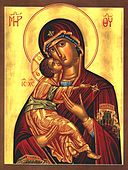
Theotokos. Using Proper Language to describe mothers. Daily Graces. kktaliaferro.wordpress.com
By MapperDB (Own work) [CC BY-SA 4.0], via Wikimedia Commons
So, what we say about the mother directly impacts what we know and believe about her child. The Church has understood this for centuries. The early Church held Mary in high esteem as the Mother of God, the Theotokos. Prior to the Council of Ephesus, 431, this term had been widely used for Mary. However, it wasn’t until the council that she was officially declared the Theotokos, the God-bearer. While this may seem like the emphasis is all on Mary, it is actually another way that the Church was protecting and promoting the belief in who Jesus is, in particular that he is both fully divine and fully human (the Incarnation).

Heresies and questionable teachings abounded in the early centuries of the Church. It was up to the councils to discern the Truth through the guidance of the Holy Spirit. One of the most hotly contested topics, obviously, revolved around Jesus. Was he truly God but only pretending to be human? Was he a super awesome human, maybe even divine-like, but not truly God? Was he a split, 50% God, 50% man, or some other ratio? Who was Jesus???

At the Council of Ephesus, a man named Nestorius began spreading doubt that Mary was truly Theotokos. He claimed she was the mother of Christ, the mother of the human Jesus, but not the mother of God. After all, how could God have a mother? Do you see how quickly things could have unraveled? If the Church had accepted Nestorius’ teaching, they would have been denying the totality of who Jesus was. For Jesus to be both fully human and fully divine, there is no way Mary could give birth to only part of Jesus. It’s all or nothing. If you want to read more, EWTN has a great summary here.

What we say about the mother directly impacts what we say about her child. Before we can ask others to see these precious little ones as fully, completely, in the here and now, children, we have to adjust the way we speak about their mothers.

Do you want to get involved in the pro-life movement? You can contact your parish or local diocese about events, the March for Life, peaceful protests and prayer vigils. You can also volunteer at a local pregnancy crisis center or see if they accept donations. If you are a rosary prayer, you can also add this simple prayer at the end of each decade following the O My Jesus prayer: “Jesus, protect and save the unborn.” Most importantly, you can pray for all those mothers and families who are faced with difficult situations and feel they have no other alternatives.

And Lead Us Not Into Temptation

I wish I could say I haven’t been avoiding you, dear reader. And though yes, we have been busy and yes, Ben has come and gone a number of times on various missions and duties  as his job requires, I have still found time to knit, read some books, crochet a new pair of slippers (almost), bake multiple batches of cookies and watch a number of interesting movies. All of this and not one post. To be completely honest, as you’ll soon be able to tell, I wrote this post nearly 2 weeks ago and am only today getting around to publishing it.

I’ve talked before about how I am capable of minor obsessions or passions. I focus intensely on one or two things, like knitting or decorating cookies, and then after some time it falls to the wayside, to be replaced with a new series of books, making rosaries or creating new crochet patterns. All of these are wonderful things. There is nothing inherently wrong with them.

And yet, if I truly believe that this writing is something I am being called to, which I do (I don’t think I could have stuck with it so long if wasn’t God’s will for me at this time), then these other wonderful, interesting and otherwise diverting are actually temptations away from what God is asking of me.

I would imagine we all experience this at some point in our lives, probably many points in fact. We know what we must do, but suddenly other things seem to be more important, are more exciting or are more appealing. We make excuses, we have reasons, we tell ourselves whatever we need to hear, yet in the depths of our hearts we know we are shirking responsibilities or avoiding the callings of God for our life.

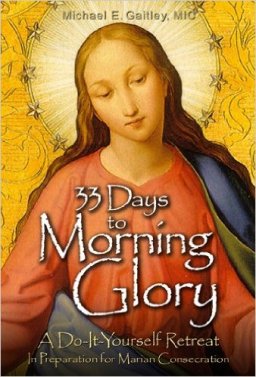
Today (well, 2 weeks ago), on the Visitation of Mary to Elizabeth, I renewed my consecration to Jesus through the heart of Mary. I have spoken of this consecration once or twice I think, but not in any great detail. For the past 33 days I’ve been reading, meditating 33 Days to Morning Glory. Marian Consecration. kktaliaferro.wordpress.com Daily Gracesand preparing to renew my consecration using an extraordinary book, 33 Days to Morning Glory. Fr. Michael Gaitley MIC, has combined the lives and teachings of St. Louis de Montfort, St. Maximilian Kolbe, soon-to-be St. Mother Theresa and Pope St. John Paul II into one complete whole that guides the seeker on a journey to understanding and deeper faith in Jesus with the help of His Blessed Mother.

What is a consecration to Jesus through Mary, or more simply put a consecration to Mary? The easiest way to understand Mary’s role is to explore her mission or “job”. Mary’s job is to form us into Christ. Just as she sheltered, guided and taught the child Jesus, she continues to shelter, guide and teach the faithful today. Mary is a living embodiment of the generosity and overabundance of God. God not only gives us His Son to be our brother, friend and Savior, on the Cross Jesus’ love continues to overflow in the gift of His mother. This moment is especially important for John Paul II, who understood that consecrating oneself to Mary was to join with the apostle John by taking Mary into his home. That’s really what this is all about, inviting Mary into our home, our life, and asking her to school us in the art of sainthood.

And so, as Mary has gradually taken over the tutelage of this unruly student, I have begun to see certain things in new light. Temptation for starters. Temptation is that which encourages us to avert our eyes from God, the sparkle in the corner of our eye that causes us to lose focus and turn our head to a different direction. Mary has been showing me where temptations are in my life. As a result, I’ve been praying that she will begin to give me the strength I need to overcome them and ignore them. Hopefully we all will see the fruit of her labor here in the blog, or in my “Other ideas” folder which seems to be ever expanding.

To be clear, a consecration to Mary in no way obscures, distracts or circumvents a person’s relationship with Jesus, our Savior and Mediator. Mary’s sole purpose is to form us into saints, that is, to help us become every more fully living images of Jesus. She is a gift from the abundant love God has for each one of us. The sacrifice of Jesus for the salvation of the world was enough, His action is complete. Mary is simply one more way that God continues to shower us with His blessing, grace and mercy. That is why we ask Mary to “pray for us sinners, now and at the hour of our death.” We ask her to stand alongside us, to show us the way, as we journey both with and toward her Son.

Advent Reflections – December 24, 2015

What Could the World Be?

And now we have reached the day before the day, Christmas Eve. Today may well contain the most anticipation, require the most patience, and obtain the least notice. Today takes the longest and goes the quickest. Our anticipation for Christmas can fully consume us as we prepare feasts, clean our homes, greet guests and wrap presents. So, before you launch into your final Christmastide preparations or choose your Christmas Eve party outfit, I hope that you find a few moments to take stock of your Advent experience. Have you prepared your heart and your home for the Christ-child?

If you have been following these Advent reflections, you know that I have tried to present a number of qualities or characteristics that I believe could be beneficial for all persons. Using Mary, the Mother of God, as well as our growing understanding of the Motherhood of Jesus, as the starting point, we all spent time reflecting on these valuable characteristics.

So the final question really is simple.

How could your life change if you choose to highlight these characteristics, to cultivate them, to make them your own, so that they came to you as easily and simply as breathing? 

To truly live these characteristics – openness to life, forgiveness, self-sacrifice, unconditional love and unity – requires dedication, devotion and perseverance. As we saw yesterday, each one draws on elements of the other. It is impossible to love unconditionally but withhold forgiveness. There can be no unity without a special, undiscriminating openness to life. This is really a package deal. How radically could our world change if these were the guiding principles of our daily life, of our political endeavors, of our financial decisions, of our social interactions?

The life that Mary inspires is the life that Jesus desires. Above all things, Mary’s purpose is to bring us to her Son. When you go to Mass tonight or tomorrow, pay special attention to the figure of Mary in the nativity scene. I think I can safely promise you that when your eyes discover her place in the stable, you will immediately follow her gaze to her child, the newborn Savior of the world.

If we choose to follow Mary, to adopt those things she holds dear as our own, we will find we can look no other place than into the eyes of Christ.

602px-Gerard_van_Honthorst_001.jpg
“Gerard van Honthorst 001” by Gerard van Honthorst – The Yorck Project: 10.00 Meisterwerke der Malerei. DVD-ROM, 2002. ISBN 3936122202. Discributed by DIRECTMEDIA Publishing GmbH. Licensed under Public Domain via Commons