Book Review: My Badass Book of Saints: Courageous Women Who Showed Me How To Live

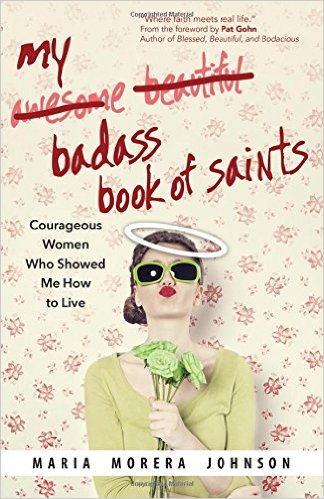
My Badass Book of Saints #dailygraces #bookreview kktaliaferro.wordpress.comWith such a title, who wouldn’t want to pick up this book?! I have to say, it certainly grabbed my attention. Even the cover is great. Maria Morera Johnson, author of My Badass Book of Saints: Courageous Women Who Showed Me How to Live, is a college professor, blogger and radio host who has selected a beautiful and badass group of women that are sure to inspire you. Not only has she chosen named saints (that is, saints with a capital St.) but she has also chosen bold, courageous and devoted women from a variety of backgrounds. For Johnson, to be truly badass you are, in her native Spanish, tremendaTremenda means “tremendous, sometimes. It also means terrific, and terrible. It translates to bold. Daring. Fearless. Stalwars. Smart. Courageous…But mostly, it means badass” (xvi).

Johnson weaves the lives of these badass women with her own story, a first generation Cuban-American, military wife and mother. The women, 24 in total, each represent characteristics that Johnson considers “badass.” They are audacious, courageous, missionaries, advocates, selfless, passionate, compassionate, and virtuous, to name just a few. At the end of each chapter, Johnson offers reflection questions on the highlighted quality and how we as people of faith can integrate the lessons from these women into our life.

Some of the saints and women I knew about already. Consider how St. Joan of Arc would be a model of courage, St. Catherine of Siena a model of advocacy or St. Gianna Beretta Molla a model of human dignity. I also knew about Audrey Hepburn and her work with the UN and Immaculee Ilibagiza and how she not only survived but found forgiveness in the Rwandan Genocide of 1994.

I was blown away by the women I had never heard of. Did you know that Sr. Blandina Segale stood up to Billy the Kid not once but 3 times!? Or how about Nancy Wake, an Australian socialite turned super secret spy for the French Resistance and was so good at it the Nazi’s never figured out who she was?! Or Phyllis Bowman who founded the Right to Life movement in 1998, but started her work on behalf of the unborn in the mid-1960s by forming the Society for the Protection of Unborn Children in the United Kingdom?

The women in this book are incredible. They are more than beautiful, they are more than strong, they are more than awesome. They really are badass.

Saint Mommy

Saint Mommy by Kate Taliaferro. Daily Graces kktaliaferro.worddpress.com
St John the Divine Rose Window by 2a by Tony Hisgett (2010) via Flickr, CC. Modified by Kate Taliaferro

My husband has a complicated last name. When you look at the spelling, you would think it is fairly obviously pronounced just as you would sound it out. Whenever someone does this, I usually smile and say “Sure, that’s how it goes.” It’s much easier to move on than to stop our conversation and say “Well actually, it’s pronounced absolutely nothing like it is spelled, sorry for messing up every English lesson you had growing up for a moment.” Because of this, we made the decision early on that we would give our children first names that were classic and simple to pronounce. They are going to always struggle with the last name, at least their first people will be able to get on the first try. We also have intentionally named them after saints so that no matter what, they would have a solid role model attached to them in their name.

John (age 4) is becoming more aware of the saints as holy men and women who are now in heaven with God. Not only are they with God, they can help us by praying for us and reminding us to have good behavior and morals. We have already encouraged our children to pray to their name-saint, asking for help in whatever area of the day they struggled with .

When Ben left for his last deployment, John was pretty upset Ben’s last night home. We decided while praying together that we should choose a family saint – a saint that could watch over our family while Daddy was gone and we all could pray to during our nightly prayers, no matter where in the world we are. John liked that and of course, asked if our family saint could be St. John. The next day, he figured we should add St. Rose and St. Clare too for Rosie and Clare.

This evening at dinner, Rosie (age 3) was trying to figure out the whole saint thing since we’ve been talking about it so much. “Mommy, St. John helps John make good choices and helps take care of him right?” “Yes Rosie, St. John can do that.”

“And St. Rose can help me?”

“Yes”

“And St. Clare can help Clare? Well, Clare is a baby, but St. Clare can help her someday?”

“Yes Rosie, St. Clare can help Clare.”

“And Mommy, St. Mommy will help you too! And St. Daddy will help him too! And St. Uncle Steve will help Uncle Steve!”

Oh my sweet Rosie. What a beautiful thing she came up with. While we might be a little confused about the whole name = saint thing, she is laying a beautiful foundation of understanding for the communion of saints.

Even if your given name isn’t a canonized saint, you can still adopt one (or many) as your own patrons. Patron saints are saints that you feel close to, that inspire you or challenge you. Though my name is Kathryn and there are a number of St. Catherine saints, presently I feel closest to St. Therese of Lisieux, St. Frances of Rome, and a Carmelite monk from the 1600s, Br. Lawrence.

When you ask a friend to pray for you, the saints operate in the same manner. They are dear friends who happen to be situated that much closer to God – we believe they are in heaven after all.

Advent Reflections – December 10, 2015

Able to Love without Requiring Love in Return: In Church Tradition

Very simply, love is choosing to put another’s needs before our own. The First Letter of John says,

If someone who has worldly means sees a brother in need and refuses him compassion, how can the love of God remain in him? – 1 John 3:17

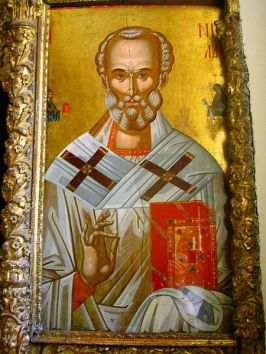
Everyone knows the iconic man, who is merry, jolly and bright, and the joy he brings to children across the world. There is a story about St. Nicholas, aka Santa Claus, that beautifully demonstrates this kind of love.

Nicholas lived in the 300s (fun fact: he attended the Council of Nicea in 325 C.E. which is when the Church formalized our understanding of Jesus’ relationship with the God the Father and officially formulated the first part of the Nicene Creed – the statement of faith we still say to this day at Mass). In those days, a father had to produce a dowry, money or some other possession of value, that would go with his daughter when she married. No dowry = little chance of a husband. The father in our story was poor and had 3 daughters. Nicholas heard of this situation and had the means to fix it. On three separate nights, he tossed a bag of gold coins (some legends say a ball of gold) into an open window, allowing the girls to have enough money for a respectable marriage.

Saint_Nicholas_icon,_Holy_Trinity_Church,_Halki_seminary
Photo of St. Nicholas byzantine icon from the Chapel of the Holy Trinity at Theological SChool of Chalki, Heybeliada Turkey. By Lapost (2015). Via Wikimedia (2005), CC.

Nicholas had two options. He could have called the father to his home and graciously bestowed the money. He could have made a public spectacle of the event, showing off to everyone what a kind and generous person he is. But, Nicholas heard well the admonishment of Jesus:


“[But] take care not to perform righteous deeds in order that people may see them; otherwise, you will have no recompense from your heavenly Father. – Matthew 6:1

Is it easier to do acts of love when others are watching? How can I more freely act in love without looking for praise or recognition in return?