Kate Taliaferro is an Air Force wife, mom of 5 under 9. She enjoys homeschooling, crafting, and reading books one sentence at a time. She has a Masters in Religious Education and tries to find God's presence in all parts of her day, be it cooking, cleaning or just the everyday ordinary. Follow her blog, (link: dailygraces.net) Daily Graces to join her crazy, adventurous, God-filled family.
When I volunteered to read and review Heather King’s Loaded: Money and the Spirituality of Enough, I did not quite know what the book would be about. Money, obviously. And perhaps something about a Catholic approach to living simply, the beatitudes, or Jesus’ teachings on not worrying about shoring up material possessions.
And yes, all these things were mentioned in the book. However, King’s work is about so much more than that. It is about our relationship with money and how, for many people, that relationship can be somewhat to severely unhealthy and even debilitating. King explores her own rocky relationship with money throughout the book, sharing stories from her life as well as those of others, and experiences of severe underearning, unrealistic expectations and an unhealthy fixation with income. At the start of the book, she describes herself and her situation this way:
My bottom came in the acknowledgement that the way I lived invited me to be “brave” in some ways that were foolhardy, and in other ways not to be brave at all. My primary goal had become not to give all of my gifts but rather to conserve all of my money” (23).
King walks through her steps to recovery in a straightforward, sit-you-down-and-stare-you-in-the-eyes kind of way. You can feel her talking to you, even if you don’t share her same exact struggles. At the end of each section she offers actions and tools to help you work through that portion of the book and the recovery process.
My biggest takeaway by far doesn’t necessarily have to do with money, though that is one of the overarching themes. Rather, I was moved by King’s honesty regarding how we can hoard our gifts the same way we can hoard money, sweaters or collectables. We all have been put in this world with something(s) to give. King observes: “I might not have owed anyone a penny. But I was taking more out of the world than I was putting in. That’s a form of debt: not only to others, but to ourselves” (27).
Loaded is about far more than money, though many lessons can and should be gleaned from it regarding a healthy relationship with both earning and spending money. Loaded is a passionate text which implores the reader to look deeply into their life to discover their inherent self-worth, their capacity for generosity and their God-given dignity as a human person.
Happy 4th of July! It is fitting that the Gospel and homily I heard yesterday coincides with this independence day holiday.
For those that need a refresher, yesterday’s Gospel reading was from the Gospel of Luke. Jesus was preparing 72 disciples to go out on mission ahead of him, telling of the Good News that Jesus had to share. He gives them specific instructions about what to bring, or rather, all the things they were to leave behind. They were not to bring money or baggage. They weren’t even permitted shoes! Why do you think Jesus was so explicit about the fact that these travelers were not permitted to bring anything other people would find necessary for travel?
Our priest had an interesting take on that question. Usually when I hear this reading I hear all the things the disciples had to do without. It is a lesson in simplicity, in solidarity with the poor and a call to let go of my clutch on material possessions. This is absolutely a fine message to interpret from this Gospel. Our priest, however, went another direction.
He asked us to think about what we had to give. We were each put on earth with something to give. Consider the disciples. They were not allowed to take things that would have possibly made their journey more comfortable – money for an inn, shoes to make traveling easier, extra clothes in the event that extra clothes would be desired or necessary. But he didn’t send them empty handed. They had their message, the courage of their conviction and their passion for their faith.
What they had seen and heard was convincing enough they felt compelled to share it with others. If they weren’t absolutely convinced in the person and message of Jesus, why would they travel with no money, feeling no anxiety about where they were going to sleep? Why would they travel with no shoes, harboring no worry about the length of the journey? Why would they bring no extra garments, not knowing what kind of weather or road conditions they would encounter?
The disciples trusted that what they had to give would be enough to take care of them. How many of us can say we feel the same? Do we give first and then graciously accept what is given to us? Or do we wait until we have received enough, only then to share what we consider extra? Another way of thinking about it is to consider whether Sunday is at the beginning or the end of your financial week. Do you give to God first (making Sunday the first day of the week), or do you wait to see what is left (making Sunday the last day of your week).
By Jnn13 (Own work) [CC BY-SA 3.0], via Wikimedia Commons. Text added by Kate Taliaferro 2016It is my opinion that the founding fathers were looking first to give and then to receive. They wanted to give our people a freedom they had not known. They wanted to give citizens basic rights and privileges. They hoped to give the generations to come a country and government that had the people’s best interests at heart. They had a vision where citizens came together, giving to one another, so that in each other’s giving we all could reap a bountiful harvest of freedom, protection, representation and basic rights.
On this July 4, 2016, I hope that you are able to find a few quiet moments to thank those who have answered this call to give before receiving. May our country continue to flourish, holding true to the vision that brought it into being.
“In every way I have shown you that by hard work of that sort we must help the weak, and keep in mind the words of the Lord Jesus who himself said, ‘It is more blessed to give than to receive.’” – Acts 20:35
In the past few months I’ve been trying to make an effort to be more present on Twitter and Instagram. It’s been fun, challenging and sometimes tiring, but I think it’s been worth the effort. I’ve found some pretty incredible articles and resources that I would have missed or not known about had I not been using these social media tools.
As with all things, I have also stumbled across some things I wish I hadn’t, or read statements I do not agree with. Once such instance happened this past weekend that got me so riled up, I’m still thinking about it and maybe, if this post goes well, try to formulate my thoughts into an article that I could submit to a publication (hopes and dreams anyway).
I was scrolling through Twitter when I came across this tweet from a pro-life activist:
Lots of would be mothers regret their abortions.I dont know a single mom who regrets having a child
Photo by tipstimes.com/pregnancy. 2008. via Flickr. CC. Modified by Kate Taliaferro 2016
Now, there are a few things that I take issue with in this statement, and I am pro-life. Regarding the 2nd sentence, I am sure that there are mothers out there, unfortunately, who go through periods of time that they regret having children. Maybe they regret a loss of independence or ability to work, maybe they are struggling to feed all the members of their family, maybe they regret the circumstances that lead to that child. While each child is a precious gift from God, we are a broken humanity who do not always recognize God’s gifts when we receive them.
But this is not my main issue. My main issue is the term “would be mothers.” Friends, if we ever, and I mean EVER, hope to bring about a cultural revolution for the culture of life, we have to first remove the log from our own eye before looking to anyone else’s. Consider the term “would be mother.” According to Merriam-Webster, “would-be” is defined as
used to describe someone who hopes to be a particular person or type of person
or
having the potential to be
So, based on this tweet and it’s language, a would be mother is someone who has the potential to be a mother, but isn’t. And you might say, of course. In this context, we are talking about a woman who had an abortion, so she isn’t a mother.
Or is she?
Here’s the kicker folks, by calling these women “would-be mothers” we are denying the fact that they ever were mothers. We are denying the fact that the life in her womb began at conception. Fr. Frank Pavone says it best:
A woman who is pregnant is not “expecting” a child. She already has one. The child exists and is living and growing in her womb. She is not about to bring the child “into the world.” The child is already in the world. The mother’s womb is as much in the world as the mother herself.
The pregnant woman is not “going to be” a mother. She already is a mother. By saying she is “going to be” a mother, we inadvertently reinforce the notion that motherhood begins at birth. This reinforces the idea that the child really is a child only at birth.
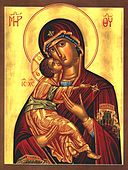
By MapperDB (Own work) [CC BY-SA 4.0], via Wikimedia CommonsSo, what we say about the mother directly impacts what we know and believe about her child. The Church has understood this for centuries. The early Church held Mary in high esteem as the Mother of God, the Theotokos. Prior to the Council of Ephesus, 431, this term had been widely used for Mary. However, it wasn’t until the council that she was officially declared the Theotokos, the God-bearer. While this may seem like the emphasis is all on Mary, it is actually another way that the Church was protecting and promoting the belief in who Jesus is, in particular that he is both fully divine and fully human (the Incarnation).
Heresies and questionable teachings abounded in the early centuries of the Church. It was up to the councils to discern the Truth through the guidance of the Holy Spirit. One of the most hotly contested topics, obviously, revolved around Jesus. Was he truly God but only pretending to be human? Was he a super awesome human, maybe even divine-like, but not truly God? Was he a split, 50% God, 50% man, or some other ratio? Who was Jesus???
At the Council of Ephesus, a man named Nestorius began spreading doubt that Mary was truly Theotokos. He claimed she was the mother of Christ, the mother of the human Jesus, but not the mother of God. After all, how could God have a mother? Do you see how quickly things could have unraveled? If the Church had accepted Nestorius’ teaching, they would have been denying the totality of who Jesus was. For Jesus to be both fully human and fully divine, there is no way Mary could give birth to only part of Jesus. It’s all or nothing. If you want to read more, EWTN has a great summary here.
What we say about the mother directly impacts what we say about her child. Before we can ask others to see these precious little ones as fully, completely, in the here and now, children, we have to adjust the way we speak about their mothers.
Do you want to get involved in the pro-life movement? You can contact your parish or local diocese about events, the March for Life, peaceful protests and prayer vigils. You can also volunteer at a local pregnancy crisis center or see if they accept donations. If you are a rosary prayer, you can also add this simple prayer at the end of each decade following the O My Jesus prayer: “Jesus, protect and save the unborn.” Most importantly, you can pray for all those mothers and families who are faced with difficult situations and feel they have no other alternatives.

 And yes, all these things were mentioned in the book. However, King’s work is about so much more than that. It is about our relationship with money and how, for many people, that relationship can be somewhat to severely unhealthy and even debilitating. King explores her own rocky relationship with money throughout the book, sharing stories from her life as well as those of others, and experiences of severe underearning, unrealistic expectations and an unhealthy fixation with income. At the start of the book, she describes herself and her situation this way:





 Daily Graces