The Empire vs. The Cross

With the upcoming release of Season 2 of Disney’s Star Wars series Andor, Ben and I have been rewatching Season 1. We both enjoy this gritty story and the way the characters develop throughout the episodes. This time through, we have been commenting on some particular phrases that the Empire uses as it begins to take further control of the galaxy. The security folks (I’m not going to get super technical here), talk about “tightening their grip” and extending the reach of imperial control. Contract security is out, storm troopers are in. As we watched this unfold, we looked at each other and said Leia’s line from Episode 4: A New Hope, “the more you tighten your grip, the more star systems will slip through your fingers.” Here, in Andor, we were watching the beginnings of the tightening, which is the same moment that the rebellion is really starting to come together. The further the Empire stretches itself, the more cracks form for the rebels to slip in and out of.

The Empire’s purpose in all of this is control. They want things ordered they way they want them with no surprises, incidents, or creative thought. When watching Star Wars, I would think that most of us are inclined to side with the rebels. Stand up to the power, resist!

And yet, as I was reading through my most recent copy of Evangelization & Culture (Issue No. 22 on Courage), I found myself coming to realize that deep down, I’m much more like the Empire than I would want to admit.

At its most basic, primal level, the Empire (in my estimation) is operating from a place of fear. The fear of the unknown, of individual thought, of being replaced, of losing what it had gained. The fear of loss of control is a critical motivating force that causes the grip tightening seen in the Andor series. In his article “Spiritual Direction for the Fearful,” Fr. Billy Swan’s counsel reminded me of the Empire and how it’s actions are exactly what not to do in our own lives:

For us, the fear of losing our lives might not be active every waking hour, but the fear of losing something is always lurking – material things, power, honor, status, our mob, our health, our loved ones, our independence, our freedoms. How do we respond to this fear of loss? One option is to double down on our efforts to protect what we have, whether it be our freedoms, our assets, or even our very lives. Yet we know deep down, sooner or later, that we will have to let go of everything and surrender to the mystery of love that is infinitely greater than our fears.

What am I holding on to too tightly? Where am I seeking to be in control, instead of allowing God to direct my life? What am I afraid to lose?

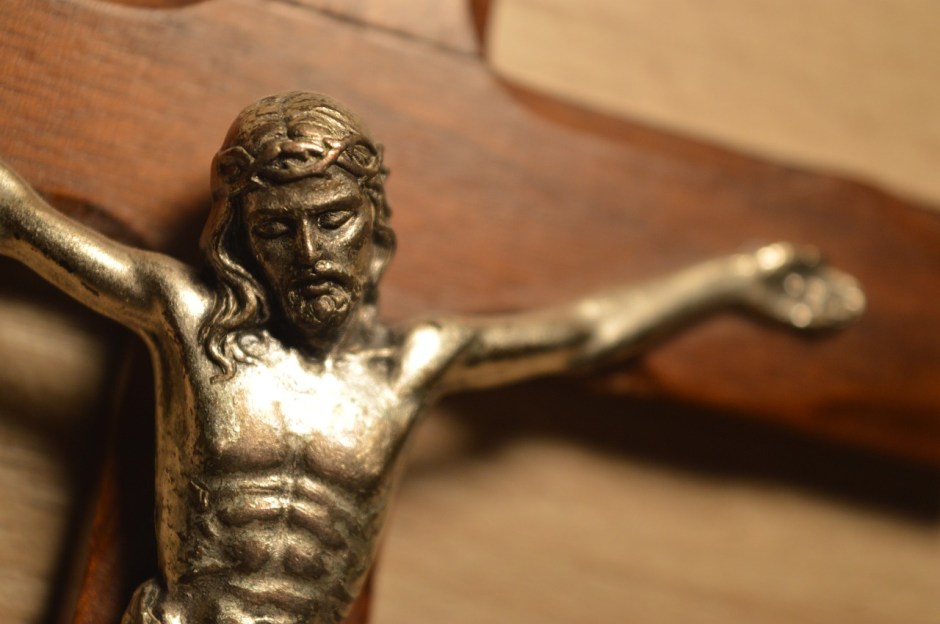
Today is Good Friday, the day of the complete loss of control. Not in the sense of acting rashly or wildly, like a young child who cannot contain her emotions. No, today is the day where we see what perfect surrender looks like. It is the day where hands are stretched wide, holding nothing and at the same time, holding everything at once. Jesus hangs on the cross in what appears to be a complete loss of control. He was taken, beaten, stripped of everything he had, even his connection with the Father. In these moments, Jesus completely empties himself of everything he is. Where Adam and Eve grasped, tightening their grip on the forbidden fruit to gain something they did not need, Jesus releases his hold on everything, to gain everything we desperately require.

Nothing, not one thing. No one, not one person, slips through Jesus’ fingers.

We have a choice today. Will we join Christ, opening our own hands wide to accept all God has to offer us? Or will we side with the Empire, tightening our grip on the things we think we need, only to watch them slip away one day at a time, never realizing that all we had to do was let go. In a magnificent reversal, to find what we truly need, we have to be ready to lose everything.

Daily Graces. kktaliaferro.wordpress.com

Plans for Lent + Hallow Review

As is typical for this time of year, it’s good to share about what some of my plans are for Lent. Not only will this help keep me accountable to them, but I have found a good many ideas for how to observe the season by hearing how others plan to pray, fast, and give alms.

Screens

I’m on the fence about this first one, which probably means it would be a good idea to give it a shot. In a Focolare women’s group meeting last month, we were talking about communication and especially social media use. A few ideas were shared about how to make our phones less attractive and it was a really interesting conversation. Our phones are brightly colored and everything about them is designed to make them appealing. The apps we engage with utilize all kinds of methods that foster addictive behaviors, consistently and constantly drawing us back to their content. While I know giving up social media or a specific app is a popular Lenten observance, there were a few other ideas shared that I’m considering.

  • Turn your phone to black and white mode. Our brains are wired to be attracted to bright colors. I know for me, I don’t even read the names under the app icons, I’m looking for the picture or color associated with the app. So, if we turn off the colors, we will have to be more intentional in order to even find what we are looking for. Then, once we are in the app, it’s actually rather dull. The same exact content we looked at the day before is less catchy, less interesting, less “scroll worthy.”
  • Turn off all (or nearly all) notifications. Do I really need to know when someone posts on Instagram? What about the little red numbers that show something is waiting for me on Facebook?
  • Removing the social media apps. This doesn’t mean necessarily taking a break from them, just making it harder to get to because of the extra steps required to get there. So, I would only access them through a web browser. Or, even further, I only access them on my computer, not on my phone.

Hallow

I am very excited for this one. I am going to be participating in the Pray40 challenge for adults on the Hallow app. I have not been disappointed by this program yet so I am confident this year will be another good one. In the past, I have tried to listen in the mornings when I’m getting ready for the day. The challenge this year will be timing, because I am already listening (also on Hallow) to a daily Gospel reflection that is usually about 10 minutes. Perfect for my typical morning routine. In past years, I’ve replaced this Gospel reflection time with the Pray40 content. However, I would very much like to continue with the Gospel reflections in addition to the Pray40 experience. So, it’s going to take some trial and error to see when will be the best time to listen consistently.

In addition to the Pray40 challenge, Hallow is going to be offering a kids’ Lenten content journey. They are calling it “The Little Way” and I’m very excited about it. Hallow actually reached out to me and asked if I would offer a review of the content which got me even more excited for it.

This series is going to be more than a series of prayers. The kids will be journeying along with Paul and Mia Buckley, two kids who are on a trip through France. We are going to get to experience their story while also meeting some pretty fabulous saints, hearing vocation stories, Sunday homilies, even a few family games. Of course, there are also going to be opportunities for prayer and reflection throughout the 40 days of Lent. 

The Saints Alive podcast, the creators of The Little Way, provide truly immersive and thoughtful podcast episodes exploring the lives of the saints. Complete with a multitude of voices, sound effects, surprises, and applications for little lives, our family enjoys these episodes so much. I was very excited to hear that they were behind this new initiative of Hallow’s. 

Disclaimer: It is important to remember that this experience, as well as Hallow’s Pray40 Lenten reflections for adults, are part of their premium content and are not available on the free version of the app.

The Plan

I know, you’re probably wondering where on earth we are going to find time to add this to our schedule. However, I have a plan. I recently saw on Corda Candle’s website a package of Lent-focused candles which I was delighted to find (Corda did not request this review or mention, I just love their candles and these are going to fit so well with my Lenten plans). I don’t know about your kids, but mine find candles fascinating. It draws everyone in, even for a few minutes, and can really help focus a few minutes of quiet. As an added bonus, these candles are beautifully scented. We had one that we used for our prayer time over the Christmas season and not a day went by that we forgot because everyone loved the smell and looked forward to lighting it. I am hoping for a repeat experience.

My plan is to light one of the candles in the middle of the table, and then we will listen to our episode during lunchtime. My kids usually read during lunch because they can’t seem to survive without a book in front of them. With this plan, we are going to offer the sacrifice of a few minutes of free reading time to listen together. 

Fasting

The past few years now I’ve chosen to do a full fast on all of the Fridays during Lent, not only on Ash Wednesday and Good Friday. I’m thinking I’ll do this again, though I’m praying about my motivation for doing it. It isn’t easy to be sure, but it is familiar. Am I choosing this fast because of its familiarity, like someone who habitually gives up chocolate because it’s just what they do without much thought put into why, or because I’m avoiding considering alternatives God could be calling me to? I have some time yet to discover the answer.

These are some of my ideas for Lent this year. What will you be doing? I hope that you discover the practices God is calling you to work with this Lent that will draw you closer to His merciful love.

Daily Graces. kktaliaferro.wordpress.com

Circumstances

No one lives with perfect circumstances. Things might be going really well, but there is always something in your life that could be fixed up. Even in the lives of Mary, Joseph, and Jesus – two of whom were perfect people in that they were without sin – even they lived in imperfect circumstances. We don’t get to pick our circumstances but we do choose how we respond to them. The Christmas season highlights a few different biblical characters and the way they chose to respond to unusual, perhaps even seemingly imperfect, circumstances.

Zachariah, the father of John the Baptist, responded with fear and doubt when told about his coming son by the angel. He relied on his own understanding and was not open to the possibilities the Holy Spirit could create. Mary, on the other hand, received a message from an angel about a baby as well. But in her case, she remained open to the action of the Holy Spirit, being willing to cooperate with God’s plans even though she did not understand them. She was filled with the Holy Spirit and even before Jesus was born we are able to hear how both Mary and Elizabeth (John the Baptist’s mother) speak inspired words to one another. Both Mary’s fiat, her “yes” to God, and her Magnificat spring from her faith and trust in God’s love.

The Holy Spirit still speaks to us today if we are attentive. Sometimes in the words of others, sometimes in the words that come out of our own mouth. Sometimes, even in our imperfect circumstances.

This fall, my mom was diagnosed with a glioblastoma tumor in her brain. This is an aggressive type of tumor and it was less than 48 hours between diagnosis and brain surgery to remove as much as possible. Our whole world was completely turned upside down. Thankfully, the surgery was as successful as the doctors could hope for. There is still a long road to go, and we don’t know the twists and turns that will come.

Before my mom was diagnosed, she had some speech and word finding issues. After surgery, the doctors said she could have a hard time with speech due to the location of the tumor. We have some funny stories of those early days and the word switches, misses, and adaptations my mom came up with as her healing began. Every so often, she still slips. However, there is one particular slip that I believe is Holy Spirit inspired.

While the chemo my mom was prescribed are daily oral pills she can take at home, radiation had to happen at a cancer center. Every weekday for 6 weeks she went to the center for treatment. After a few visits and settling into a routine, she began calling “radiation” “adoration.” Obviously, these two things are definitely different. And yet, as we talked about it, I can’t help but feel there is some kind of Holy Spirit inspiration between the switch.

What happens in radiation? For a few minutes (really, less than 10, it’s rather remarkable), the person has to lie in perfect stillness while the mechanisms and machinery delivers the radiation treatment to a specific and carefully aligned area of the body. There isn’t anything my mom can do to make this process more effective or efficient except to be faithful to the treatment process. If she didn’t go every day, the effectiveness would greatly diminish. If she wasn’t compliant to the doctor’s recommendations for staying active even when she was exhausted, to try her best to eat as well as she could even when all she wanted was saltines, her body wouldn’t be as strong as it could be to continue fighting this invisible enemy.

What is adoration? Adoration is coming to adore Christ. It is taking time out of our day to place Jesus at the center of our life. Typically, people are pretty still during adoration, with sitting or kneeling being the predominant postures. Adoration is an opportunity to open ourselves up to Jesus’ action in our lives, to let him highlight the areas of our life in need of his mercy, his healing, and his love. In Adoration we can receive inspiration for how to live our lives, what actions should we do or avoid that will help us more fully follow God’s Will. We faithfully show up to adoration, but it’s God’s action that is on display.

From this light, there is a lot in common between radiation and adoration. If you are willing, I’d like to invite you to pray for my mom, Mary Kay, and for her healing. I’d also invite you to pray for my dad, Steve, as he walks this journey with her. My parents have both asked for prayers specifically through Chiara Lubich’s intercession. Long-time readers will hopefully recognize Chiara as the founder of the Focolare Movement that our family is a part of. Below is the prayer of intercession that is officially recognized by the Church. Chiara is a named Servant of God but cannot move forward in the canonization process without miracles associated with her intercession. God willing, my mom can be one of those miracles.


Eternal Father, source of Love, and of every light and goodness, we give You thanks for the charism of unity given to Chiara and for the remarkable witness to the Church and humanity that she gave of this charism, remaining faithful to Jesus Forsaken.

Grant us, O Father, through the action of the Holy Spirit and the Word lived in the present moment, and in following Chiara’s example, the grace to contribute together with all people of good will to the fulfilment of Your Son’s will: “That they may all be one!”

Humbly we ask You to grant us, Your children, to live in mutual love and in love of all so as to rejoice in the presence of the Risen One while, in communion with Chiara and through her intercession, we ask You, if it be Your will, the grace for the complete healing of Mary Kay Jennrich from brain cancer, through Jesus and for the glory of the Most Holy Trinity.

Amen

If you’d like to learn more about Chiara and the movement, I have three resources for you. First is the film Love Conquers All that can be viewed on Formed.org. Many parishes subscribe to this streaming database. Check with your local parish if you are unsure if you have free access or not. The second is the primary website of the Focolare Movement. Third is the main media resource for the Focolare which has videos, articles, and other resources you may be interested in.

Daily Graces. kktaliaferro.wordpress.com