The Heart Sees – Nineteenth Sunday in Ordinary Time 2023

While this week’s YouTube video focuses on the Gospel, as usual, I can’t pass up an opportunity to talk about the story of Elijah in 1 Kings. This is one of my favorite Old Testament stories. It is quite the epic situation. Elijah is on the run for his life. He has wandered through the wilderness and come close to death. He has been sustained by angels and miraculous food appearing before him. Finally, he has found shelter in a cave on Mount Horeb, the mountain of the Lord.

This mountain is not insignificant. You might know it by another name, Mount Sinai. This is the same mountain where Moses received the Ten Commandments. This is the place of covenant, a place where God came to meet His people. Elijah has had to flee here, not from outsiders, but from his own people. Elijah tells God that, “the Israelites have forsaken your covenant. They have destroyed your altars and murdered your prophets by the sword. I alone remain, and they seek to take my life” (1 Kings 19:10).

Frightened and fearful, Elijah gives his report to God. What would God say? What do you think went through Elijah’s mind when God called him to stand outside the cave, utterly exposed, so God could pass by?

And then we behold both God’s power and His restraint. There is a wind that whips through the mountains, strong enough to crush rocks. An earthquake shakes the world, fire scorches past. Power, yes, such power over all the elements. How small Elijah must have felt. Yet, also perceptive. While these wonders were indeed displays of God’s power, He Himself was not in them.

In a way, and this is my own interpretation, God was giving Elijah one final test. You see, Elijah could have been righteously angry at the Israelites. He could have desired their punishment or at least reprimand for the way they were neglecting their faith. He could have sought revenge for his fellow prophets who had been killed. He could have sought retribution for the pains he himself had suffered. Any of those first displays of power could have swayed Elijah – yes, here is my mighty God who will bring vengeance and judgment down upon the people! But it would have been false, because God was not truly there.

The disposition of our heart affects how we perceive the world. Elijah’s heart was not full of anger, revenge, or despair. Through it all, he had remained faithful to God’s friendship and obedient to God’s will. This is why it is only in the smallest breeze, a still, small wind, that he hid his face in his cloak and went out to meet his God.

So often, we chase after what we believe will make us happy only to be disappointed. The disposition of our hearts can lead us in all manner of directions. The Bible talks quite a bit about our heart. One of the recurring themes in the season of Lent is the notion of allowing God to soften our heart, to give us a new heart. This new heart is one that is soft and clean, rather than hard and stoney.

A clean heart create for me, God;
renew within me a steadfast spirit.

Psalm 51:12

I am aware it isn’t Lent, but the message is timeless. God is always in what’s best for us, and what’s best for us is always God. This doesn’t necessarily mean a life of solitude and a diet of brown bread and water. And thank God! A person with a clean heart, a soft heart, is one that God can shape and form into who he or she God intended them to be. Another word for this is holiness. Holiness is a universal call – each one of you reading this, as well as the person sitting next to you, as well as your neighbor down the street, even that person who cut you off on the highway – all of us are called to holiness.

Pope Francis’ excellent exhortation, Gaudete et exultate, is all about the universal call to holiness. Check this quote out:

The important thing is that each believer discern his or her own path, that they bring out the very best of themselves, the most personal gifts that God has placed in their hearts (cf. 1 Cor 12:7), rather than hopelessly trying to imitate something not meant for them. We are all called to be witnesses, but there are many actual ways of bearing witness. Indeed, when the great mystic, Saint John of the Cross, wrote his Spiritual Canticle, he preferred to avoid hard and fast rules for all. He explained that his verses were composed so that everyone could benefit from them “in his or her own way”. For God’s life is communicated “to some in one way and to others in another”.

Gaudete et exsultate, 11.

So good, right? Ok, I know this has been a longer post so I’ll leave it here. I would encourage you to read over that quote again though and think about what gifts God has specially and specifically given to your heart. How are you using them? This really is a beautiful exhortation, though I wouldn’t read it all in one sitting. Take it a paragraph at a time. It’s really worth it.

Daily Graces. kktaliaferro.wordpress.com

Feast of the Transfiguration of the Lord

I’m late in getting this out to you this week. We started our homeschool back up and while things are more or less going smoothly now, it was a bit bumpy earlier in the week. Top it off with a minor ant invasion (all taken care of now, thank goodness) plus the transition that always happens when grandparents go home (we miss you Grandma!) and you have a pretty good recipe for a crazy week. But, I was gifted a small amount of relative quiet this morning and was able to record.

I don’t, however, have an extended reflection for you here. I do, however, have a bonus video to share from earlier this Lent. If you are new and didn’t see it, this works great with spending time with the Transfiguration from a few angles. If you have seen it already, well, I hope you can still get something new from it since it has been about 6 months since you last watched.

Thanks for your patience and understanding with me this week. I am hoping to be back on track next week.

This is for this week about the three apostles Jesus calls up the mountain as well as those He didn’t.
This is the vide from Lent. It is about Peter’s reaction to the Transfiguration.
Daily Graces. kktaliaferro.wordpress.com

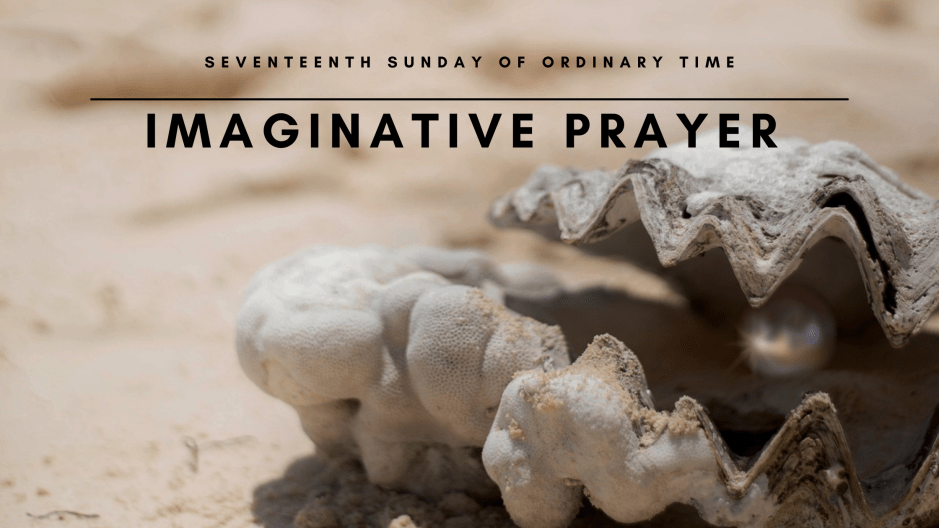
Seventeenth Sunday of Ordinary Time – Ignatian Imaginative Prayer

This Sunday’s Gospel reading includes some famous imagery. Jesus tells us that the Kingdom of Heaven is like a treasure in a field, or a pearl of great price. In both instances, a person happens upon their desired object, surprised to discover it. They swiftly go to sell all they have so they can purchase their prize, so precious it is to them.

Jesus is a master storyteller. There is so much to unpack and explore in His teachings and parables. While there are a number of angles to approach Jesus’ parables, I’d like to hold up Ignatian Contemplation, or Imaginative Prayer, as an excellent way to spend time with these parables. If you are not familiar with Ignatian imaginative prayer, or Ignatian spirituality in general, Ignatianspirituality.com is a great resource for you to check out. In a most basic definition, Ignatian imaginative prayer involves placing yourself in the scene depicted by Scripture, something from the Gospels most often, though this method is not exclusive to the Gospels. You might be a bystander in the scene, observing as things unfold. Or, you might put yourself in the place of a certain character.

A classic example is the Parable of the Prodigal Son. In imaginative prayer, you might first place yourself in the scene as the Good Samaritan. Hear what God has to say to you about your actions and attitudes in light of the Good Samaritan’s choices. Then, a second time (either that day or in the near future), place yourself in the scene as the beaten man. A third time, as the priest or Levite. A fourth time as a robber. A fifth time as the inn keeper. A sixth time as a silent observer. This one passage, only 22 verses, seen from 6 different perspectives. This is a powerful tool!

It is also possible to walk through a passage with a guide of sorts. Either a person reading aloud, or, as I propose to do for you here, a written guide that goes through the passage. There will be prompts for reflection, questions to discover how you are perceiving a specific moment or action, moments of prayer, etc.

As I studied this Gospel, I was struck by the amount of movement happening in just a few short lines. There is a discovery, there is a flurry of activity, there is a return, there is rest. So, if you will permit me to walk with you, let’s go through Matthew 13:45-46 together. I’ll include the verses, as well as questions for you to consider. I’ll be letting you into my own imaginative prayer as I consider the story of the Pearl of Great Price from the perspective of the merchant who finds it.


The kingdom of heaven is like a merchant searching for fine pearls.

Mathew 13:45

It is a normal day. The sun is shining, I can hear birds singing. I do not expect anything unordinary to happen. In the back of my mind, I know I am looking for something, a jewel or pearl perhaps, something really worth looking at. Something so beyond compare in its perfection and beauty. I do not expect to find it today, I’m not sure I expect to ever find it. But every so often, the desire for it comes to me and I wish desperately I could find it.

What are you wishing for? What do you wish would happen in your life? Where are you looking for fulfillment?

I am walking through the shops and stalls of the market. I pause by stands as items catch my attention. I am not looking for anything particular on this trip. Money changes hands, my sack becomes heavier. I’ll need to return to my caravan soon, but there is one last stall to check. You never know what you’ll find when you aren’t looking for anything special. I go over, and in my shock, I drop my sack.

The most beautiful, precious pearl I have ever seen is on a piece of cloth.

What does the Kingdom of Heaven look like to you? What would make you stop dead in your tracks when you saw it, achieved it? If Jesus were speaking this parable to you, what image would He use?

When he finds a pearl of great price, he goes and sells all that he has and buys it.

Matthew 13:46

I am in complete shock and elation. I never thought I would find such a pearl! With my mouth still hanging open, I hurriedly pick up my fallen sack of goods, paltry items in comparison to the beauty and perfection before me. I offer them to the merchant. “Please,” I beg him, “Please I must purchase this pearl.” His price is high, higher than the goods I have with me. I think, maybe, if I can sell everything I have in reserve, that might be enough. I had him my bag in the hopes he won’t sell the pearl to anyone else. I race back to my caravan and start shouting orders to unload everything. My servants are confused, we aren’t meant to sell these items here but along the road in the next few towns. My joy is bubbling over as I wildly grin, “I found it! I have found the most perfect, most precious, most lovely pearl. It is worth every shekel the merchant is asking for it and more. It is priceless to me and nothing is going to stop me from acquiring it. We sell everything!”

Have you ever experienced a joy like this? The merchant almost sounds foolish, doesn’t he? Yet how many of us have been a fool in love, walking around with that silly, classic grin and the feeling of weightlessness? Have you ever felt this way about God, the gift of salvation or the gift of forgiveness? Is this a feeling you desire to have about God?

What lengths are you willing to go to be at Mass on Sunday? What are you willing to sacrifice for prayer time? How foolish are you willing to appear to others for the sake of the Truth of the Good News?

After selling all I have, even after telling my servants I can no longer pay them and that I am selling the caravan itself along with my favorite cloak, I finally have enough. It took some time, but I was relentless. I have nothing left in the eyes of my servants or the people I sold my goods to. They do not understand that what I am gaining far surpasses anything I am leaving behind.

Trembling, I approach the merchant. He smiles warmly, the only one with understanding in his eyes. I hand him his payment. Carefully, reverently, he wraps the pearl in its cloth and holds out his hand. I open my hands and extend them, not wanting to risk the pearl dropping. He places the pearl in my hands and closes my fingers around it.

“You have worked hard and sacrificed much, ” the merchant says to me. “Yes,” I reply. “But this moment has made it all worth it. I am finally at peace. I am no longer searching for anything in the world. All I need, I have. All I desire, I possess. My soul is finally at rest.”

Do you believe this kind of peace is meant for you? Would you be able to let go of everything for the sake of Jesus? What are you holding onto? What is keeping you from letting Jesus enter fully into your soul?


I hope this reflection resonated with you in some way. Use it as a springboard to begin a conversation with God. Perhaps one question or section really stood out to you. Go back to that place and spend some time there. What is God trying to say to you, specifically to you?

Daily Graces. kktaliaferro.wordpress.com