Advent Reflections – December 12, 2015

Before starting this reflection, I would be remiss not to recognize today’s beautiful feast of Our Lady of Guadalupe. May La Virgen Morena watch over us and keep us safe.

**********************************************************

Willing to Make Sacrifices for Others: The Reality of Motherhood

Motherhood in its physical sense is a powerful force of nature. When a woman discovers she is carrying life within her, she is filled with two competing emotions: joy and fear. She is joyful, in awe of the creation that is growing within her. And she is fearful, because she knows that the fulfillment of this growth is a painful birth.

Fortunately for the human race, the fear of childbirth is one of the first sacrifices a mother makes for her child. She sacrifices that fear in order to give her child life. Motherhood is full of such sacrifices, though not all of them on such a grand scale.

A mother sacrifices the music she would like to listen to in favor of her child’s request. She going to lunch with a friend to stay home with a sick teenager. She flies across the country to help her daughter deal with the realities of deployment, sacrificing time and events with her spouse and other children. She denies wanting the last piece of pie.

The sacrificial spirit of motherhood is a spirit of giving. Each sacrifice that a mother makes becomes a gift for the person she loves. Gifts of time, of attention, of life, even of pie.

Who do I make sacrifices for? What is one thing I can sacrifice so that someone else will benefit?

Advent Reflections – December 10, 2015

Able to Love without Requiring Love in Return: In Church Tradition

Very simply, love is choosing to put another’s needs before our own. The First Letter of John says,

If someone who has worldly means sees a brother in need and refuses him compassion, how can the love of God remain in him? – 1 John 3:17

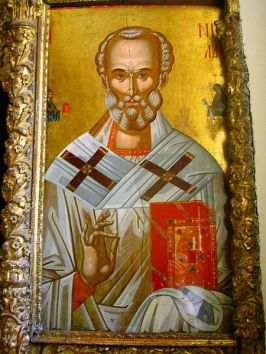
Everyone knows the iconic man, who is merry, jolly and bright, and the joy he brings to children across the world. There is a story about St. Nicholas, aka Santa Claus, that beautifully demonstrates this kind of love.

Nicholas lived in the 300s (fun fact: he attended the Council of Nicea in 325 C.E. which is when the Church formalized our understanding of Jesus’ relationship with the God the Father and officially formulated the first part of the Nicene Creed – the statement of faith we still say to this day at Mass). In those days, a father had to produce a dowry, money or some other possession of value, that would go with his daughter when she married. No dowry = little chance of a husband. The father in our story was poor and had 3 daughters. Nicholas heard of this situation and had the means to fix it. On three separate nights, he tossed a bag of gold coins (some legends say a ball of gold) into an open window, allowing the girls to have enough money for a respectable marriage.

Saint_Nicholas_icon,_Holy_Trinity_Church,_Halki_seminary
Photo of St. Nicholas byzantine icon from the Chapel of the Holy Trinity at Theological SChool of Chalki, Heybeliada Turkey. By Lapost (2015). Via Wikimedia (2005), CC.

Nicholas had two options. He could have called the father to his home and graciously bestowed the money. He could have made a public spectacle of the event, showing off to everyone what a kind and generous person he is. But, Nicholas heard well the admonishment of Jesus:


“[But] take care not to perform righteous deeds in order that people may see them; otherwise, you will have no recompense from your heavenly Father. – Matthew 6:1

Is it easier to do acts of love when others are watching? How can I more freely act in love without looking for praise or recognition in return?


Advent Reflections – December 9, 2015

Able to Love without Requiring Love in Return: Mary in Scripture

A reality of motherhood is loving someone without receiving any love back from them. This happens in more than just pregnancy. There are times when we all act out of love for a child, a spouse, a family member, a friend, a co-worker, a stranger, and do not expect to receive anything, any love in return. Our motivations are not selfish – I’ll scratch your back if you scratch mine. Instead, we act simply because we love them.

We see this quality in Mary. At the Wedding Feast in Cana, Mary comes to Jesus because the couple has run out of wine. Perhaps Mary was a friend of the couple and was helping coordinate the serving. She may have overheard the servers commenting that the wine barrels were running dry. Maybe she went to refill her own glass and was told there wasn’t any wine left. We don’t know the circumstances, and they don’t really matter.

glass-783678_1920
Image by lvicaM90 (2015) via Pixabay, CC.

What we do know is that to run out of wine, especially at a celebration like a wedding, was a major social faux pas. Mary, out of love for the couple, brings the issue to her Son. She does not seek attention, she does not even involve herself with the solution. She simply tells the servers to “Do whatever he tells you.” She acts as a mother would, motivated to act from a place of love.

What is something Jesus is asking you to do? Ask Mary our Mother for the strength and support to “Do whatever he tells you.”