Advent Reflections – December 2, 2015

The Notion of Motherhood: Part 2

Yesterday we approached God as Mother. Today, we are going to encounter the motherhood of Mary.

A number of years ago, my mother-in-law gave me a series of writings by Chiara Lubich (founder of the Focolare Movement) that have had a profound impact on how I understand Mary. In one letter, written in 1987 for the Year of Mary, Chiara states:

Let’s imitate her [Mary] in what is essential. She is a mother, Jesus’ mother and spiritually our mother. From the cross, Jesus gave her to us as such in the person of John. We have to be like her other self, as a mother. In practice we have to state this intention: during the Marian Year I will behave toward every neighbour I meet, or for whom I shall be working, as though I were their mother.

Chiara goes onto list a number of qualities that we tend to associate with motherhood, which Mary exemplified perfectly during her life. A mother is always welcoming, gracious, hopeful, forgiving, etc. When we start to adopt the heart of a mother, Mary’s heart, we are transforming our vision to see those we meet in a new light. Chiara challenged her readers, and us today:

 To live like Mary, as if we were mothers to everyone.

Who is someone in my life that I should try to see more as a mother would, to treat as their own mother would?

Advent Reflections – December 1, 2015

The Notion of Motherhood: Part 1

Mary’s role in Christ’s life, and in ours, is obvious. She is first and foremost a mother. If we are to imitate Mary, is must be from the perspective of her motherhood. Before we look at Mary as Mother, we should look at God as Mother.

No everyone, of course, is called or even capable of being a physical mother with physical children. However, we are all specifically and lovingly created in the image of God. Traditionally, we call God Father, as in the Bible and the prayer that Jesus himself gave us. However, to isolate God under the banner of one human notion of living would be inappropriate, since God is beyond our comprehension, understand and definition.

To balance out our visions and imaginations of God as Father, we should spend some time considering our perceptions of God, and specifically Jesus, as Mother. St. Julian of Norwich (ca. 1342 – ca. 1416) was an anchoress who received visions from Jesus. These visions or showings, were given to her over the course of a number of days in 1373. Julian speaks of “Jesus our Mother”, which, when you stop to think about it, makes a lot of sense. In Eucharist, we are fed from Christ’s own Body, just as babies we are fed at the breast of our own mother. Jesus our Mother gives over all of Himself, He suffers and even dies, so that we might have life. Now, our own mothers may not have died for us, though perhaps some have. They all did, most certainly, suffer so that we could be brought into the world – that we could have life.

Julian says

As truly as God is our Father, so truly is God our Mother, and he revealed that in everything, and especially in these sweet words where he says: I am he; that is to say: I am he, the power and goodness of fatherhood; I am he, the wisdom and grace of motherhood

If we are called to imitate Jesus, to be transformed into other Christs, then, according to Julian, we are to become mothers. Each and everyone of us has within us the capacity for spiritual motherhood.

What does your ideal mother look like? What qualities would she have? Can you see similar qualities in Jesus?

Advent Reflections – November 30, 2015

Imitating Mary

For those of you who do not know, I graduated from the University of Dayton, a Catholic and Marianist university. The university happens to be the home to the largest collections of resources of Mariology – the study of Mary. My thesis advisor, now director of the Marian Library, gave a speech for his installation as the director about why we should study Mary. He quotes Blessed William Joseph Chaminade, founder of the Marianist order: “We can say that the knowledge of the Blessed Virgin leads us to a much deeper knowledge of our Lord Jesus Christ.”

The story of Christianity begins not with the birth of Christ, but with the “yes” of Mary. In order to grow in our knowledge, understanding and relationship with Jesus, we must understand who he is and where he comes from. Jesus is fully God, so we study and learn about God. But Jesus is also fully human, so we must study and learn about Mary, his human mother.

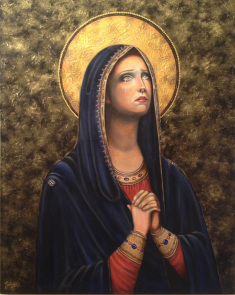
mary-mother-of-sorrow-painting
Picture from http://theveilofchastity.com/2013/06/14/7-quick-takes-friday-vol-33/

As we study Mary, we discover her role as the first theologian, the first to “ponder these things in her heart” (Luke 2:19). Mary soaked up everything Jesus had to offer and then held it close, reflecting on what it meant. Of all Jesus’ followers, Mary is the only one who was present at both his birth and his death. She truly was his first disciple, the perfect model of what it means to follow Jesus.

So we turn our gaze to Mary, for through our study of her, we will come to more intimate communion with her Son.

How has Mary impacted your faith? Is she an active player in your spiritual journey?