With the upcoming release of Season 2 of Disney’s Star Wars series Andor, Ben and I have been rewatching Season 1. We both enjoy this gritty story and the way the characters develop throughout the episodes. This time through, we have been commenting on some particular phrases that the Empire uses as it begins to take further control of the galaxy. The security folks (I’m not going to get super technical here), talk about “tightening their grip” and extending the reach of imperial control. Contract security is out, storm troopers are in. As we watched this unfold, we looked at each other and said Leia’s line from Episode 4: A New Hope, “the more you tighten your grip, the more star systems will slip through your fingers.” Here, in Andor, we were watching the beginnings of the tightening, which is the same moment that the rebellion is really starting to come together. The further the Empire stretches itself, the more cracks form for the rebels to slip in and out of.
The Empire’s purpose in all of this is control. They want things ordered they way they want them with no surprises, incidents, or creative thought. When watching Star Wars, I would think that most of us are inclined to side with the rebels. Stand up to the power, resist!
And yet, as I was reading through my most recent copy of Evangelization & Culture (Issue No. 22 on Courage), I found myself coming to realize that deep down, I’m much more like the Empire than I would want to admit.
At its most basic, primal level, the Empire (in my estimation) is operating from a place of fear. The fear of the unknown, of individual thought, of being replaced, of losing what it had gained. The fear of loss of control is a critical motivating force that causes the grip tightening seen in the Andor series. In his article “Spiritual Direction for the Fearful,” Fr. Billy Swan’s counsel reminded me of the Empire and how it’s actions are exactly what not to do in our own lives:
For us, the fear of losing our lives might not be active every waking hour, but the fear of losing something is always lurking – material things, power, honor, status, our mob, our health, our loved ones, our independence, our freedoms. How do we respond to this fear of loss? One option is to double down on our efforts to protect what we have, whether it be our freedoms, our assets, or even our very lives. Yet we know deep down, sooner or later, that we will have to let go of everything and surrender to the mystery of love that is infinitely greater than our fears.
What am I holding on to too tightly? Where am I seeking to be in control, instead of allowing God to direct my life? What am I afraid to lose?
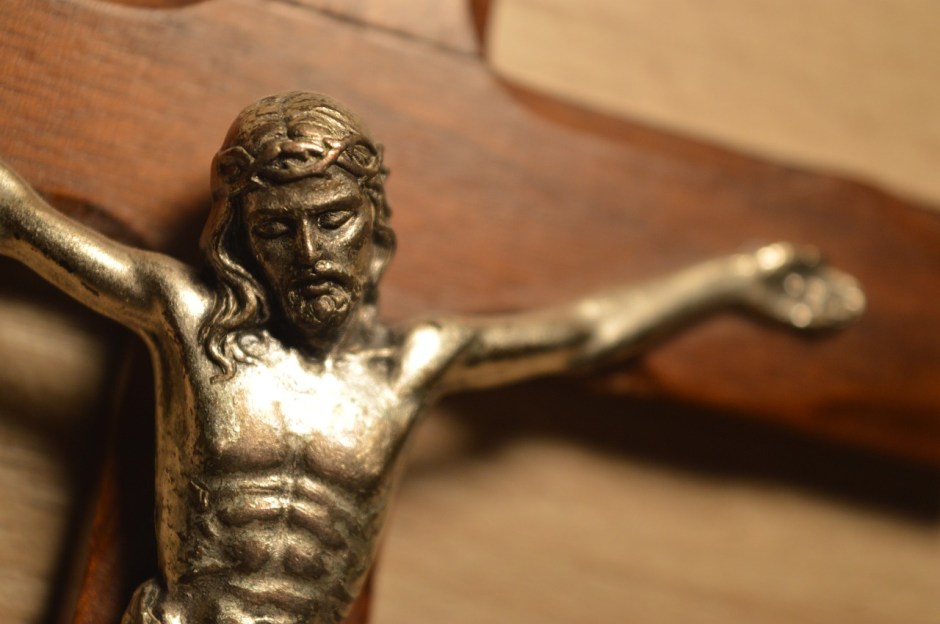
Today is Good Friday, the day of the complete loss of control. Not in the sense of acting rashly or wildly, like a young child who cannot contain her emotions. No, today is the day where we see what perfect surrender looks like. It is the day where hands are stretched wide, holding nothing and at the same time, holding everything at once. Jesus hangs on the cross in what appears to be a complete loss of control. He was taken, beaten, stripped of everything he had, even his connection with the Father. In these moments, Jesus completely empties himself of everything he is. Where Adam and Eve grasped, tightening their grip on the forbidden fruit to gain something they did not need, Jesus releases his hold on everything, to gain everything we desperately require.
Nothing, not one thing. No one, not one person, slips through Jesus’ fingers.
We have a choice today. Will we join Christ, opening our own hands wide to accept all God has to offer us? Or will we side with the Empire, tightening our grip on the things we think we need, only to watch them slip away one day at a time, never realizing that all we had to do was let go. In a magnificent reversal, to find what we truly need, we have to be ready to lose everything.
Jesus and the inspired Gospel writers have an incredible way to pierce straight to the point of an issue. It’s probably a good thing no one was grading by word count because Jesus doesn’t add any more than necessary.
Fear is one of the basic human instincts after the Fall in the Garden of Eden. Fear of missing out, fear of the unknown, fear of the known, fear of bodily harm or illness, fear of betrayal, fear of loss. All of us is afraid of something. I would also imagine, all of us, to one degree or another, suffer from the same fear. It’s the fear Jesus directly addresses today – the fear that God doesn’t care what happens to me.
So much of society today is transactional at its core. I give you X and you give me Y. If something is offered “for free” the next question is, “What’s the catch?” We become so accustomed to this manner of relating to other people and the world in general that we use the same framework to relate to God.
When we try to make our relationship with God transactional, we immediately miss the boat. Fears and doubts crowd in. Why would God care about me? I fall into the same sins over and over again. Other people have way bigger problems than I do. I’m a nobody, surely someone more important in the world needs God’s help more than I do. What can I possibly offer God that would make Him want to spend time and energy on me?
Every single one of these sentiments are lies, and Jesus refutes each of them with His words for us today. The Gospel of John says,
For God so loved the world that he gave his only Son, so that everyone who believes in him might not perish but might have eternal life.
For God did not send his Son into the world to condemn the world, but that the world might be saved through him.
John 3:16-17
The first part of this quote is often repeated in many Christian circles. But the second part is almost just as important. God sent Jesus out of love for each of us. And He didn’t send Jesus so that we would live in fear of condemnation, in fear of reprimand, or in fear of not being good enough. Jesus was sent, from a place of perfect love, to bring us back into relationship with our Creator.
God loves YOU. One of the best ways I believe to help remind yourself of this is to tell God you love Him. I heard in a homily recently that each morning and night, this particular deacon tells God “I love you.” We say I love you to our family, children, spouse, even friends. When is the last time you said those precious words to God?
Jesus tells us not to fear. We are beloved children of God, worth many sparrows. God cares deeply about each one of His children and this includes you. When you feel afraid, when you find yourself beset with worry or anxiety, tell God you love Him. Start your conversation from a place of love and be amazed at how that simple act of openness to God can allow Him to transform you.
P.S. I finished writing this post on Thursday afternoon. That evening, after dropping off some of our kids at an art class, I had the radio on. It was like God was curating a playlist for this post. Here are 4 songs I heard on the way to or from picking them up. I hope at least one of them speaks to your soul about God’s incredible love for you and how fear should not dictate your life.
Happy Divine Mercy Sunday! This specially named Sunday is always the first Sunday after Easter. St. Pope John Paul II instituted the day in the year 2000. The Church’s teaching on the endless mercy of God has been present from the beginning. However, Jesus chose to reveal to St. Maria Faustina in the 1930s a special look at His ocean or font of mercy.
My daughter, tell the whole world about My inconceivable mercy. I desire that the Feast of Mercy be a refuge and shelter for all souls, and especially for poor sinners. On that day the very depths of My tender mercy are open. I pour out a whole ocean of graces upon those souls who approach the Fount of My mercy. The soul that will go to Confession and receive Holy Communion shall obtain complete forgiveness of sins and punishment. … Let no soul fear to draw near to Me. … It is My desire that it be solemnly celebrated on the first Sunday after Easter. Mankind will not have peace until it turns to the Fount of My Mercy.
It comes at no surprise then that our Gospel reading showcases Jesus’ unfailing mercy. It has been mere days since the Resurrection and Jesus has already appeared to the disciples. Just not all the disciples. Thomas, for whatever the reason, was not with the other disciples when Jesus came to them. In his shock, and likely fear and confusion, he clings to doubt.
Unless I see the mark of the nails and put my finger into the nail marks and put my hand into his side, I will not believe.
John 20:25
Because we know the whole story, we tend scoff at Thomas’ assertion. “How can he possibly have the gall to make such a demand?” “Where is this doubt coming from, doesn’t he trust his friends?” “If I were in his place, I would have believed them.” And while yes, perhaps Thomas should have trusted more closely in his friends’ claims, I find Thomas to be exercising a very human response when we are left out of a crowd.
FOMO, or the Fear Of Missing Out, encourages us to make strange choices. No one wants to be left out of something new, fun, or different. As human beings we were made for community, but sometimes we confuse authentic community for the cool crowd. Think back to your teenage years and consider the choices you made out of FOMO. Maybe they were benign, like wearing a certain color t-shirt or getting a specific haircut. Maybe they were a bit more drastic – drinking alcohol at too young an age, getting a piercing without your parents’ permission, sneaking out at night. While you are, hopefully, past these growing pains, FOMO still has a part to play in your psyche.
Commercials, marketing campaigns, billboards, YouTube and Instagram ads – all of these rely at a certain level on FOMO. They want you to see the next best thing, what are your friends clicking on, what’s the latest trend or fad in an area of interest for you.
It’s even in the knitting and spinning yarn world people – I know because I’m actively following a FOMO rabbit hole right now. Long story short, you can spin yarn on a spinning wheel. Cool, I have 2 (and I love them both, don’t make me choose!). You can also spin yarn on spindles, which are basically sticks with a weight at the bottom that you spin like a top and use that spinning to twist wool fiber into yarn. Slower yes, but you can make thinner yarn and it’s just another way to achieve the same result. This is not a fast craft so why not embrace the slow nature of the make.
For whatever the reason, YouTubers are popping up with spindle spinning and now, guess who wants a spindle? Yep. Guess who already has one in the mail and used sweet puppy eyes on her husband so he would also get her one for her birthday? Yep. Because of course you need more than one, they are little and there’s so much yarn to spin!
FOMO. It’s a thing. It’s not always a bad thing, but it’s a thing we have to acknowledge plays a role in our lives. Depending on the topic or situation, we might react to it differently.
I am reacting to my FOMO by acquiring 2 spindles, and being very strict with myself not to get any more (there’s a hot resale market. I know, you think I’m crazy, but that’s ok), until I know if this is a new craft I want to spend time on. I’m engaging in the established community more as I learn more about spinning and enriching my overall understanding of fiber crafts. While calling it a natural progression seems a bit too much like permission to lose self control, it is still related to interests I already have made room for in my life. However, I acknowledge this is a potential slippery slope, so I need to proceed cautiously.
Thomas took a more aggressive approach to his FOMO episode. Not wanting to be left out or undone, Thomas makes a wild assertion about what level of proof he needs in order to be convinced. We’ve seen this before in our lives – a wild bet, an outlandish or fantastical claim, making or accepting a dare – all done to impress the group and be accepted by it.
We call Thomas “Doubting Thomas” because of this series of events. He doubts, not just Jesus’ resurrection, but I believe his place in the group. Why didn’t Jesus wait for him to be back from whatever errand he was on? Why had he been left out? Was he someone less than or inferior to the others? Notice how Thomas doesn’t just need to see Jesus, but to touch Him as well. No one else had done that, surely his bravery would be rewarded in some way, if only just to be considered an equal again.
Doubts. We talk about how seeds of doubt are sown in our minds and hearts. Doubt is such a deceptive thing. It’s one of the primary weapons the Devil employs against us. Doubts come to us in little one liners, often out of no where. “If you really loved your wife, you’d let her get as many spindles as she wants” ……. sorry, couldn’t help it. But really, the phrase “If you really” usually ends with a seed of doubt planted. Consider these possible endings.
If you really….
wanted that job, you would have found a way to get it.
loved your kids, you would be at every single soccer game no matter what.
were beautiful, he would have asked you out.
were successful, she wouldn’t have left you.
are fun to be around, that specific group would be your friends.
believed in Jesus, you wouldn’t have been in that accident.
Doubt, FOMO. They go hand in hand. The Devil wishes for us to be in a state of continual doubt and FOMO. Doubt makes us question what we are doing, who we are, and what we believe. FOMO makes us constantly chase after what we perceive we are lacking, even if we aren’t lacking anything at all. This cycle of doubt and fear will lead us down a path of destruction in quick order.
Thank goodness we have a Sunday like this Sunday. This Sunday, Divine Mercy Sunday, shows us that there is nothing to fear, nothing to doubt. Jesus’s Divine Mercy is boundless, endless, and ever present for us. We don’t have to doubt it. We don’t have to be fearful that He will keep it from us. Jesus is waiting for us to reach out to Him. He wants nothing more than to shower us with His merciful love. I cannot say it better than Pope John Paul II:
As a gift to humanity, which sometimes seems bewildered and overwhelmed by the power of evil, selfishness, and fear, the Risen Lord offers His love that pardons, reconciles, and reopens hearts to love. It is a love that converts hearts and gives peace. How much the world needs to understand and accept Divine Mercy! Lord, who reveals the Father’s love by Your death and Resurrection, we believe in You and confidently repeat to You today: Jesus, I trust in You, have mercy upon us and upon the whole world.
St. Pope John Paul II, Regina caeli message prepared for Divine Mercy Sunday, April 3, 2005
Jesus not only requested a day to be set aside for us to commemorate and celebrate His Divine Mercy, He also instructed St. Faustina to pray a chaplet to divine mercy. If you have never prayed the Divine Mercy Chaplet before, I highly encourage you to find some time this weekend. It is prayed on rosary beads, but takes about half the time as the rosary. Not that time should be a factor, but it’s also good to know what you’re getting yourself into. Check out the Hallow app’s guide to praying the chaplet.








 Daily Graces