The Empire vs. The Cross

With the upcoming release of Season 2 of Disney’s Star Wars series Andor, Ben and I have been rewatching Season 1. We both enjoy this gritty story and the way the characters develop throughout the episodes. This time through, we have been commenting on some particular phrases that the Empire uses as it begins to take further control of the galaxy. The security folks (I’m not going to get super technical here), talk about “tightening their grip” and extending the reach of imperial control. Contract security is out, storm troopers are in. As we watched this unfold, we looked at each other and said Leia’s line from Episode 4: A New Hope, “the more you tighten your grip, the more star systems will slip through your fingers.” Here, in Andor, we were watching the beginnings of the tightening, which is the same moment that the rebellion is really starting to come together. The further the Empire stretches itself, the more cracks form for the rebels to slip in and out of.

The Empire’s purpose in all of this is control. They want things ordered they way they want them with no surprises, incidents, or creative thought. When watching Star Wars, I would think that most of us are inclined to side with the rebels. Stand up to the power, resist!

And yet, as I was reading through my most recent copy of Evangelization & Culture (Issue No. 22 on Courage), I found myself coming to realize that deep down, I’m much more like the Empire than I would want to admit.

At its most basic, primal level, the Empire (in my estimation) is operating from a place of fear. The fear of the unknown, of individual thought, of being replaced, of losing what it had gained. The fear of loss of control is a critical motivating force that causes the grip tightening seen in the Andor series. In his article “Spiritual Direction for the Fearful,” Fr. Billy Swan’s counsel reminded me of the Empire and how it’s actions are exactly what not to do in our own lives:

For us, the fear of losing our lives might not be active every waking hour, but the fear of losing something is always lurking – material things, power, honor, status, our mob, our health, our loved ones, our independence, our freedoms. How do we respond to this fear of loss? One option is to double down on our efforts to protect what we have, whether it be our freedoms, our assets, or even our very lives. Yet we know deep down, sooner or later, that we will have to let go of everything and surrender to the mystery of love that is infinitely greater than our fears.

What am I holding on to too tightly? Where am I seeking to be in control, instead of allowing God to direct my life? What am I afraid to lose?

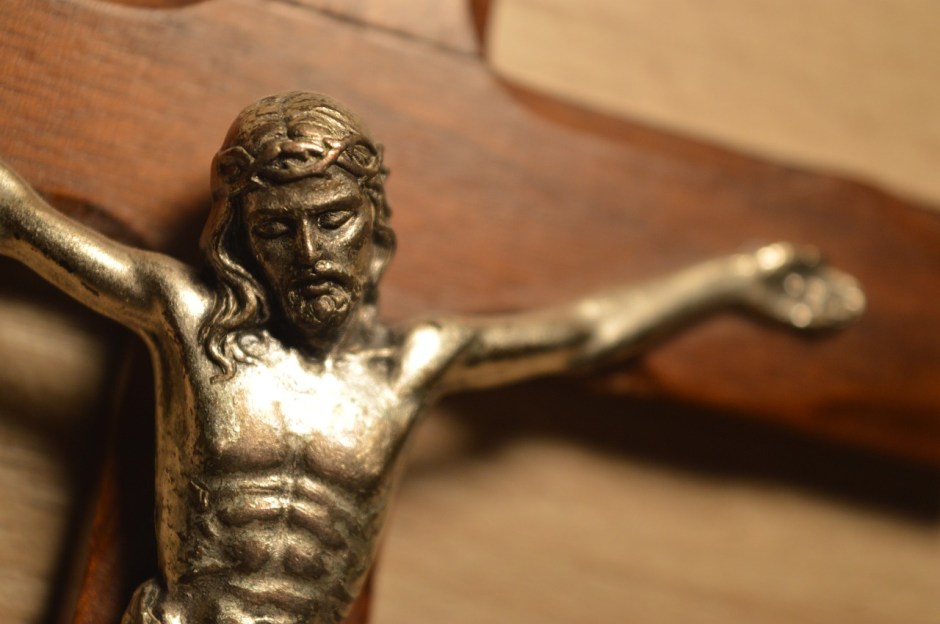
Today is Good Friday, the day of the complete loss of control. Not in the sense of acting rashly or wildly, like a young child who cannot contain her emotions. No, today is the day where we see what perfect surrender looks like. It is the day where hands are stretched wide, holding nothing and at the same time, holding everything at once. Jesus hangs on the cross in what appears to be a complete loss of control. He was taken, beaten, stripped of everything he had, even his connection with the Father. In these moments, Jesus completely empties himself of everything he is. Where Adam and Eve grasped, tightening their grip on the forbidden fruit to gain something they did not need, Jesus releases his hold on everything, to gain everything we desperately require.

Nothing, not one thing. No one, not one person, slips through Jesus’ fingers.

We have a choice today. Will we join Christ, opening our own hands wide to accept all God has to offer us? Or will we side with the Empire, tightening our grip on the things we think we need, only to watch them slip away one day at a time, never realizing that all we had to do was let go. In a magnificent reversal, to find what we truly need, we have to be ready to lose everything.

Daily Graces. kktaliaferro.wordpress.com

Circumstances

No one lives with perfect circumstances. Things might be going really well, but there is always something in your life that could be fixed up. Even in the lives of Mary, Joseph, and Jesus – two of whom were perfect people in that they were without sin – even they lived in imperfect circumstances. We don’t get to pick our circumstances but we do choose how we respond to them. The Christmas season highlights a few different biblical characters and the way they chose to respond to unusual, perhaps even seemingly imperfect, circumstances.

Zachariah, the father of John the Baptist, responded with fear and doubt when told about his coming son by the angel. He relied on his own understanding and was not open to the possibilities the Holy Spirit could create. Mary, on the other hand, received a message from an angel about a baby as well. But in her case, she remained open to the action of the Holy Spirit, being willing to cooperate with God’s plans even though she did not understand them. She was filled with the Holy Spirit and even before Jesus was born we are able to hear how both Mary and Elizabeth (John the Baptist’s mother) speak inspired words to one another. Both Mary’s fiat, her “yes” to God, and her Magnificat spring from her faith and trust in God’s love.

The Holy Spirit still speaks to us today if we are attentive. Sometimes in the words of others, sometimes in the words that come out of our own mouth. Sometimes, even in our imperfect circumstances.

This fall, my mom was diagnosed with a glioblastoma tumor in her brain. This is an aggressive type of tumor and it was less than 48 hours between diagnosis and brain surgery to remove as much as possible. Our whole world was completely turned upside down. Thankfully, the surgery was as successful as the doctors could hope for. There is still a long road to go, and we don’t know the twists and turns that will come.

Before my mom was diagnosed, she had some speech and word finding issues. After surgery, the doctors said she could have a hard time with speech due to the location of the tumor. We have some funny stories of those early days and the word switches, misses, and adaptations my mom came up with as her healing began. Every so often, she still slips. However, there is one particular slip that I believe is Holy Spirit inspired.

While the chemo my mom was prescribed are daily oral pills she can take at home, radiation had to happen at a cancer center. Every weekday for 6 weeks she went to the center for treatment. After a few visits and settling into a routine, she began calling “radiation” “adoration.” Obviously, these two things are definitely different. And yet, as we talked about it, I can’t help but feel there is some kind of Holy Spirit inspiration between the switch.

What happens in radiation? For a few minutes (really, less than 10, it’s rather remarkable), the person has to lie in perfect stillness while the mechanisms and machinery delivers the radiation treatment to a specific and carefully aligned area of the body. There isn’t anything my mom can do to make this process more effective or efficient except to be faithful to the treatment process. If she didn’t go every day, the effectiveness would greatly diminish. If she wasn’t compliant to the doctor’s recommendations for staying active even when she was exhausted, to try her best to eat as well as she could even when all she wanted was saltines, her body wouldn’t be as strong as it could be to continue fighting this invisible enemy.

What is adoration? Adoration is coming to adore Christ. It is taking time out of our day to place Jesus at the center of our life. Typically, people are pretty still during adoration, with sitting or kneeling being the predominant postures. Adoration is an opportunity to open ourselves up to Jesus’ action in our lives, to let him highlight the areas of our life in need of his mercy, his healing, and his love. In Adoration we can receive inspiration for how to live our lives, what actions should we do or avoid that will help us more fully follow God’s Will. We faithfully show up to adoration, but it’s God’s action that is on display.

From this light, there is a lot in common between radiation and adoration. If you are willing, I’d like to invite you to pray for my mom, Mary Kay, and for her healing. I’d also invite you to pray for my dad, Steve, as he walks this journey with her. My parents have both asked for prayers specifically through Chiara Lubich’s intercession. Long-time readers will hopefully recognize Chiara as the founder of the Focolare Movement that our family is a part of. Below is the prayer of intercession that is officially recognized by the Church. Chiara is a named Servant of God but cannot move forward in the canonization process without miracles associated with her intercession. God willing, my mom can be one of those miracles.


Eternal Father, source of Love, and of every light and goodness, we give You thanks for the charism of unity given to Chiara and for the remarkable witness to the Church and humanity that she gave of this charism, remaining faithful to Jesus Forsaken.

Grant us, O Father, through the action of the Holy Spirit and the Word lived in the present moment, and in following Chiara’s example, the grace to contribute together with all people of good will to the fulfilment of Your Son’s will: “That they may all be one!”

Humbly we ask You to grant us, Your children, to live in mutual love and in love of all so as to rejoice in the presence of the Risen One while, in communion with Chiara and through her intercession, we ask You, if it be Your will, the grace for the complete healing of Mary Kay Jennrich from brain cancer, through Jesus and for the glory of the Most Holy Trinity.

Amen

If you’d like to learn more about Chiara and the movement, I have three resources for you. First is the film Love Conquers All that can be viewed on Formed.org. Many parishes subscribe to this streaming database. Check with your local parish if you are unsure if you have free access or not. The second is the primary website of the Focolare Movement. Third is the main media resource for the Focolare which has videos, articles, and other resources you may be interested in.

Daily Graces. kktaliaferro.wordpress.com

Tolkien’s Liturgical Imagination – Course Review

I was delighted to have the opportunity to participate in the St. Paul Center’s Emmaus Academy this January. I was able to take the course Tolkien’s Liturgical Imagination presented by Dr. Ben Reinhard. This course covered a wide range of topics, both liturgical and Tolkien, as perhaps the name suggests. It did not disappoint.

Emmaus Academy is a paid subscription in order to access this and all of the other courses. The Academy is run by the St. Paul Center which was founded by Dr. Scott Hahn. I was able to review this course free of charge in exchange for a thoughtful review of the content.

Dr. Reinhard begins his lectures by inviting the listeners into Tolkien’s daily life, proposing that before liturgical elements can be found within Tolkien’s works, we first have to understand just how liturgically grounded his life was. And boy, was it! As someone who has studied liturgy, I was deeply impressed with Tolkien’s knowledge of liturgical texts and the ways he seamlessly wove them into his regular correspondence and life. He even recommends memorizing important liturgical prayers as a critical way for his son, Christopher, to remain close to his faith while serving in World War II. 

Many of us know the prayers of the Mass and can say them along with the priest and community during Mass. Many of us know popular songs or poetry that can be recited along with the album playing. But have you ever tried to repeat them on your own, by yourself, without the text in front of you? It is an interesting and challenging exercise, because sometimes those prayers, songs, or poems you thought you knew so well are difficult to recall in full unless you have taken the time to deeply study them. Tolkien studied them deeply. 

This deep study of the liturgy and daily living it out (Tolkien attended Mass daily for the majority of his life) could not but shape and inform his writing. Dr. Reinhard goes through a number of examples, letters, and short stories, teasing this theory out before getting to what everyone is waiting for, The Lord of the Rings. I am a Tolkien lover, and I found many references and moments which made me smile as I recalled the wider story surrounding whatever portion was being referenced. However, Dr. Reinhard does a good job providing the wider context and details needed to understand whatever portion of whatever story he is using to illustrate his point.

I very much enjoyed this course. As I said, I already love Tolkien’s stories. But after this course, I have a deeper appreciation for who Tolkien was and how his quiet Catholicism helped him tell these masterful tales. I also have a better grasp on why these stories have such an inspirational quality. If you are someone who is on the fence about Tolkien, or hasn’t quite gotten through his stories, I would still recommend this course to you. I hope that you will find a new connection to Tolkien that inspires you to give his works a try. At the end of the day, as Dr. Reinhard explains, Tolkien’s works are about the exaltation of the humble (I’m looking at you, hobbit fans), which is, at it’s core, a most liturgical and Catholic viewpoint.

If all this isn’t enough, I talked at length about what I learned with Ben. These conversations, coupled with our 12 year old just finishing listening to an abridged version of The Lord of the Rings, we’ve had a lot of Tolkien in our house. But instead of being tired of hearing his name, Ben is now re-reading the series and we are slowly watching the Director’s Cuts of the films (for the unknown numbered time, these are favorites!). Basically, if you’ve been thinking about reading the series, or re-reading it, this course has the potential to tip the scales for you in a very good way.

Daily Graces. kktaliaferro.wordpress.com