Good Friday is always such a hard day to reflect upon. It’s one of the main reasons why I’ve struggled to write Lenten reflection books, so this is going to be short.
Toward the close of today’s video, I touched on Jesus’ greatest moment of suffering. Just before Jesus dies, He cries out, “My God, my God! Why have you abandoned me?” In this moment of furthest separation from God, Jesus offers up for us the greatest example of His love. He was willing to go so far, as far as to be emptied of everything. Yet at the same time, He was placing on display for the whole world exactly who God is – Love. Perfect, complete, unyielding, undying – God is Love.
Through Chiara Lubich, founder of the Focolare Movement, we have a name for this distinct moment. Jesus Forsaken. I am currently working through a book that contains all of Chiara’s writings about Jesus Forsaken, not light reading to be sure. But at the same time, it is so full of hope and love and light. Jesus’ darkest moment is also where we find His greatest love. Here’s just one quote, a poem of sorts, from too many to count that I’ve highlighted so far, and I’m not halfway through yet.
So that we might have Light, you made yourself blind.
So that we might have union, you tasted separation from the Father.
So that we might possess Wisdom, you made yourself “ignorance.”
So that we might be clothed with innocence, you became “sin.”
So that we might have hope, you almost despaired…
So that God might be in us, you felt him far from you.
So that Heaven might be ours, you experienced Hell.
So that we might have a glad sojourn on earth, among hundreds of brothers and sisters, you were banished from Heaven and from earth, from humankind and from nature.
You are God, you are my God, our God of infinite love.
Chiara Lubich, Jesus Forsaken, pg 33.
A few years ago, Bishop Kurtz of the Louisville Archdiocese, wrote a beautiful article about looking for and discovering Jesus Forsaken in our daily lives. I would invite you to follow the link to read his article. He does a much more eloquent job than I can about how we all have the opportunity to embrace Jesus Forsaken each day.
There will not be a video or blog post for Holy Saturday. Together, we will wait in anticipation for the wondrous miracle of Jesus’ Resurrection on Easter Sunday.
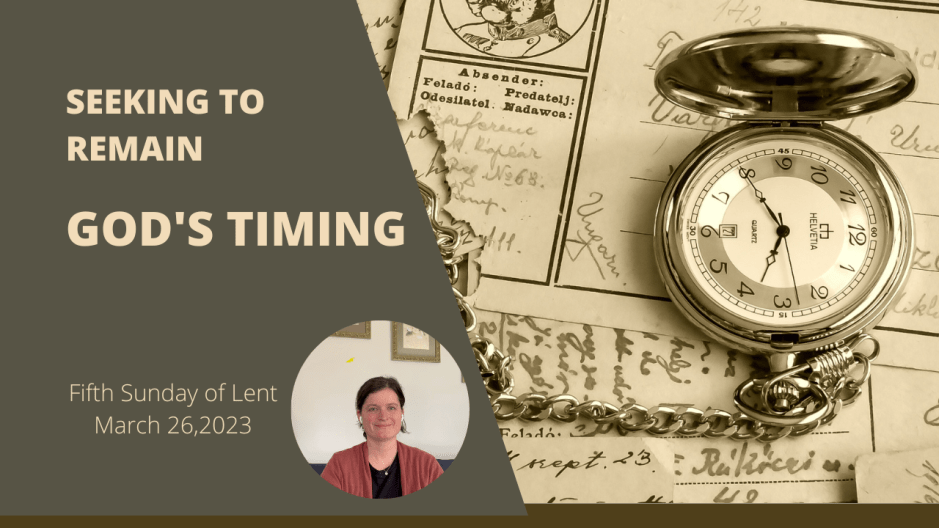
Today’s post is going to be a little different in that it’s also a book review. Over spring break I was able to read a most excellent book I wanted to share with you. By the Rivers of Babylon by Michael D. O’Brien is a historical fiction novel about the early life of the prophet Ezekiel. I fell in love immediately and one of the overall themes of the book fits in perfectly with this Sunday’s Gospel reading – God’s timing.
In case you haven’t noticed, either from Scripture or your own life experience, God doesn’t follow a schedule we can easily decipher. In the story of Jesus’ raising Lazarus, Jesus finds out about Lazarus’ illness 2 full days before He begins to journey to Bethany. Jesus is about 30ish miles from Bethany at this time (the previous chapter of John tells us Jesus traveled to Samaria after some confrontations at the Temple in Jerusalem). At a walking pace, it would have taken them at least 2 days to get to Bethany, maybe longer. And Jesus waited to get started.
I’m sure everyone was wondering why Jesus chose to wait. If they had listened closely, they would have already known the answer to their question:
When Jesus heard this he said, “This illness is not to end in death, but is for the glory of God, that the Son of God may be glorified through it.”
John 11:4
Something larger was at work in Lazarus’ illness. Jesus could have rushed to Lazarus’ side and cured him of whatever was ailing him. But, the bigger, more miraculous, impossible story happens because Jesus choses to wait for God’s timing. To reflect more fully on God’s timing, check out this week’s video.
The Israelite people experienced this time and again. In By The Rivers of Babylon, you walk with Ezekiel through the crumbling of faithfulness in Jerusalem and into exile in Babylon. While this at first sounds like a depressing read, Ezekiel’s perspective lifts your eyes to heaven and God’s larger plan that is at work. Below is my full review:
Because of the distance of time between today and Biblical days, it can be difficult to fully appreciate the world during which the Bible was written. We rely on ancient texts, cultural traditions, and the inspiration of the Holy Spirit to reveal to us what life could have been like during the Israelites wandering in the wilderness, the glory of David’s kingship, or times of exile. We are also blessed by the imaginations of authors such as Michael D. O’Brien who, through his new book, By The Rivers of Babylon, can open up for us a whole new perspective on a particular moment in Biblical history.
O’Brien has crafted a beautiful book about the early life of the prophet Ezekiel, or Yezekiel in the Hebrew O’Brien utilizes. I was entranced by this book and the gentle way O’Brien unfolds the young Ezekiel’s life. The inside of the dust jacket includes the question, “What makes a prophet?” I found this to be a poignant question. While the book thoughtfully unfolds moments of Ezekiel’s life which are clearly preparatory for his eventual calling to be a prophet to the exiles, O’Brien also invites the reader to consider what God could be preparing them for someday. Do we each have a unique purpose to which God is calling us? How is God using today to prepare us for the tomorrow we do not yet see?
I’ll share one quote as an example:
“I am carefully fitting corner bricks to overlap with bricks of the adjoining wall. Ah, if only I could mold a whole wall in an instant, go my thoughts. I could carry it here on my shoulders. I could put four walls together and make a house in the blink of an eye.
Then I smile at the notion. Life is like this, I remind myself. You cannot move a whole wall on your shoulders. You move the wall brick by brick. This is how God as built Israel, little by little, step by step.
pg 178
What a beautiful, timeless insight into the human heart. We want things to happen immediately. We want quick answers, minimal waits, instant gratification. The story of Ezekiel through O’Brien’s imagination is one of slowness, anticipation, and difficult waiting. Instead of lashing out against their conquerors, Ezekiel offers a prayerful approach. He trusts in God’s plan for His people and continually unites himself to that plan through simple acts of love and generosity. He also would have been a man immersed in the psalms, which O’Brien does a masterful job of weaving into all sections of the book. Through these psalm-prayers of Ezekiel, we are able to witness a powerful form of praying in, with, and through the words of Scripture.
You know you’ve found a good book of Biblical historical fiction when the first thing you want to read after finishing is the book(s) of the Bible referenced. This is exactly how I felt and what I did upon closing By The Rivers of Babylon.
I cannot encourage everyone enough to find the time to read this book, and then to go on to read through the book of Ezekiel. I am already planning a second read through, likely of both.
We were so blessed to spend part of Spring Break at Ben’s family cabin outside of Denver. We were there for 6 days and had a lovely time, even if the little boys were struggling to sleep between runny noses and the altitude. It is such a joy to be able to share this cabin with our kids. Ben’s family has old films of the cabin being built by his great-grandparents and their children. The cabin has since been expanded upon, improved and maintained by the whole extended family. It is a work of art and a bit of a historical record for the family.
We know, as Jesus tells us, that afflictions like blindness are not caused by a family member’s sinfulness. Children do not receive the spiritual punishment that their parents or grandparents earned through their wrong choices. We do, however, still pass on many things from one generation to the next. These can be big, serious things, like alcoholism, mental health struggles, perfectionism, abuse, gambling. They can be littler things like leaving dishes on the counter, staying up late reading, sleeping past alarms, forgetting to water plants, etc. They can be fantastic things like diligence in going to Mass each week, following the Lenten fasts, cleaning up each night before bed, having a prayer routine, putting clothes away once they are folded, calling parents, grandparents, and other family members on a regular basis, etc. I’m sure you have come up with some of your own ideas.
In the nature vs. nurture conversation, there’s a lot to be said for the nurture side of things. We receive a lot. We give a lot. This then begs the following questions:
What have I received that I appreciate, use, and has helped me become a better person?
What do I wish I hadn’t received?
What have I given to my children, nieces, nephews, coworkers, or friends?
How is what I am giving helping them grow in holiness?
As if this wasn’t enough, while I was recording I found myself starting to veer off this topic of generational sins and gifts and reflecting on the cause Jesus gives for the man’s blindness:
Neither he nor his parents sinned; it is so that the works of God might be made visible through him.
John 9:3
The suffering isn’t a punishment. That’s almost as hard to swallow as the notion of generational sin.
As humans, we like cause and effect. X leads to Y. There was a sin, a consequence follows. Wrongdoing is followed by negative consequences, i.e. suffering. The Jewish people had experienced this many, many times. The people refused to enter Canaa and none of that generation was allowed to enter the promised land. Their descendants had to wander in the desert as the consequence of their disobedience (See Numbers 13-14 for the story). The same thing happens when the Kingdoms of Israel and Judah are overrun and taken into exile. The people rebelled against God, forgetting their side of the covenant. As a consequence, they and their children suffered.
Jesus tells us this type of transactional causes for suffering no longer rules the world. He has come, and He bears the punishment for all of our sins. For what purpose, then, does suffering occur? Jesus tells us in our Gospel that even suffering can be used for God’s glory. Put another way, I can think of no better answer than this clip from Season 3 of the Chosen. I hope you take the time to watch it, even if you chose these 6 minutes over mine that is linked above.
If suffering is something you struggle with, either your own, someone you know, or a suffering that has been passed through your generational story, I would encourage you to read the book, When You Suffer: Biblical Keys for Hope and Understanding, by Jeff Cavins. It is a beautiful and gentle book about suffering and how the Bible can help us better understand, accept, and then use suffering to participate in God’s plan for our lives.






 Daily Graces