Phrasing can be as Important as the Question

My five and four year olds have been running through the house with their race cars recently shouting, “Rampage!” It’s been consistent enough, and loud enough, both Ben and I have been wondering where it came from. Ben recalled it as a quote from a TV show, but not one for kids, so it obviously wasn’t that. He asked them, “Where is the whole ‘Rampage!’ thing from?” They both blankly looked back, unable to tell him. Ben was telling me about this and I asked if he had tried phrasing the question differently. “Which character says it?” or “What was happening in the show or book when you heard it?” Eventually we settled on the recent race car show after trying a few different questions to help jog their memories.

This whole experience got me thinking about the importance of how we phrase questions. We’ve all had a hard time accessing a memory until someone says just the right phrase, we smell the right smell, or are able to back track through a series of memories to get to the one we want. It’s like getting the right key in the lock, once we get the right key the memory opens. It doesn’t matter how we got there, just that it makes sense in our mind.

I experience this same kind of thing when doing math with my kids, especially when they are first learning the basics of addition, subtraction, multiplication, and division. 8+4 can be looked at a few ways. You can start at 8 and count up 4. You can start at 4 and count up 8. You can borrow 2 from the 4 to get to 10, then add the extra 2 that are left. 8×4 is 4 8’s, or 8 4’s, or it’s 8×2 twice, 4×4 twice, etc. No matter how we get there, 8+4 =12 and 8×4 = 32. I’ve learned that each kid has their own preferences for how to break down numbers and put them back together again. It’s important to learn all the ways of course, but it’s also good to learn that this one prefers doubling while another prefers counting up or back, etc.

This is also a great way to think about the different spiritualities and movements in the Church. All the spiritualities of the Church have the same goal – holiness and intimacy with Christ. But how they get there is different, and that’s great! Let’s look at a few (there are so very many, it would be quite challenging to list them all) and see the wonderful diversity open to our spiritual journeys.

Focolare

You had to know I’d start with the Focolare. This is the lay ecclesial movement our family is a part of. In the spirituality of the Focolare, the main focus is unity. The way unity is achieved is by following the two Great Commandments of Jesus – love of God and love of neighbor. Unity can be achieved when we recognize in every person we meet Jesus alive and present before us. In this way, we can go to God together, two (or more) people loving to their fullest capability Jesus in the other person. We become a participation in the life of the Trinity: God, myself, and the person I love.

Benedictine

One of the earliest formal spiritualities in the Church is the Benedictine Order. Founded by St. Benedict in the early 500s A.D., the Benedictines follow the Rule of St. Benedict, the first of its kind. Benedictine spirituality places great emphasis on balance in life, especially between work and prayer. The community of monks come together at regular intervals throughout the day to pray, and then go out into the community (or elsewhere in the monastery) to work and serve in all areas of life. Benedictine spirituality is therefore deeply communal. Rather than moving from place to place, Benedict wished, as much as possible, for the members of the order to remain stable so they could fully invest in their community.

Franciscan

The Franciscan spirituality was founded by St. Francis of Assisi and is one of the largest religious communities, present in nearly every country across the world. Franciscan spirituality highlights both deep contemplation as well as intentional action with special focus on evangelical poverty and care of creation. For St. Francis, and by extension St. Clare who helped found the Poor Clares, the women’s branch of the Franciscan order, all of creation is an opportunity to witness and participate in the goodness of God. This included everything from beautiful sunsets to worms and dirt, from the immense joy of a newborn baby to the suffering and sorrow of a painful death.

Carmelites

Carmelites have a fascinating history as there is no single person we can trace as their founder. The Carmel refers to Mt. Carmel where the prophet Elijah settled, as we can read about in 1 Kings. In 1155 we find the first recorded references to hermit monks living in the caves on Mt. Carmel, dedicating themselves to penance and prayer. They built a church and in the 1200s St. Albert of Jerusalem wrote a Rule for them to follow. The goal of the rule was for the hermit monks to live with greater intensity their faith through lives dedicated to prayer, silence, and solitude. Today, Carmelites continue in this tradition. While many Carmels are cloistered, there are some active communities that live and work within the wider community. Carmelites strive for intimacy with God, recognizing the incredible gift of God’s entrance into human history in the Incarnation. This intimacy is especially sought after in contemplation, stillness, and solitude.


I could, of course, go on and on. There are so many beautiful spiritualities in the Church that offer unique and practical ways of journeying through this life towards heaven. There are the Marianists, the order who ran my college and sparked my interest in the importance of community. The Lasallian priests and brothers founded my high school and impressed upon me the importance of a Catholic education where all the subjects can be connected, faith interwoven even in math. There is the Institute of the Blessed Virgin Mary, an old order founded in 1609 during the height of the Protestant Reformation in England by a woman, Mary Ward, who wished for her companions to be uncloistered – a revolution within a revolution and a fascinating study (as I did in my undergraduate thesis). There are the Dominicans, the preaching order, the Jesuits (Pope Francis!), the Augustinians (Pope Leo!), and so very many, many more.

I hope that this post has inspired you to consider learning more about one or two of these spiritualities. Look around your local community. Do you have a monastery nearby, a cloister? Does your parish or diocese have a certain spirituality that meets regularly? Is your parish or one in your area run by an ordered priest? What about the local Catholic schools or universities?

No matter the spirituality, the goal of them all is to bring us closer to Jesus. I heard it explained like this once. The whole of the Gospels brings us to Jesus. But, we read them usually in short snippets, focusing on one or two aspects of Jesus at a time. Just as the smallest particle of Eucharist is still the whole Eucharist, so too these shorter sections still contain all of Jesus. So perhaps I read about one of the healing miracles and feel drawn to a spirituality that has special focus on healthcare, poverty, and service. Someone else may read about Jesus moving away from the crowd to spend time in silence and prayer and feel called to a contemplative life, one that focuses on intense prayer for the whole world and a life detached from the things of the world. Another could read the Sermon on the Mount and be drawn to a life of teaching and preaching, dedicating themselves to the spiritual works of mercy such as “instruct the ignorant,” “counsel the doubtful,” and “admonish the sinner.” Each of these biblical moments tells us something about Jesus and is a way to be close to Jesus. Isn’t it wonderful that Jesus, in his humanity, shows us such a myriad of ways to follow after him!

Daily Graces. kktaliaferro.wordpress.com

Emmaus Academy Course Review

I think we can easily forget that there isn’t an end of learning when it comes to our faith. We don’t “graduate” or “finish” in terms of faith and knowledge of God. God is immeasurable, infinite, eternal, outside of time and space. Even when we die and come into His full presence, there will still be things outside of our understanding because we are not God, nor will we ever be. 

While there is no true end to learning about what we believe, that doesn’t mean there isn’t a journey worth pursuing. We are immensely blessed with a faith that is rich in meaning, tradition, and history. We also believe in a living faith. The Holy Spirit is still actively guiding the Church as a whole as well as each one of us individually. Mysteries of our faith are still being revealed, apparitions are still happening, saints are still being made. Even if someone, somehow, managed to learn all the things that have been discovered about our faith to this point, they still would not know all of it because there is more the Holy Spirit is waiting to draw us into. 

If you haven’t guessed yet, I love to learn and I especially love this adventure of learning the deep mysteries of our faith. I was so pleased to be able to review a new course from the St. Paul Center’s Emmaus Academy entitled, “Full of Grace.” The Emmaus Academy is a learning platform that has a wide range of video based courses on a variety of topics especially pertaining to Sacred Scripture. It also has a few book based series where you can read through a modern text and engage in reflections guided by the author. Finally, there are a growing number of special presentations on specific topics. So far, Dr. Scott Hahn has a video series that walks through the Our Father and this July a new series will be released titled, “The Catholic Table.” Emmaus Academy has monthly or yearly subscription options.

“Full of Grace” is a Marian focused series of 12 videos, ranging from 22-40 minutes (only 1 40 minute video, the rest were 35 minutes or less). The videos are given by Fr. Daniel Maria Klimek, TOR, a professor of Mariology at Steubenville University. At the conclusion of each video there is an optional 5 question quiz which highlights some of the overall concepts discussed in the video. 

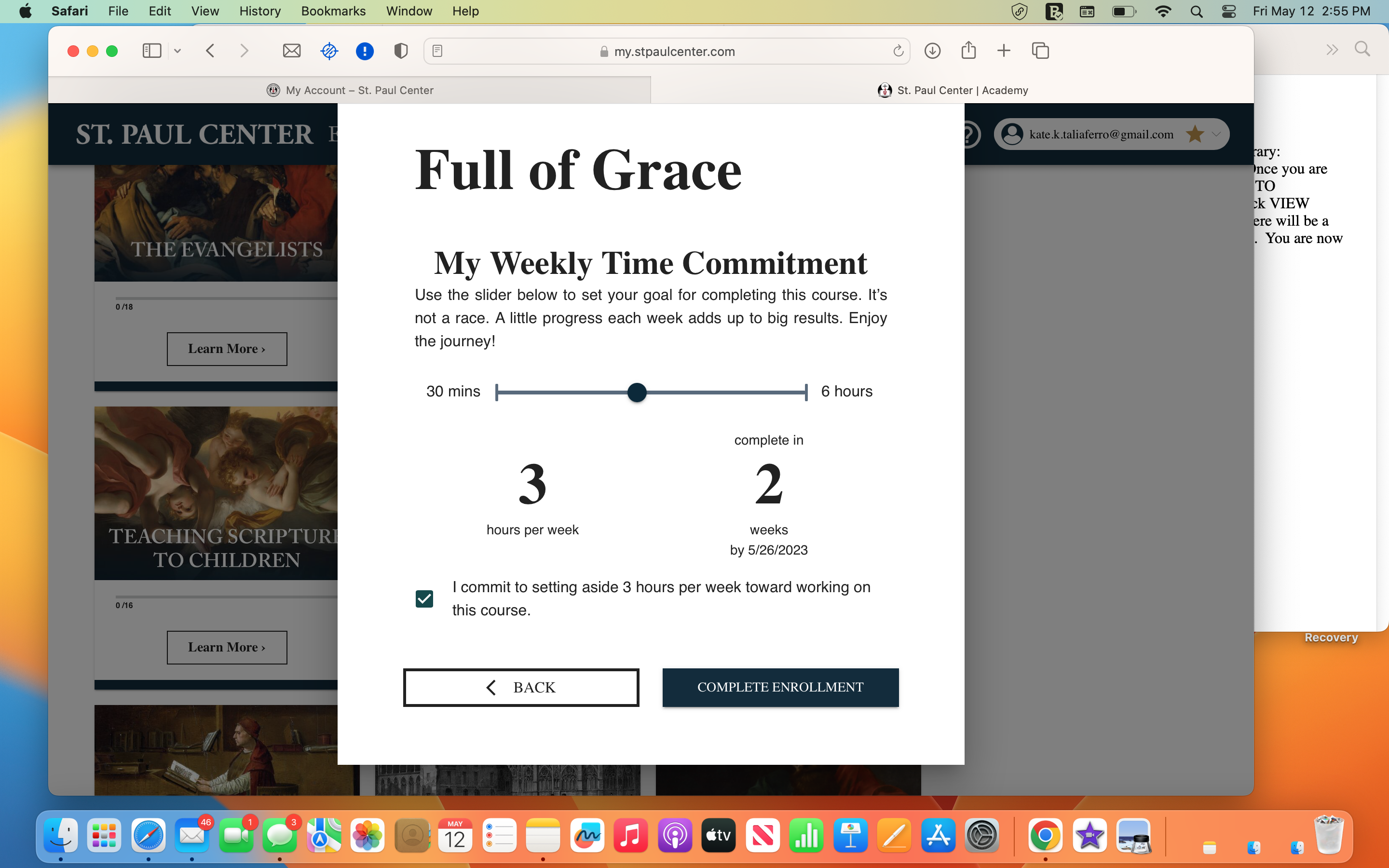
There is no time specific requirements for these courses. You are working through them on your own and at your own pace. However, at the start of the course, I appreciated that you were shown a window which projected how many hours a week you wished to dedicate to your course and if you stuck to that plan, when you would expect to conclude. While not a binding document, it was a nice touch for emphasizing that this course should be a priority in your schedule. 

As a mom of 6 kids, I don’t have a ton of time to sit down and devote 30 minutes to a video that delivers a lot of information I want to retain. These aren’t background noise videos. Each one was full of interesting content pertaining to Mary’s role in Scripture, background information about the Garden of Eden and how Mary is part of the fulfillment of God’s promises to Adam and Eve, the history and development of Marian dogmas, Marian apparitions, and even Mary’s role in spiritual warfare. This was a packed course.

The interface is very clean and easy to navigate which I appreciated. Even more, I appreciated that the course kept my place in the video I was in the middle of, even if I was switching between my computer and my phone. This was a huge plus for me because it happened often that I would start a video on my phone, want to stop to take a note and get distracted by this, that or the other, and then return in the evening on my laptop. There wasn’t any trying to remember the time stamp or which video was I in the middle of again. 

This was a very dense course. Excellent, but dense. I would highly recommend a notebook because there will be a lot to write down as well as a number of new authors you might want to check out. If you haven’t had the opportunity to study your faith in a more academic setting, this course might be a little overwhelming. But, because these are pre-recorded videos, you can pause or rewatch as you need so you can fully explore all the concepts presented. 

Overall, this was an excellent experience for me. It was so good to spend this time focusing intently on the Blessed Mother and how special she is for the Church, as well as for me personally. 

Daily Graces. kktaliaferro.wordpress.com

The Will of God

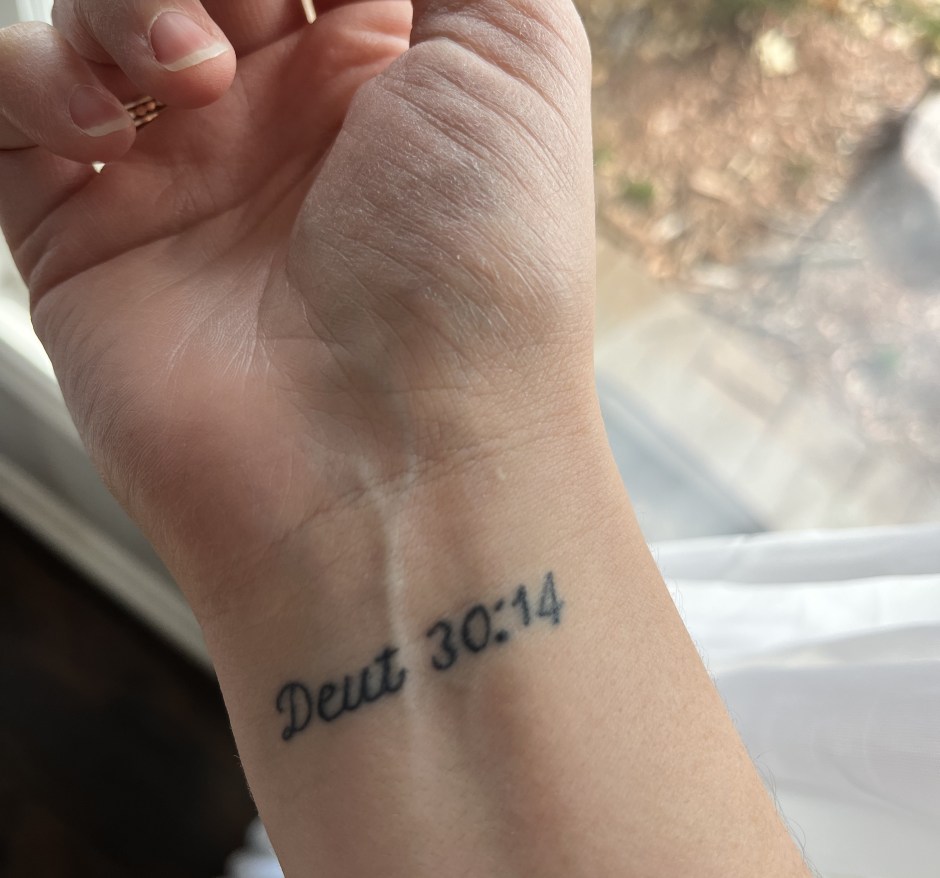
I have a tattoo. I don’t think I’ve shared that here. It’s on my wrist, as you can see, and it references Deuteronomy 30:14. Last summer, Deuteronomy 30:10-14 was the First Reading one Sunday. On that day, I felt these words of Scripture pierce my heart in a way I never had before. This is the passage in full:

Moses said to the people:
“If only you would heed the voice of the LORD, your God,
and keep his commandments and statutes
that are written in this book of the law,
when you return to the LORD, your God,
with all your heart and all your soul.

“For this command that I enjoin on you today
is not too mysterious and remote for you.
It is not up in the sky, that you should say,
‘Who will go up in the sky to get it for us
and tell us of it, that we may carry it out?’
Nor is it across the sea, that you should say,
‘Who will cross the sea to get it for us
and tell us of it, that we may carry it out?’
No, it is something very near to you,
already in your mouths and in your hearts;
you have only to carry it out.”

Deuteronomy 30:10-14

The last part, about carrying out the commands of God, was what struck me. God’s Will isn’t so far away I have to strive to find it. It is not too mysterious, not some lofty thing I cannot attain. It is already written in my heart. Do I have the courage to carry it out?

So many times in my life I have allowed myself to become trapped by the grandness of God’s plan and how it is too big for me to see my part in. While this is true, God’s ways are not my ways nor are His thoughts my thoughts, and yes, His grand design for the whole world is beyond my comprehension, that does not mean I don’t know anything at all. I don’t know where God will take me in 10 years, in 5, in tomorrow. What I can know is God’s Will in this present moment. How? Jesus told us in last Sunday’s Gospel reading and in so many other places in the Gospels:

Love

Love your enemies. Love your neighbors. Love yourself. Love God. Act out of love for God. Pray because you love God.

What do you need to do, now, in the present moment? Love. And in the next moment? Love. And in all the moments that follow? Love.

This is HARD! Especially when love looks like cleaning up after a sick child in the middle of the night, or forgiving a colleague for a hurtful comment. Love is sacrifice, love takes courage, love is selfless.

I can give a recent example.

Ben had left for a 3-4 week trip and we were only on day 3. The day Ben left, Nathan (the 1 year old) threw up twice, once in the middle of the night in his bed. He was fine for a day and then was sick again the following. The rest of the kids missed their dad, were tired from a week of school and other activities, and generally needy. Gabriel, the 3 year old, was especially insistent for every moment of my attention he could get. And I just couldn’t take it. I was snappy all morning, harsh when I didn’t need to be, impatient and generally awful. I knew it and I chose to lean into selfishness instead of following Deuteronomy’s advice.

Our big 4 kids had piano practice so they were out of the house for 2 hours. I let Gabe and Nathan watch some Bluey (of course, Bluey!), and I sat down with my coffee. The reality of the morning and my behavior hit me. I was so discouraged. I almost went and got my book to distract myself and get a break from it all.

Then I felt it. The little nudge, the random thought that you don’t know where it came from. “Don’t run away, sit here. Sit here and then do something to make it right.” So I did. It was probably the first moment I truly tried to do God’s Will all day. I sat, and then came the next nudge, “Write to them.” I got out 5 cards and I wrote apology notes to each one of my kids (Nathan excluded, I just gave him extra hugs). I apologized, I asked for forgiveness. I also let them know, according to their ages, how one specific behavior was not helping our family thrive. I asked them to think on it and see if it could be a place to work on. I told them I loved them.

I left the notes on their pillows and went peacefully to read. For about 30 seconds because it was time to turn off Bluey but that’s ok. I had followed God’s Will for those moments, my cup was being filled with grace and His Love.

I’d love to say we had a beautiful day after the kids read their notes. I’d love to say they had marked improvement in behavior, that I was was gracious and gentle from that moment forward. They did not, and I was not. But it was still better. I reigned myself in faster, I spoke more calmly. It was easier to make the right choice faster, even if I initially made the wrong one. I had become more attentive to God’s Will in the present moment because I had practiced it earlier.

I have grown so much in my trust in the Holy Spirit since hearing this reading. It has changed my relationship with God and encouraged me to form a deeper bond with the Holy Spirit. I chose to get the tattoo because I want to keep these words ever present with me, “God’s Will is already in my heart, I have only to carry it out.” This is not a lesson I will ever be done learning.

God has grand designs for each of us. Perhaps we have already seen Him working in our lives, perhaps we are wondering when it will all begin. No matter what God’s larger plans are, His perfect Will for each of our individual moments is the same: Love.

P.S. As a woman and mom, I know I have gotten trapped in the lie that everyone else needs to be served before I can take care of myself. Self-care is a big topic is popular society and it is important. We do need to take care of ourselves, but in a way that does not lead to selfishness or entitlement. It takes practice, it is a work of discernment. If you struggle with the line between no-care, self-care and selfish-care, take it to prayer. Ask the Holy Spirit to pay special attention to this area and to inspire you to rest how and when you need to rest, and to recognize when your focus on rest is inhibiting your ability to do God’s Will.

Daily Graces. kktaliaferro.wordpress.com