A few years ago I started a book writing project. I have about 3/4 of it written, but haven’t touched it for some time. I began it around the time when I started making the Advent and Lenten Lectio Divina Journals. I was feeling passionate about helping people encounter Scripture in easy and meaningful ways. I was also incorporating some simple Bible verse memorization in our homeschool day.
I decided to try to write something about a foundational piece of Scripture and attempt to incorporate all these ideas. It has Lectio Divina, some Scripture exegesis (the fancy word for exploration, analysis, and interpretation of Scripture), activities to help memorize the passage, space for reflection and follow-up discussion questions. The passage I chose was the Christ Hymn from Philippians 2:5-11.
While I don’t know if I’ll ever have this manuscript in a publishable state, I have been thinking about it lately and am dusting it off a little bit. Today is Good Friday, the day of days. Jesus, true God and true Man, offers Himself as the perfect and ultimate sacrifice so that we, His beloved creation, could once again be one with God. This passage beautifully sums up the mystery of Christ. I thought I’d offer my thoughts and research on the first verse, Philippians 2:8 here with you all (* indicate the citations listed at the bottom). I’d love to hear what you think, if you find it insightful or would be interested in hearing more.
We are living in a unique time in history. I hope that during this Great Lent (as some have been calling it) you have learned more about yourself and your relationship with God. As we look forward to Sunday, let’s remember that no matter what chaos rains down around us, we are an Easter people. Darkness and death, though deep and dark indeed, cannot shut out the light of Christ.
and he humbled himself,
becoming obedient to death, even death on a cross
Philippians 2:8
We will start, with a brief study of words. Paul opens this verse by focusing us on the word, “humbled” which he interestingly uses as a verb. This is the same Greek word, tapeinoó, Paul uses in the verses prior to the hymn (Phil 2:3-4). Here is the key which unlocks the first 4 verses of this hymn. Briefly, let’s recall what it means for Paul to be humble:
- Do nothing out of selfishness or a desire to further your own status
- Regard others as more important than yourself
- Do not look out for your own interests first
- Put the needs of others before your own
Paul explained to the Philippi community what humility is in theory, but here he illustrates in no uncertain terms exactly what humility is in flesh and blood. Humility is Jesus, who did not regard equality with God a thing to be grasped, even though He was well within His right to demand it (1). Jesus emptied Himself (2), taking the form of a servant, the lowliest of the low (3). He became obedient (4) even to the point of death. Here we have on full display what it means to be humble. It is to be like Christ.*
Pope Benedict XVI compares Jesus to Adam when he states,
Through the Cross of Christ man is redeemed and Adam’s experience is reversed. Adam, created in the image and likeness of God, claimed to be like God through his own effort, to put himself in God’s place and in this way lost the original dignity that had been given to him. Jesus, instead, was “in the form of God” but humbled himself, immersed himself in the human condition, in total faithfulness to the Father, in order to redeem the Adam who is in us and restore to man the dignity he had lost. The [Church] Fathers emphasize that he made himself obedient, restoring to human nature, through his own humanity and obedience, what had been lost through Adam’s disobedience.
Pope Benedict XVI. General Audience: Wednesday 27. https://w2.vatican.va/content/benedict-xvi/en/audiences/2012/documents/hf_ben-xvi_aud_20120627.html
Origin, one of the Church Fathers, reflects on this verse in one of his Commentary on the Gospel of John: Pt 379. He states that Jesus’ obedience, even to death, was part of God’s gathering the whole world and all its inherent brokenness due to sin back under His authority.** Paul is expressing the mysterious reality that God descended into His creation. This hymn can be broken into two distinct sections: the descent (Phil 2:6-8) and the ascent(Phil 2:7-11). Here we reach the depths of the descent. St. Augustine pondered these crucial words in this way: “He ’emptied Himself,’ He ‘humbled himself.’ Though He was God, He appeared as man. He was despised as He walked on earth, He who made the heaven. He was despised as though a mere man, as though of no power. Yea, not despised only, but slain moreover.”***
The downward movement of Christ is reflected deeply upon by Henri Nouwen in his book The Selfless Way of Christ: Downward Mobility and the Spiritual Life. He challenges us to see the downward way the way of Christ. Humanity, in all our brokenness, needed a savior. How beautiful, how mysterious, that our God chose to enter into that brokenness, to descend down into its very core death itself, in order that we might be redeemed. Nouwen tells us, “The great mystery upon which our faith rests is that the One who is in no way like us, who cannot be compared with us, nor enter into competition with us, has come among us and taken on our mortal flesh.”**** Note the echoes of Paul’s definition of humility. Jesus doesn’t come to compete with us but serve us. He is God, powerful and mighty, yet he enters into creation as a tiny, helpless baby.
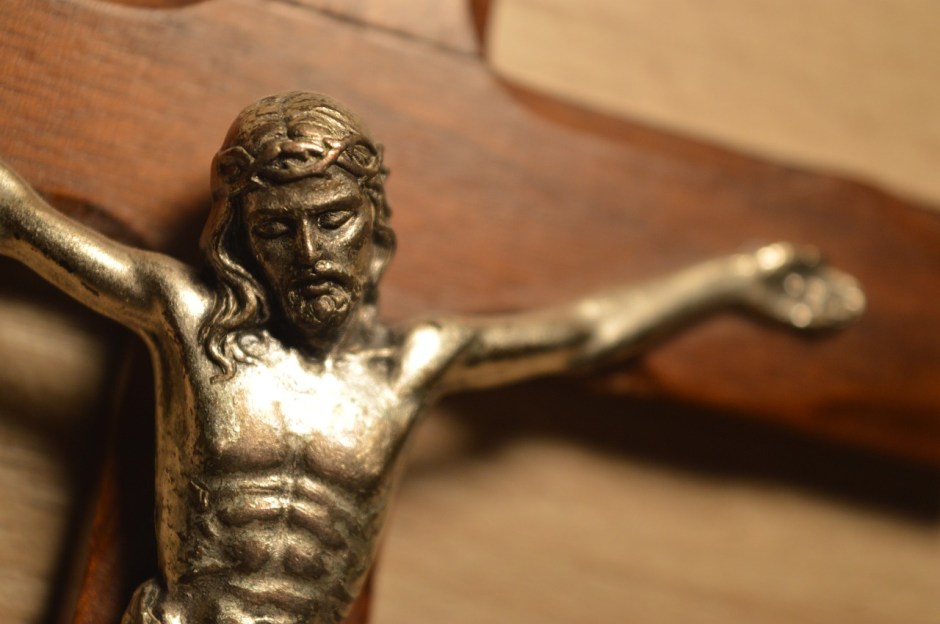
And then to top it all off, Jesus dies. There can be no greater descent than this. Jesus, our Savior, is obedient to the Father, and offers Himself as ransom for us all.
The spotless lamb, the blameless victim. The one true God who kneels at our feet, wishing to wash them clean allows Himself to be raised up on a cross for our salvation. Pope John Paul II quotes St. Ambrose at length, with words of such power and beauty I couldn’t hope to do them justice by paraphrasing.
“Christ, hung on the tree of the Cross… was pierced by the lance, whereby blood and water flowed out, sweeter than any ointment, from the victim acceptable to God, spreading throughout the world the perfume of sanctification…. Thus, Jesus, pierced, spread the perfume of the forgiveness of sins and of redemption. Indeed, in becoming man from the Word which he was, he was very limited and became poor, though he was rich, so as to make us rich through his poverty (cf. II Cor 8: 9). He was powerful, yet he showed himself as deprived, so much so that Herod scorned and derided him; he could have shaken the earth, yet he remained attached to that tree; he closed the heavens in a grip of darkness, setting the world on the cross, but he had been put on the Cross; he bowed his head, yet the Word sprung forth; he was annihilated, nevertheless he filled everything. God descended, man ascended; the Word became flesh so that flesh could revindicate for itself the throne of the Word at God’s right hand; he was completely wounded, and yet from him the ointment flowed. He seemed unknown, yet God recognized him”
St. Ambrose. III, 8, Saemo IX, Milan-Rome 1987, pp. 131, 133 as quoted by Pope John Paul II. General Audience: Wednesday 19 November 2003. Vatican. https://w2.vatican.va/content/john-paul-ii/en/audiences/2003/documents/hf_jp-ii_aud_20031119.html
* Brant Pitre. Philippians 2. YouTube.
** Origin. Commentary on the Gospel of John: Pt 379. Kenosis: Christ “emptied himself” (Philippians 2:7). http://kenosis.info/ANF-10A.html.
*** St. Augustine. Sermons on Selected Lessons, Sermon 42: Pt 2. Kenosis: Christ “emptied himself” (Philippians 2:7). http://kenosis.info/NPN1-06E.htm
**** Henri Nouwen. The Selfless Way of Christ: Downward Mobility and the Spiritual Life. (Maryknoll, Orbis Books. 2007). 38.







 Daily Graces