The Empire vs. The Cross

With the upcoming release of Season 2 of Disney’s Star Wars series Andor, Ben and I have been rewatching Season 1. We both enjoy this gritty story and the way the characters develop throughout the episodes. This time through, we have been commenting on some particular phrases that the Empire uses as it begins to take further control of the galaxy. The security folks (I’m not going to get super technical here), talk about “tightening their grip” and extending the reach of imperial control. Contract security is out, storm troopers are in. As we watched this unfold, we looked at each other and said Leia’s line from Episode 4: A New Hope, “the more you tighten your grip, the more star systems will slip through your fingers.” Here, in Andor, we were watching the beginnings of the tightening, which is the same moment that the rebellion is really starting to come together. The further the Empire stretches itself, the more cracks form for the rebels to slip in and out of.

The Empire’s purpose in all of this is control. They want things ordered they way they want them with no surprises, incidents, or creative thought. When watching Star Wars, I would think that most of us are inclined to side with the rebels. Stand up to the power, resist!

And yet, as I was reading through my most recent copy of Evangelization & Culture (Issue No. 22 on Courage), I found myself coming to realize that deep down, I’m much more like the Empire than I would want to admit.

At its most basic, primal level, the Empire (in my estimation) is operating from a place of fear. The fear of the unknown, of individual thought, of being replaced, of losing what it had gained. The fear of loss of control is a critical motivating force that causes the grip tightening seen in the Andor series. In his article “Spiritual Direction for the Fearful,” Fr. Billy Swan’s counsel reminded me of the Empire and how it’s actions are exactly what not to do in our own lives:

For us, the fear of losing our lives might not be active every waking hour, but the fear of losing something is always lurking – material things, power, honor, status, our mob, our health, our loved ones, our independence, our freedoms. How do we respond to this fear of loss? One option is to double down on our efforts to protect what we have, whether it be our freedoms, our assets, or even our very lives. Yet we know deep down, sooner or later, that we will have to let go of everything and surrender to the mystery of love that is infinitely greater than our fears.

What am I holding on to too tightly? Where am I seeking to be in control, instead of allowing God to direct my life? What am I afraid to lose?

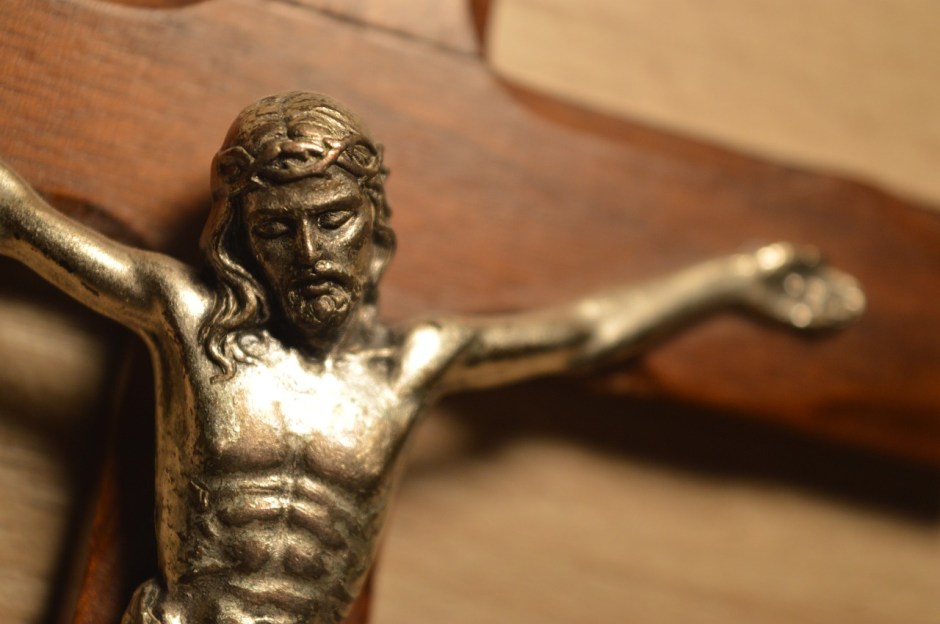
Today is Good Friday, the day of the complete loss of control. Not in the sense of acting rashly or wildly, like a young child who cannot contain her emotions. No, today is the day where we see what perfect surrender looks like. It is the day where hands are stretched wide, holding nothing and at the same time, holding everything at once. Jesus hangs on the cross in what appears to be a complete loss of control. He was taken, beaten, stripped of everything he had, even his connection with the Father. In these moments, Jesus completely empties himself of everything he is. Where Adam and Eve grasped, tightening their grip on the forbidden fruit to gain something they did not need, Jesus releases his hold on everything, to gain everything we desperately require.

Nothing, not one thing. No one, not one person, slips through Jesus’ fingers.

We have a choice today. Will we join Christ, opening our own hands wide to accept all God has to offer us? Or will we side with the Empire, tightening our grip on the things we think we need, only to watch them slip away one day at a time, never realizing that all we had to do was let go. In a magnificent reversal, to find what we truly need, we have to be ready to lose everything.

Daily Graces. kktaliaferro.wordpress.com

Fourth Sunday of Lent 2023

We were so blessed to spend part of Spring Break at Ben’s family cabin outside of Denver. We were there for 6 days and had a lovely time, even if the little boys were struggling to sleep between runny noses and the altitude. It is such a joy to be able to share this cabin with our kids. Ben’s family has old films of the cabin being built by his great-grandparents and their children. The cabin has since been expanded upon, improved and maintained by the whole extended family. It is a work of art and a bit of a historical record for the family.

Nothing happens by coincidence and I am unsurprised that before arriving at the cabin, I wasn’t sure what to talk about for this week’s video. I was drawn to the conversation Jesus has with His disciples at the start of the reading about whose sin caused the man’s blindness – his or his parents? This tied into a question I reflected upon in my Bible Study about generational sin. Then, I found myself at this generational cabin. The generations it is, even if it can be an uncomfortable topic.

We know, as Jesus tells us, that afflictions like blindness are not caused by a family member’s sinfulness. Children do not receive the spiritual punishment that their parents or grandparents earned through their wrong choices. We do, however, still pass on many things from one generation to the next. These can be big, serious things, like alcoholism, mental health struggles, perfectionism, abuse, gambling. They can be littler things like leaving dishes on the counter, staying up late reading, sleeping past alarms, forgetting to water plants, etc. They can be fantastic things like diligence in going to Mass each week, following the Lenten fasts, cleaning up each night before bed, having a prayer routine, putting clothes away once they are folded, calling parents, grandparents, and other family members on a regular basis, etc. I’m sure you have come up with some of your own ideas.

In the nature vs. nurture conversation, there’s a lot to be said for the nurture side of things. We receive a lot. We give a lot. This then begs the following questions:

  • What have I received that I appreciate, use, and has helped me become a better person?
  • What do I wish I hadn’t received?
  • What have I given to my children, nieces, nephews, coworkers, or friends?
  • How is what I am giving helping them grow in holiness?

As if this wasn’t enough, while I was recording I found myself starting to veer off this topic of generational sins and gifts and reflecting on the cause Jesus gives for the man’s blindness:

Neither he nor his parents sinned; it is so that the works of God might be made visible through him.

John 9:3

The suffering isn’t a punishment. That’s almost as hard to swallow as the notion of generational sin.

As humans, we like cause and effect. X leads to Y. There was a sin, a consequence follows. Wrongdoing is followed by negative consequences, i.e. suffering. The Jewish people had experienced this many, many times. The people refused to enter Canaa and none of that generation was allowed to enter the promised land. Their descendants had to wander in the desert as the consequence of their disobedience (See Numbers 13-14 for the story). The same thing happens when the Kingdoms of Israel and Judah are overrun and taken into exile. The people rebelled against God, forgetting their side of the covenant. As a consequence, they and their children suffered.

Jesus tells us this type of transactional causes for suffering no longer rules the world. He has come, and He bears the punishment for all of our sins. For what purpose, then, does suffering occur? Jesus tells us in our Gospel that even suffering can be used for God’s glory. Put another way, I can think of no better answer than this clip from Season 3 of the Chosen. I hope you take the time to watch it, even if you chose these 6 minutes over mine that is linked above.

If suffering is something you struggle with, either your own, someone you know, or a suffering that has been passed through your generational story, I would encourage you to read the book, When You Suffer: Biblical Keys for Hope and Understanding, by Jeff Cavins. It is a beautiful and gentle book about suffering and how the Bible can help us better understand, accept, and then use suffering to participate in God’s plan for our lives.

Daily Graces. kktaliaferro.wordpress.com

Struggler

Happy New Year’s! Well, we made it. 2020 is on it’s way into memory and we are all opening our arms wide to welcome 2021. It’s the same kind of feeling each year, but this year, for obvious reasons, those feelings of shaking the dust of the previous year from our feet are stronger than usual. I wrote earlier this fall about being careful not to totally write off 2020, or as Ben’s grandpa would say, put it in the book of the dead. And while yes, I too am excited to embark on a new year, I keep being reminded that shaking my fist at 2020 isn’t the right choice.

There is a music artist that I like who is a Franciscan monk named Brother Isaiah. He has mostly acoustic stuff and is often fairly repetitive which makes the lyrics easy to learn and excellent to pray with. His latest album, Poco a Poco, has been cued up in my phone often lately, especially one song in particular.

This song is so good, because it is so much of 2020. 2020 has been a struggle! It has been hard, horrific, frustrating, heart wrenching, and isolating. As the song says, it has often felt like we are reeds broken in the wind, how many more hits can we take? Without my faith, I’m not sure how I could answer this question.

This is one of the beautiful mysteries of our faith. Suffering always bears fruit – “every good thing is born of a struggle.” The song acknowledges that suffering happens, and that it’s hard to struggle through. But we all know that the best things in life are the ones that we have to work for, work through and continue to grapple with. None of us is a finished masterpiece, we are works in progress. The song pulls this image to the fore:

Something being born in you so beautiful and so true

Like a statue of David chiseled-away and never fading

We are being honed, refined. Brother Isaiah calls life a crucible, a place of extreme heat which can transform metal. This reminds me of the refiners fire the prophet Zechariah talks about when speaking of the coming of the Lord. Zechariah 13:9 says: “I will bring the one third through the fire; I will refine them as one refines silver, and I will test them as one tests gold. They will call upon my name, and I will answer them; I will say, “They are my people,” and they will say, ‘The LORD is my God.'”

2020 has definitely been a refining year. And things aren’t going to magically change now that the clocks and calendars have turned over to January 1, 2021. The same struggles are being carried forward, but not without hope. Listen to how the singer chooses to respond to the new knowledge about struggle:

Yes I’m a struggler, but I’m not gonna give up no

You give me heart when I want to give up

He affirms that yes, he is a struggler. But he’s a struggler that’s going to keep on going because what’s being created is worth the effort. My friends, let’s walk forward into 2021 seeing where we are struggling, and instead of trying to run away from it, let’s embrace it. Let’s discover what beauty is waiting to be found within the crucible of our struggle. God does not abandon us in our struggle, but walks right alongside us. Whatever your struggle, wherever you are, my new year’s wish for you is that 2021 will bring forth fruit in your life that strengthens you to continue becoming the person He desires you to be.

Happy New Year!