Plans for Lent + Hallow Review

As is typical for this time of year, it’s good to share about what some of my plans are for Lent. Not only will this help keep me accountable to them, but I have found a good many ideas for how to observe the season by hearing how others plan to pray, fast, and give alms.

Screens

I’m on the fence about this first one, which probably means it would be a good idea to give it a shot. In a Focolare women’s group meeting last month, we were talking about communication and especially social media use. A few ideas were shared about how to make our phones less attractive and it was a really interesting conversation. Our phones are brightly colored and everything about them is designed to make them appealing. The apps we engage with utilize all kinds of methods that foster addictive behaviors, consistently and constantly drawing us back to their content. While I know giving up social media or a specific app is a popular Lenten observance, there were a few other ideas shared that I’m considering.

  • Turn your phone to black and white mode. Our brains are wired to be attracted to bright colors. I know for me, I don’t even read the names under the app icons, I’m looking for the picture or color associated with the app. So, if we turn off the colors, we will have to be more intentional in order to even find what we are looking for. Then, once we are in the app, it’s actually rather dull. The same exact content we looked at the day before is less catchy, less interesting, less “scroll worthy.”
  • Turn off all (or nearly all) notifications. Do I really need to know when someone posts on Instagram? What about the little red numbers that show something is waiting for me on Facebook?
  • Removing the social media apps. This doesn’t mean necessarily taking a break from them, just making it harder to get to because of the extra steps required to get there. So, I would only access them through a web browser. Or, even further, I only access them on my computer, not on my phone.

Hallow

I am very excited for this one. I am going to be participating in the Pray40 challenge for adults on the Hallow app. I have not been disappointed by this program yet so I am confident this year will be another good one. In the past, I have tried to listen in the mornings when I’m getting ready for the day. The challenge this year will be timing, because I am already listening (also on Hallow) to a daily Gospel reflection that is usually about 10 minutes. Perfect for my typical morning routine. In past years, I’ve replaced this Gospel reflection time with the Pray40 content. However, I would very much like to continue with the Gospel reflections in addition to the Pray40 experience. So, it’s going to take some trial and error to see when will be the best time to listen consistently.

In addition to the Pray40 challenge, Hallow is going to be offering a kids’ Lenten content journey. They are calling it “The Little Way” and I’m very excited about it. Hallow actually reached out to me and asked if I would offer a review of the content which got me even more excited for it.

This series is going to be more than a series of prayers. The kids will be journeying along with Paul and Mia Buckley, two kids who are on a trip through France. We are going to get to experience their story while also meeting some pretty fabulous saints, hearing vocation stories, Sunday homilies, even a few family games. Of course, there are also going to be opportunities for prayer and reflection throughout the 40 days of Lent. 

The Saints Alive podcast, the creators of The Little Way, provide truly immersive and thoughtful podcast episodes exploring the lives of the saints. Complete with a multitude of voices, sound effects, surprises, and applications for little lives, our family enjoys these episodes so much. I was very excited to hear that they were behind this new initiative of Hallow’s. 

Disclaimer: It is important to remember that this experience, as well as Hallow’s Pray40 Lenten reflections for adults, are part of their premium content and are not available on the free version of the app.

The Plan

I know, you’re probably wondering where on earth we are going to find time to add this to our schedule. However, I have a plan. I recently saw on Corda Candle’s website a package of Lent-focused candles which I was delighted to find (Corda did not request this review or mention, I just love their candles and these are going to fit so well with my Lenten plans). I don’t know about your kids, but mine find candles fascinating. It draws everyone in, even for a few minutes, and can really help focus a few minutes of quiet. As an added bonus, these candles are beautifully scented. We had one that we used for our prayer time over the Christmas season and not a day went by that we forgot because everyone loved the smell and looked forward to lighting it. I am hoping for a repeat experience.

My plan is to light one of the candles in the middle of the table, and then we will listen to our episode during lunchtime. My kids usually read during lunch because they can’t seem to survive without a book in front of them. With this plan, we are going to offer the sacrifice of a few minutes of free reading time to listen together. 

Fasting

The past few years now I’ve chosen to do a full fast on all of the Fridays during Lent, not only on Ash Wednesday and Good Friday. I’m thinking I’ll do this again, though I’m praying about my motivation for doing it. It isn’t easy to be sure, but it is familiar. Am I choosing this fast because of its familiarity, like someone who habitually gives up chocolate because it’s just what they do without much thought put into why, or because I’m avoiding considering alternatives God could be calling me to? I have some time yet to discover the answer.

These are some of my ideas for Lent this year. What will you be doing? I hope that you discover the practices God is calling you to work with this Lent that will draw you closer to His merciful love.

Daily Graces. kktaliaferro.wordpress.com

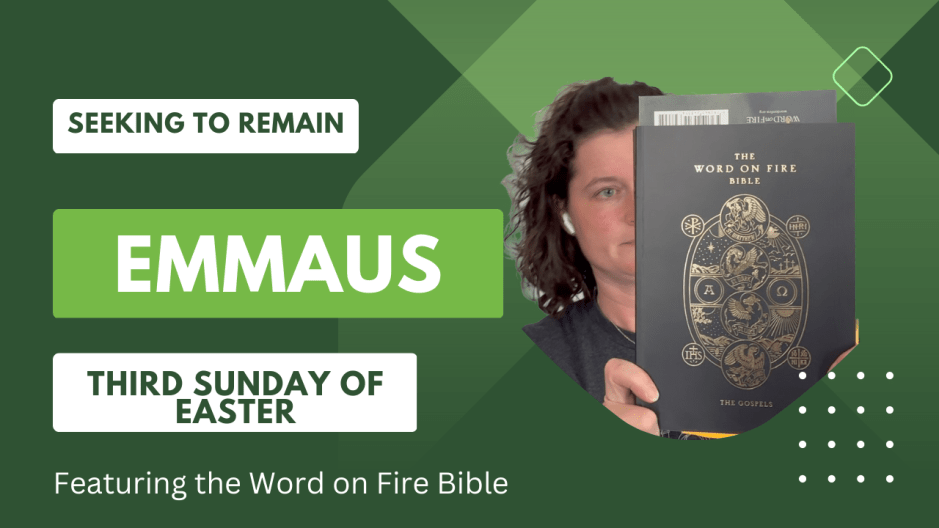
Third Sunday of Easter 2023 – Road to Emmaus

I’ll be honest, I was a little stumped by this week’s Gospel reading. Maybe not stumped, but unable to hone in on a single idea for the brief video reflection that I wanted to create. So, I ended up merging two ideas, more or less successfully.

First, I mentioned the invitation of the disciples to Jesus into the house where they were going to spend the evening. More on that in a moment. Secondly, I spent the rest of the video talking about how this story is a type of analogy for the Mass. I was inspired by a homily given by Bishop Robert Barron, and I wanted to take the opportunity to share it in full for anyone interested. You can find it here.

For this accompanying blog post, I think I want to spend a little more time with the first point I made. Jesus is the master of the invitation. He calls, He doesn’t command, His disciples to come follow Him. In the Gospel of John, two of John the Baptist’s disciples begin to follow Jesus. He asks them, “What are you looking for?” They ask Him where He is staying. In the perfect one-liner, Jesus responds: “Come and see” (John 1:38-39).

Again and again, Jesus invites people into His circle. In the Gospel today, the disciples do not recognize Jesus on the road. Even as He opens their eyes to the Scriptures He fulfilled, and as they reflected afterward they realized their hearts were burning within them in Jesus’ presence, still they do not recognize Him. They would have missed Him entirely if they hadn’t extended the simple offer of hospitality. Jesus made to go on, but they stopped Him.

But they urged him, “Stay with us,
for it is nearly evening and the day is almost over.”

Luke 24:29

They led Jesus inside, and it was in the breaking of the bread that they finally recognized who He was.

We have the same choice before us every single day. Do we invite Jesus in, or do we go about our day without opening the door of our hearts to Him?

Here are a few ideas for consciously and concretely inviting Jesus into your daily life:

  • Morning Offering Prayer – there are many versions of this prayer, some are short and simple, others more complex. The basic structure of this prayer is to offer your day to Jesus, in all it’s ups and downs, to unite yourself with Jesus throughout the day, to seek His assistance in your day, and to proclaim your love for Him. When we homeschooled, we began each day with this prayer: Dear Jesus, I offer you this day, my works, my joys, my sorrows, and my play. Please help me to be good today. I love you Jesus, Amen. That’s it, it doesn’t need to be fancy. This site has a whole bunch of Morning Offerings if this one isn’t a good fit for you.
  • Setting daily check in prayer times – maybe you pray an Angelus at noon. Maybe you say a rosary while you walk every day. Setting up specific, routine, prayer times is a great way to reconnect with Jesus throughout your day. The Hallow app is great for this. You can set reminders within the app and have the prayers or reflections you want to utilize queued up and ready to go. (The link provided will give you a 3-month free trial of the full version of the app if you haven’t made an account already. This works best on a computer. I do not gain anything monetary or otherwise if you choose to use my link).
  • Frequent the sacraments. When was the last time you went to a daily Mass? What about Adoration, Confession, or other liturgical celebration offered by your parish? Invite Jesus into your schedule by prioritizing these opportunities.
  • Coming from Chiara Lubich and the Focolare Movement, be intentional about recognizing Jesus in your neighbor. When you are in the presence of others, see Jesus in them. Jesus can be encountered in every single person you come in contact with each day. Even if they aren’t your favorite person, Jesus invites us to love them as He does. For more on this, check out my Catholicmom.com post about the Cube of Love.
  • Find some inspirational saint quotes and Scripture verses. I have a friend who loves to be reminded of the things she has read, so she puts post-it notes everywhere. One over the kitchen sink, one or two on the bathroom mirror, the visor of her car. Anyplace that catches her eye or where she spends a lot of time. She changes them up also, which I think is so wise. We can start to glaze over things we see on a highly regular basis. Either changing the quotes around, or switching up the color of paper they are written on, can help avoid this.
  • Add your own ideas in the comments. It would be great to hear your ideas about how to invite Jesus into your everyday life. What works for you? What do you want to try?
Daily Graces. kktaliaferro.wordpress.com

Book of the Dead

When I met Ben’s family, one of the stories that I heard about was his grandfather’s “Book of the Dead.” If he had a bad experience at a restaurant, gas station, you name it, often it went into the Book of the Dead. Meaning he would not go back. There was one restaurant that he didn’t go back to for something like 30 or 40 years because of the poor service he had experienced all those years earlier. When I asked Ben what the name of the restaurant was, his response was, “Which one?”

Ben’s mom still jokes about this and has her own version of the book of the dead. When we move to Kansas this winter it will be the first time she and his dad have driven in the state since the Ice/Wind Storm of one of his childhood trips to Colorado. Fingers crossed Kansas doesn’t get a double entry!

I have recently begun using the Hallow app. The app is full of Catholic prayers, resources and meditations. It’s very peaceful and has a multitude of ways to engage in prayer. There are psalms, homilies, guided silence, and Lectio Divina. I have been trying to do the guided Lectio Divina each day as well as a Divine Mercy Chaplet. I will be honest, one of the things I really like is the timer feature. For nearly every experience you can choose how long you want it to be. If I know I have time, I can do my Lectio for 30 minutes (I haven’t actually gotten to do this yet, but it’s nice to know the option is there for someday!) Or, if I know the kids will be awake soon, I can set it for only 5 or 10 (what usually happens).

The Lectio passage from a few days ago had some interesting words to say about life and death. It was a short Gospel, and to be honest it isn’t one I’ve really noticed before. The meditation was on Luke 20:37-38. This passage is part of a longer story where the Sadducees are trying to trick Jesus into making judgments about what happens after people die. Jesus, of course, answers their question in a way they don’t expect and wins the day.

Part of His answer was to point out that God is the God of the living, not the dead, for “to Him all are alive.” I had to stop and really think about that for a minute. No one is dead to God, for even the dead on earth are still living souls in eternity. Their bodies may be gone, but their soul remains forever.

This, I believe, is big news for the past year. How often have we heard people (ahem, and maybe our selves?) exclaiming that they want this year over, that it’s time to move one, that it’s dead to them, or in Ben’s grandpa’s words, ought to be put in the Book of the Dead? But no, this isn’t what Jesus wants us to do with the year we have been given!

There has been pain, suffering and death in this year. Fact. We cannot sugar coat the tragedies, the sorrow and the large sacrifices that have taken place all over the world. Many, if not most, people have personally encountered the pandemic’s devastating effects on their families, friends and workplaces. It has been a hugely difficult year. But that doesn’t mean it should be written off, left for dead or abandoned.

Jeff Cavins has an excellent book, When You Suffer: Biblical Keys for Hope and Understanding, which I highly recommend (I posted a review of it a while back if you’re interested in checking that out). Cavins fully acknowledges that suffering is painful, challenging and a universal truth of human existence. Everyone suffers. But, as Christians and especially as Catholics, suffering is much more than this. It is also an “immense treasure” because of what we can choose to do with our suffering (pg 157). Quoting Fr. Mike Schmitz, Cavins asserts: “Suffering without Christ just hurts. But suffering with Christ can transform the world” (ibid).

Many of us have experienced suffering of a new level than we have previously. We have suffered isolation, loss, loneliness, sacrifice and more. But do not let that be the end of the story for 2020. Suffering united with Christ’s passion, using the power of our suffering to grow beyond ourselves and offer it for the suffering of others, and other tools Cavins explores in his book are all ways to discover the transformative potential this year has given to us.

With Advent at our doorstep, a new liturgical year is dawning. Advent is an excellent opportunity for focused spiritual reading, intentional prayer time, and closeness with the Holy Family. If you are able to find a copy of Jeff Cavins’ book, I very much recommend it to everyone. Don’t forget about the free Advent journals I have created for your personal use as well. They are still available and will always be free to print.

I hope that you had a joyful Thanksgiving, even if it was a smaller one. If you haven’t already, this weekend is a beautiful opportunity to take some time to write down what you are grateful for this past year. It’s easy to think of negative things first. Give yourself time to really dig into the year. Go back through your planner, your Facebook or Instagram accounts. What brings a smile to your face? When did you have a sense of peace, of happiness, or contentment? This is also an excellent way to begin preparing for the Advent season.

Wishing you and yours a Happy Thanksgiving weekend and a blessed First Sunday of Advent.

Daily Graces. kktaliaferro.wordpress.com